The Hezbollah connection: Missile chain of evidence from Tehran, to Lebanon, to Houthis

1 / 3
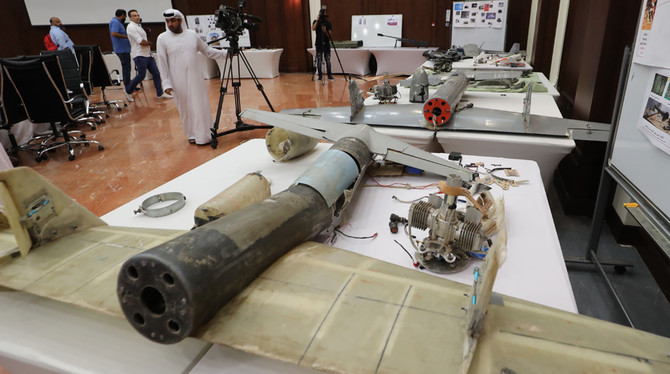
A picture taken on June 19, 2018 shows debris of Iranian-made Ababil drones displayed Abu Dhabi, which the Emirati armed forces say were used by Houthi rebels in Yemen in battles against the coalition forces led by the UAE and Saudi Arabia. (AFP / KARIM SAHIB)
2 / 3
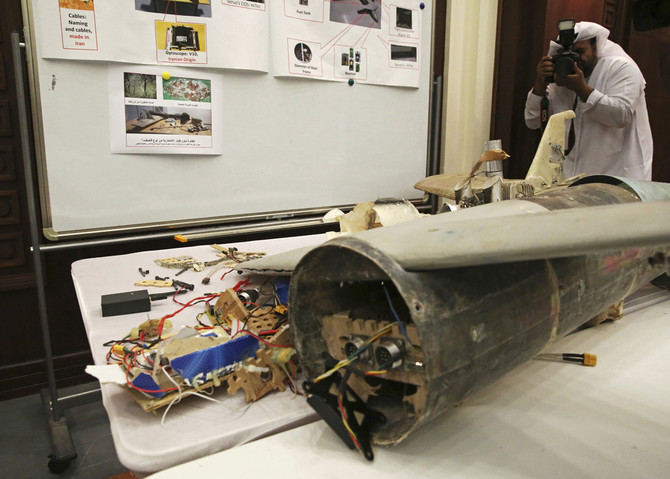
A photographer takes pictures of what officials describe as an Iranian Qasef drone captured on the battlefield in Yemen, during a news conference in Abu Dhabi, United Arab Emirates, on June 19, 2018. (AP Photo/Jon Gambrell)
3 / 3
Houthi supporters demonstrate in Yemen's capital, Sanaa, on June 25, 2018, in support of their allies engaged in battles against the coalition forces led by the UAE and Saudi Arabia in the Red Sea port city of Hodeidah. (AFP / Mohammed Huwais)
Updated 26 June 2018
Follow

The Hezbollah connection: Missile chain of evidence from Tehran, to Lebanon, to Houthis

  • Missile parts are smuggled into Yemen through the Red Sea port of Hodeidah, and coalition forces launched a military offensive on June 12 to wrest control of the port from the Houthis. 
  • Dozens of missiles fired from Yemen into Saudi Arabia have targeted Riyadh, Makkah and the southern cities of Jazan and Najran.

JEDDAH: Eight Hezbollah militants from Lebanon have been killed in a Saudi-led coalition attack in Maran in northern Yemen, near the Saudi border.

The presence of Iran-backed Lebanese Shiite militia members in the Houthi stronghold of Saada province supports the coalition accusation that Tehran supplies ballistic missiles to the Houthis, and Hezbollah technicians launch them at targets in Saudi Arabia.

“The coalition killed 41 terrorist elements in Maran and destroyed their vehicles and equipment. Among the dead were eight members of Lebanese Hezbollah, including a commander,” coalition spokesman Col. Turki Al-Maliki said on Monday.

Dozens of missiles fired from Yemen into Saudi Arabia have targeted Riyadh, Makkah and the southern cities of Jazan and Najran. After one attack last November, the Saudi Foreign Minister Adel Al-Jubeir accused Hezbollah of being responsible.

The coalition has produced evidence that the missiles are made in Iran, including fuel delivery mechanisms with Iranian labels.

Missile parts are smuggled into Yemen through the Red Sea port of Hodeidah, and coalition forces launched a military offensive on June 12 to wrest control of the port from the Houthis. 

Saudi officials have consistently maintained that their military intervention in Yemen is a war of necessity, not a war of choice, said Fahad Nazer, a Saudi political analyst and an International Fellow at the National Council on US-Arab Relations.

 “The fact that the Houthis continue to fire Iranian-supplied ballistic missile at civilian targets across Saudi Arabia, including as far as the capital Riyadh, is proof that the Houthis do pose a serious threat to the security of the countries in the region, including Saudi Arabia,” he told Arab News. 

“The Houthis have repeatedly shown a callous disregard for the safety and well-being of the people of Yemen, so it is not a surprise that they are showing the same disregard for the laws of war by targeting civilian infrastructure in Saudi Arabia.”

 Nazer was in Riyadh in April, when the Houthis fired a ballistic missile which was intercepted over the Saudi capital.

 “While these attacks do not disrupt life in the Kingdom, Saudi Arabia is well within its rights to take every measure necessary to make sure that its civilians and infrastructure are not vulnerable to the whims and callousness of this militant group,” he said. “It is not an accident that the legitimate government of Yemen and the Saudi-led coalition have the support of the entire international community.”

In Riyadh, meanwhile, the clear-up continued after the most recent attack on Sunday night, when Saudi air defenses intercepted two missiles over the capital.

Debris fell near the US mission and at a school in the diplomatic quarter, and on the roof of a private residence, but there was no serious damage.

Coalition spokesman Al-Maliki said the alliance’s advances on Hodeidah and other fronts were pushing the Houthis to try to project strength through such attacks.


Saudi traveler drives in search of the aurora 

Updated 25 January 2026
Follow

Saudi traveler drives in search of the aurora 

  • ‘It felt like a dream,’ says 27-year-old Malik Al-Sultan after seeing the famed Northern Lights 

JEDDAH: A Saudi adventurer has driven thousands of kilometers across continents in pursuit of one of the planet’s rarest natural spectacles.

Malik Al-Sultan set out from Riyadh in a modified Toyota Hilux, crossing Europe by road to reach northern Norway, where he witnessed the Northern Lights. 

Auroras, or Northern Lights, are colorful and often delicate displays that occur when charged solar particles collide with Earth’s magnetic field and upper atmosphere. In the northern hemisphere, these shifting curtains of light are visible only during certain seasons. 

“I love trying new experiences, seeking adventure, and facing challenges,” Al-Sultan told Arab News. 

The idea of traveling long distances by car began in 2017 while Al-Sultan was in Switzerland with his family. “I saw a car there with a plate from one of the Gulf countries, and from that moment I was inspired,” he said.  

Once his plans were complete, the destination was clear. “When everything was ready, I chose Norway.” 

Al-Sultan, 27, is a university graduate and an employee who prefers simple travel. “I try to share my experience without exaggeration or change,” he said. “My goal is to visit as many countries as I can and share what I learn, what people need, and how much it costs.” 

His journey took nearly three weeks of driving, with extended stops to explore several countries. 

The route passed through Saudi Arabia, Kuwait, Turkiye, Bulgaria, North Macedonia, Albania, Kosovo, Montenegro, Bosnia, Croatia, Slovenia, Austria, Italy, Switzerland, Liechtenstein, France, the UK, Belgium, the Netherlands, Germany, Denmark, Sweden, and finally Norway. 

Along the way, Al-Sultan relied on ferry crossings between France and the UK and between Denmark and Norway, as well as for some travel within Norway. 

Driving alone for long distances was challenging. “It was a bit tiring, but I took breaks to rest,” he said. Friends joined him on some stages during the trip. 

Al-Sultan made only essential modifications to his 2020 Toyota Hilux 4x4. “I changed the tires and some consumable parts,” he said. For winter conditions in Norway, he used special snow tires with metal studs. 

He said the vehicle was tested in difficult conditions — “especially in remote areas, high elevations, changing weather, and long distances.” Among the main challenges were “long distances and difficulty finding accommodation late at night.” 

The Northern Lights are best seen in the night sky and far away from city lights. The aurora season usually begins in late September and lasts until late March. Even during this period, witnessing the phenomenon requires luck, and many aurora hunters return home disappointed. 

Al-Sultan reached northern Norway near the city of Bodo, where he saw the Northern Lights earlier this month, close to the Rana area.

“It felt like a dream,” he said. “At first, I thought it was clouds or factory smoke reflecting light.” 

The lights appeared in green and red, and remained visible for more than half an hour.  

Reflecting on the experience, Al-Sultan said the journey taught him patience and self-reliance. “It showed me the value of endurance, trusting my own judgment, and making decisions independently,” he said. “I also discovered how to embrace and even enjoy challenges.” 

During the trip, he was warmly hosted by families in different countries. People “were genuinely excited about my journey, and their enthusiasm grew even more when they learned I’m from Saudi Arabia,” he said. “They were also curious about the purpose of my journey and where I was headed.” 

Despite the freezing temperatures during the trip, Al-Sultan chose to wear traditional Saudi attire. 

“The thobe and shemagh are part of my identity, and I’m proud of them,” he said. “I feel most comfortable wearing them, so it was the natural choice.”  

Al-Sultan added that this helped showcase “the true image of the Saudi citizen,” and he hoped he had represented his country positively. 

His journey is far from over. “My next goal,” he said, “is to reach Iceland.”