

Prince William visits Jerash, meets students during Jordan visit

1 / 10
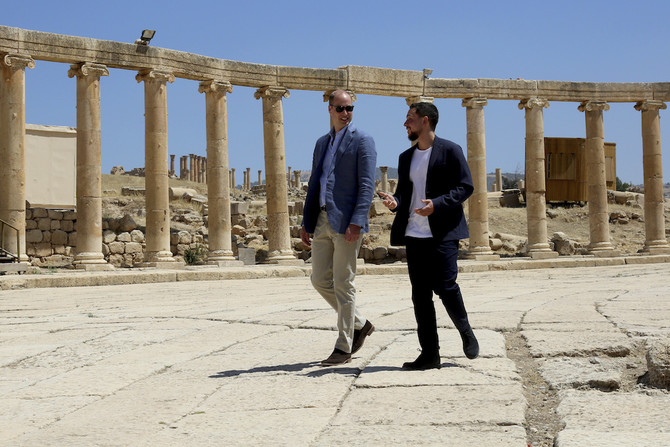
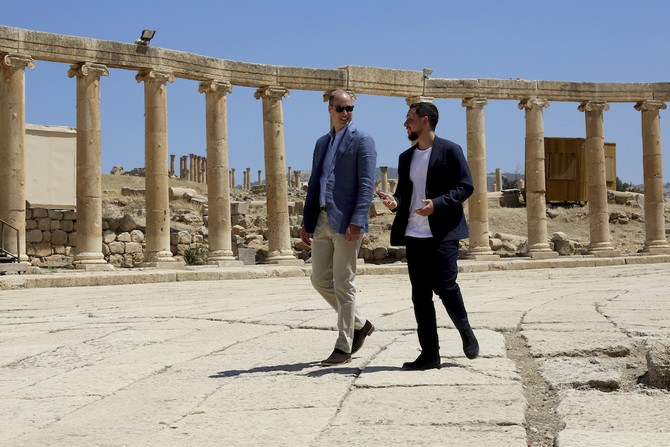
Britain's Prince William and Jordan's Crown Prince Hussein tour the archaeological site in Jerash, northern Jordan, on Monday. (AP)
2 / 10
Britain's Prince William (1st-L) and Jordanian Crown Prince Hussein bin Abdullah (2nd-L) visit the Jerash archaeological site, some 50 kilometers north of the Jordanian capital Amman, on June 25, 2018. (AFP)
3 / 10
Britain's Prince William and Jordan's Crown Prince Hussein tour the archaeological site in Jerash, northern Jordan, on Monday. (AP)
4 / 10
Britain's Prince William and Jordan's Crown Prince Hussein tour the archaeological site in Jerash, northern Jordan, on Monday. (AP)
5 / 10
Britain's Prince William and Jordan's Crown Prince Hussein tour the archaeological site in Jerash, northern Jordan, on Monday. (AP)
6 / 10
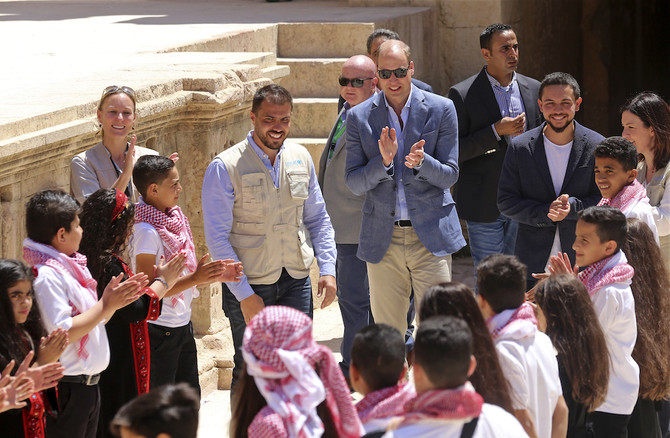
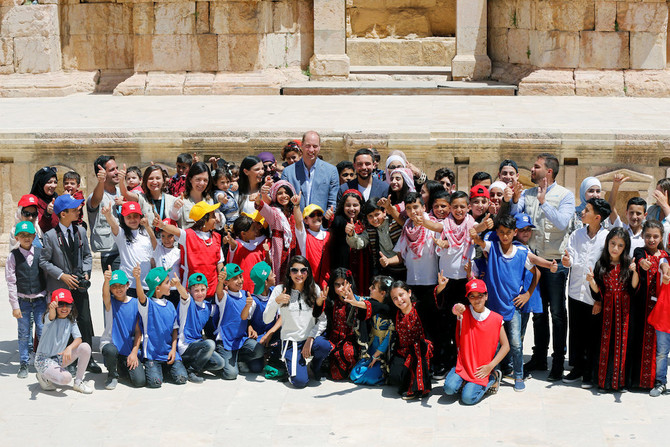
Britain’s Prince William and Jordanian Crown Prince Hussain meet with a group of young people from the Makani Center, a free education and support program for Syrian refugee children and local Jordanian children, at the Jerash archaeological site, northern Jordan. (AP)
7 / 10
Britain’s Prince William and Jordanian Crown Prince Hussain meet with a group of young people from the Makani Center, a free education and support program for Syrian refugee children and local Jordanian children, at the Jerash archaeological site, northern Jordan. (AP)
8 / 10
Britain’s Prince William and Jordanian Crown Prince Hussain meet with a group of young people from the Makani Center, a free education and support program for Syrian refugee children and local Jordanian children, at the Jerash archaeological site, northern Jordan. (AP)
9 / 10
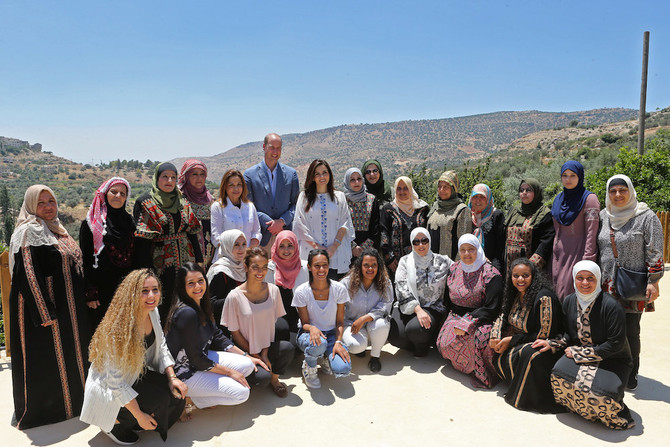
Britain's Prince William visits the Princess Taghrid Institute for Development and Training in the province of Ajloun, north of the Jordanian capital Amman. (Reuters)
10 / 10
Britain's Prince William visits the Princess Taghrid Institute for Development and Training in the province of Ajloun, north of the Jordanian capital Amman. (Reuters)
Updated 26 June 2018
Follow

Prince William visits Jerash, meets students during Jordan visit

  • Britain’s Prince William visited the Roman ruins of Jerash in northern Jordan, accompanied by his host Crown Prince Hussein bin Abdullah
  • The two princes met children from Jordan and neighboring war-torn Syria during their visit to the site

AMMAN: Britain’s Prince William ended a two-day tour of Jordan on Monday that included a visit to the archaeological Roman city of Jerash. The visit also included meetings with young Jordanian and Syrian students.
Ziad Guneimat, head of the Jordanian Ministry of Tourism and Archaeology in Jerash, told Arab News that the visit was very successful. “The prince toured the entire facility and expressed amazement at the location and its history,” he said.
Guneimat said that the British prince was accompanied by Jordan’s Crown Prince Hussein bin Abdullah, who said that this was his first official visit to the important archaeological site since becoming crown prince and regent.
Prince William posed for a photo in the same location where his wife Catherine, the Duchess of Cambridge, was photographed as a two-year-old when her father was director of the British Airways office in Amman. 

The Duke of Cambridge told a crowd of Jordanian and internationals at a reception that his wife, who had recently given birth, was sorry she could not make the trip to Jordan.
Osama Salameh, a spokesman for the Royal Court in Amman, told Arab News that Prince William and the Jordanian crown prince spoke with Jordanian and Syrian students on the sidelines of the visit to the archaeological site. 
A spokesperson for UNICEF said that Prince William met with younger Syrian refugees benefiting from UNICEF’s Makani program, which offers psychological support for Syrian refugee parents and children.

The British prince was unable to watch his country’s World Cup game live on Sunday, so the UK embassy recorded the game and he was seen watching the recorded version of Britain’s 6-1 victory over Panama along with Jordan’s crown prince.
At an event sponsored by the UK Embassy in Amman on Sunday to celebrate Queen Elizabeth’s official birthday, Prince William read out a message in which the queen looked back warmly on her 1984 visit to Jordan and spoke of the country as “a staunch and long-held friend.” 
“The way in which you opened your doors to hundreds of thousands of refugees from Syria, not to mention your longstanding commitments to Palestinian refugees, is remarkable,” the prince told Jordanians. The event was attended by Jordanians, members of the diplomatic corps as well as the newly sworn-in Prime Minister Omar Razzaz and members of his Cabinet. 
Prince William arrived in Israel on Monday for the first-ever official visit of a member of the British royal family to the tumultuous region London once ruled.
Arriving from neighboring Jordan, the Duke of Cambridge landed at Israel’s Ben-Gurion International Airport and then departed to Jerusalem, where he will stay at the elegant King David Hotel, site of the former administrative headquarters of the British mandate.
Israeli daily Haaretz reported that Prince William will be staying at the Hotel, which was the main administrative building of officials during the British Mandate from 1920-1948. The hotel was also the site of a terrorist attack by a Zionist underground organization in July 1946, which killed 91 people.


Fledgling radio station aims to be ‘voice of the people’ in Gaza

Updated 15 February 2026
Follow

Fledgling radio station aims to be ‘voice of the people’ in Gaza

  • The electricity crisis is one of the most serious and difficult problems in the Gaza Strip, says Shereen Khalifa Broadcaster

DEIR EL-BALAH: From a small studio in the central city of Deir El-Balah, Sylvia Hassan’s voice echoes across the Gaza Strip, broadcast on one of the Palestinian territory’s first radio stations to hit the airwaves after two years of war.

Hassan, a radio host on fledgling station “Here Gaza,” delivers her broadcast from a well-lit room, as members of the technical team check levels and mix backing tracks on a sound deck. “This radio station was a dream we worked to achieve for many long months and sometimes without sleep,” Hassan said.

“It was a challenge for us, and a story of resilience.”

Hassan said the station would focus on social issues and the humanitarian situation in Gaza, which remains grave in the territory despite a US-brokered ceasefire between Israel and Hamas since October.

“The radio station’s goal is to be the voice of the people in the Gaza Strip and to express their problems and suffering, especially after the war,” said Shereen Khalifa, part of the broadcasting team.

“There are many issues that people need to voice.” Most of Gaza’s population of more than 2 million people were displaced at least once during the gruelling war.

Many still live in tents with little or no sanitation.

The war also decimated Gaza’s telecommunications and electricity infrastructure, compounding the challenges in reviving the territory’s local media landscape. “The electricity problem is one of the most serious and difficult problems in the Gaza Strip,” said Khalifa.

“We have solar power, but sometimes it doesn’t work well, so we have to rely on an external generator,” she added.

The station’s launch is funded by the EU and overseen by Filastiniyat, an organization that supports Palestinian women journalists, and the media center at the An-Najah National University in Nablus, in the occupied West Bank.

The station plans to broadcast for two hours per day from Gaza and for longer from Nablus. It is available on FM and online.

Khalifa said that stable internet access had been one of the biggest obstacles in setting up the station, but that it was now broadcasting uninterrupted audio.

The Gaza Strip, a tiny territory surrounded by Israel, Egypt, and the Mediterranean Sea, has been under Israeli blockade even before the attack on Oct. 7, 2023, which sparked the war. Despite the ceasefire, Israel continues to strictly control the entry of all goods and people to the territory.

“Under the siege, it is natural that modern equipment necessary for radio broadcasting cannot enter, so we have made the most of what is available,” she said.