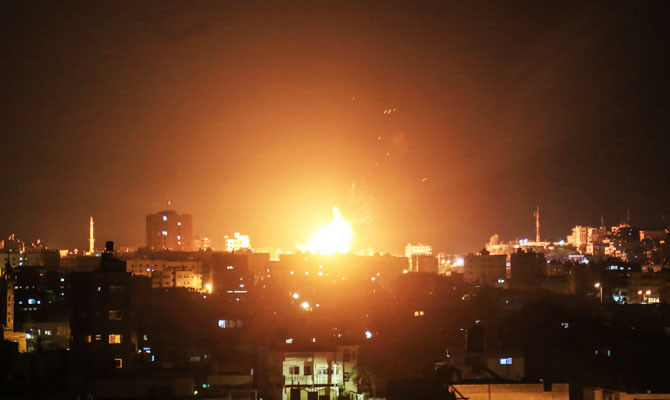
GAZA CITY: Israeli warplanes pounded Hamas targets in the Gaza Strip early Wednesday in a new flare-up of hostilities that saw dozens of rockets and mortar shells fired from the Palestinian enclave, the army said.
The strikes targeting Hamas’ military wing, the Ezzedine Al-Qassam Brigades, were more intense than in previous sorties to convey the message “we will not allow this situation to continue,” Israeli military spokesman Jonathan Conricus told reporters.
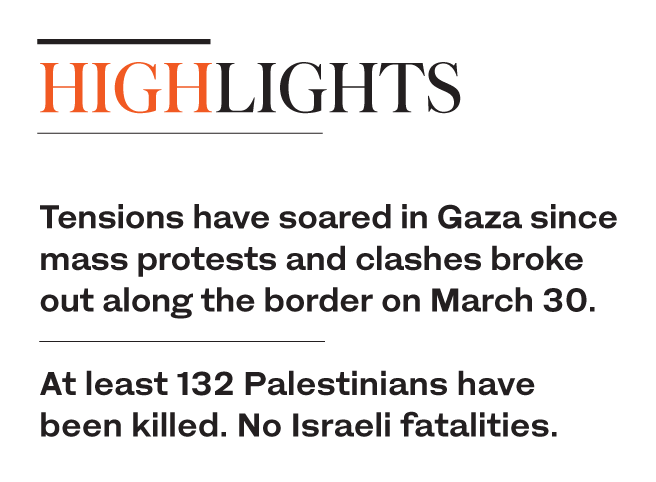
The latest spike in tensions follows weeks of deadly protests and clashes along the Gaza-Israel border as well as the worst military escalation last month since a 2014 war.
It comes as US President Donald Trump’s special envoy Jason Greenblatt and adviser Jared Kushner visit the region to discuss issues including the Palestinian-Israeli peace process.
Israeli planes initially targeted three Hamas military positions overnight in Gaza in response to kites and balloons carrying incendiary and explosive devices launched into Israel from the Palestinian territory, the army said.
“They may look like toys but I can assure they are not toys, they are weapons intended to kill and to inflict damage,” Conricus said.
He said that so far Israel had sought to warn off those launching the airborne devices but that could change.
“Hamas and other militants, but mainly Hamas” hit back after the first air raids with more than 45 rockets and mortar rounds fired from Gaza toward Israel, seven of which were intercepted by the Iron Dome missile defense system, he added.
Three more landed inside the Jewish state, he said, but did not account for the remainder.
In response, Israeli planes carried out more raids against 25 “terror objectives” including an underground training compound, according to the army.
Gaza medical sources said that five people were lightly injured in the strikes.
In a joint statement, the military wings of Hamas and allied militant group Islamic Jihad said they had “targeted seven Israeli military positions near Gaza... in response to continued Israeli aggression against resistance sites in Gaza.”
Conricus said that most of the 200,000 Israeli civilians who live within range of the short-range rockets fired from Gaza “spent the night in bomb shelters.”

Israel threatens to get tougher on Gaza after warplanes hit Hamas
- Israeli planes initially targeted three Hamas military positions overnight in Gaza in response to kites and balloons carrying incendiary and explosive devices launched into Israel
- The military wings of Hamas and allied militant group Islamic Jihad said they had “targeted seven Israeli military positions near Gaza
Israel accused of move expanding Jerusalem borders for first time since 1967
- Planned development is formally a westward expansion of the Geva Binyamin, or Adam, settlement situated north-east of Jerusalem in the West Bank
- Some 200,000 Israelis live in Israeli-annexed east Jerusalem, while more than 500,000 others live in West Bank settlements and outposts
JERUSALEM: Israeli NGOs have raised the alarm over a settlement plan signed by the government which they say would mark the first expansion of Jerusalem’s borders into the occupied West Bank since 1967.
Israel has occupied east Jerusalem since 1967 and later annexed it in a move not recognized by the international community.
Palestinians view east Jerusalem as the capital of their future state.
The proposal, published in early February but reported by Israeli media only on Monday, comes as international outrage mounts over creeping measures aimed at strengthening Israeli control over the West Bank.
Critics say these actions by the Israeli authorities are aimed at the de facto annexation of the Palestinian territory.
The planned development, announced by Israel’s Ministry of Construction and Housing, is formally a westward expansion of the Geva Binyamin, or Adam, settlement situated north-east of Jerusalem in the West Bank.
In a statement, the ministry said the development agreement included the construction of around 2,780 housing units for the settlement, with an investment of roughly 120 million Israeli shekels (around $38.7 million).
But the area to be developed lies on the Jerusalem side of the separation barrier built by Israel in the early 2000s, while Geva Binyamin sits on the West Bank side of the barrier, and the two are separated by a road.
In a statement, Israeli settlement watchdog Peace Now said there would be no “territorial or functional connection” between the area to be developed and the settlement.
“The new neighborhood will be integral to the city of Jerusalem,” Lior Amihai, Peace Now’s executive director, told AFP.
“What is unique about that one is that it will be connected directly to Jerusalem, but it will be beyond the annexed municipal border. So it will be in complete West Bank territory, but just adjacent to Jerusalem,” he said.
‘Living there as Jerusalemites’
The move comes days after Israel’s government approved a process to register land in the West Bank as “state property,” drawing widespread international condemnation and fears among critics that it would accelerate annexation of the Palestinian territory.
Days earlier, Israel’s security cabinet approved a series of measures to tighten control over areas of the West Bank administered by the Palestinian Authority under the Oslo accords.
Those measures, which also sparked international backlash, include allowing Jewish Israelis to buy West Bank land directly and allowing Israeli authorities to administer certain religious sites in areas under the Palestinian Authority’s control.
Amihai said that the current government — one of the most right-wing in Israel’s history — was “systematically working to annex the occupied territories and to prevent Palestinian statehood.”
The case of Jerusalem, he said, was particularly symbolic.
“Every change to Jerusalem is sensitive to both the Israeli public, but also to the Palestinians,” he told AFP.
Aviv Tatarsky, a researcher at Ir Amim, an Israeli NGO focusing on Jerusalem within the context of the Israeli-Palestinian conflict, said the latest planned development amounted to a de facto expansion of the city of Jerusalem.
“If it is built, and people live there, the people who will live there, they will be living there as Jerusalemites,” he told AFP.
“In all practical terms, it’s basically not the settlement that will be expanded, but Jerusalem.”
‘Facts on the ground’
The development agreement was signed by Israel’s Construction and Housing Ministry, the Finance Ministry and the Binyamin Regional Council, which represents settlements north of Ramallah in the central West Bank.
It has yet to be reviewed by the Civil Administration’s Higher Planning Committee, in a process which could take several months or years.
Tatarsky said that international pressure had so far made it difficult for recent Israeli governments to make formal declarations on annexation.
“It’s much easier to create facts on the ground, which, altogether... actually add up to annexation,” the researcher said.
The West Bank, occupied since 1967, would form the largest part of any future Palestinian state but is seen by many on the religious right as Israeli land.
Some 200,000 Israelis live in Israeli-annexed east Jerusalem, while more than 500,000 others live in West Bank settlements and outposts, which are illegal under international law.
Around three million Palestinians live in the territory.
The current Israeli government has fast-tracked settlement expansion, approving a record 52 settlements in 2025.
Israel has occupied east Jerusalem since 1967 and later annexed it in a move not recognized by the international community.
Palestinians view east Jerusalem as the capital of their future state.
The proposal, published in early February but reported by Israeli media only on Monday, comes as international outrage mounts over creeping measures aimed at strengthening Israeli control over the West Bank.
Critics say these actions by the Israeli authorities are aimed at the de facto annexation of the Palestinian territory.
The planned development, announced by Israel’s Ministry of Construction and Housing, is formally a westward expansion of the Geva Binyamin, or Adam, settlement situated north-east of Jerusalem in the West Bank.
In a statement, the ministry said the development agreement included the construction of around 2,780 housing units for the settlement, with an investment of roughly 120 million Israeli shekels (around $38.7 million).
But the area to be developed lies on the Jerusalem side of the separation barrier built by Israel in the early 2000s, while Geva Binyamin sits on the West Bank side of the barrier, and the two are separated by a road.
In a statement, Israeli settlement watchdog Peace Now said there would be no “territorial or functional connection” between the area to be developed and the settlement.
“The new neighborhood will be integral to the city of Jerusalem,” Lior Amihai, Peace Now’s executive director, told AFP.
“What is unique about that one is that it will be connected directly to Jerusalem, but it will be beyond the annexed municipal border. So it will be in complete West Bank territory, but just adjacent to Jerusalem,” he said.
‘Living there as Jerusalemites’
The move comes days after Israel’s government approved a process to register land in the West Bank as “state property,” drawing widespread international condemnation and fears among critics that it would accelerate annexation of the Palestinian territory.
Days earlier, Israel’s security cabinet approved a series of measures to tighten control over areas of the West Bank administered by the Palestinian Authority under the Oslo accords.
Those measures, which also sparked international backlash, include allowing Jewish Israelis to buy West Bank land directly and allowing Israeli authorities to administer certain religious sites in areas under the Palestinian Authority’s control.
Amihai said that the current government — one of the most right-wing in Israel’s history — was “systematically working to annex the occupied territories and to prevent Palestinian statehood.”
The case of Jerusalem, he said, was particularly symbolic.
“Every change to Jerusalem is sensitive to both the Israeli public, but also to the Palestinians,” he told AFP.
Aviv Tatarsky, a researcher at Ir Amim, an Israeli NGO focusing on Jerusalem within the context of the Israeli-Palestinian conflict, said the latest planned development amounted to a de facto expansion of the city of Jerusalem.
“If it is built, and people live there, the people who will live there, they will be living there as Jerusalemites,” he told AFP.
“In all practical terms, it’s basically not the settlement that will be expanded, but Jerusalem.”
‘Facts on the ground’
The development agreement was signed by Israel’s Construction and Housing Ministry, the Finance Ministry and the Binyamin Regional Council, which represents settlements north of Ramallah in the central West Bank.
It has yet to be reviewed by the Civil Administration’s Higher Planning Committee, in a process which could take several months or years.
Tatarsky said that international pressure had so far made it difficult for recent Israeli governments to make formal declarations on annexation.
“It’s much easier to create facts on the ground, which, altogether... actually add up to annexation,” the researcher said.
The West Bank, occupied since 1967, would form the largest part of any future Palestinian state but is seen by many on the religious right as Israeli land.
Some 200,000 Israelis live in Israeli-annexed east Jerusalem, while more than 500,000 others live in West Bank settlements and outposts, which are illegal under international law.
Around three million Palestinians live in the territory.
The current Israeli government has fast-tracked settlement expansion, approving a record 52 settlements in 2025.
© 2026 SAUDI RESEARCH & PUBLISHING COMPANY, All Rights Reserved And subject to Terms of Use Agreement.


