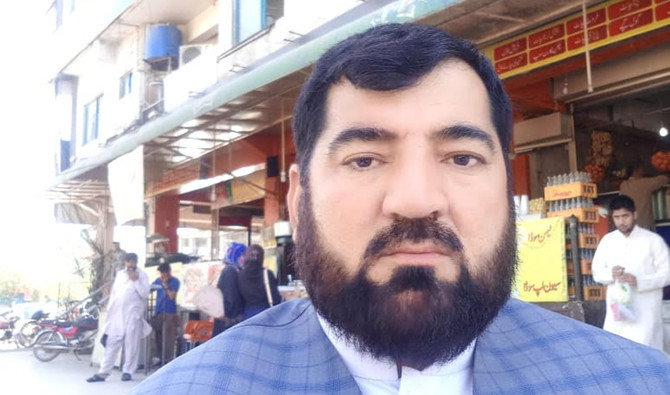
PESHAWAR: Rasool Khan, 40, and his four siblings were born in Pakistan, his family having moved there immediately after the former Soviet Union invaded Afghanistan in 1978.
Both his grandfather and father were merchants and frequently visited Pakistan. “My father used to visit Pakistan for business, but in the 1970s he permanently moved there because of the war in Afghanistan,” Khan said.
But Pakistan has set June 30 as the deadline for Afghan refugees to leave the country. Khan, a representative of Afghan traders in the Pakistan-Afghanistan Joint Chamber of Commerce, said there should be a separate policy for students, businesspeople and Afghans married to Pakistani women.
“It’s not fair to deal with all Afghans under the same policy of deportation and repatriation,” he added.
With World Refugee Day being observed on June 20, Afghans living in Pakistan hope that the deadline will be extended.
Abdul Hameed, director of the Afghan Ministry of Refugees and Repatriations, said Pakistan’s Khyber Pakhtunkhawa (KP) province hosts 1.1 million Afghan refugees.
Based in KP’s capital Peshawar, he expressed hope that Pakistan’s caretaker government will extend the stay of Afghan refugees.
“Relations between Pakistan and Afghanistan are improving, and both sides are in touch on the refugee issue,” he told Arab News.
The director general of the Commissionerate for Afghan Refugees in KP, Waqar Maroof, said Islamabad is considering adopting a separate policy for Afghan students, traders and those married to Pakistani women.
“Once KP’s Interior Ministry gives the go-ahead, we’ll implement the plan,” he told Arab News.
Qaiser Khan Afridi, spokesman in Pakistan for the UN High Commissioner for Refugees (UNHCR), said 4.2 million Afghans have been repatriated to their native country since 2002.
“Pakistan is the second-largest refugee host country (in the world), and it is hosting around 1.4 million Afghan registered refugees at the moment,” he added.
Islamabad says there are more than 1 million Afghans living in Pakistan without proper documentation.
“We want Afghan refugees to stay in Pakistan with legal and valid documents,” said Maroof. “Afghans who were repatriated to their native country want to come to Pakistan on a valid visa and passport so they can stay here legally.”
Khan fears losing the business he and his father built over the last four decades if he is forced to go to Afghanistan.
His friend Masham Khan moved there a few months ago, but returned to Pakistan after getting a visa because “there isn’t enough business activity” in Afghanistan.


On World Refugee Day, Afghans in Pakistan fear deportation


On World Refugee Day, Afghans in Pakistan fear deportation
- Islamabad has set June 30 as the deadline for Afghan refugees to return to their country
- Nearly 4.2 million Afghans have been repatriated to their native country since 2002, according to the UN refugee agency


Pull him off TV: Steve Bannon shuts down Sen. Lindsey Graham
- Trump’s former chief strategist called for the senator to be registered as a foreign agent
DUBAI: Former White House chief strategist Steve Bannon called on Tuesday for US Senator Lindsey Graham to be registered as a foreign agent of the Israeli government, escalating a growing conservative backlash against the senator’s vocal support for Israel.
Speaking on his podcast “War Room,” Bannon said Graham should be “pulled off of television,” adding: "This is dangerous… because you have guys like Lindsey Graham and dozens more that are doing the wrong thing.”
In a Fox News interview on Monday, Graham said: “To all the antisemites, to all the isolationists… I’m not with you, I’m with Israel, I will be with Israel to our dying day.”
Graham also urged Gulf Arab states to join military action against Iran. “What I want you to do in the Middle East, to our friends in Saudi Arabia and other places, [is] step forward and say, ‘this is my fight too, I join America, I’m publicly involved in bringing this regime down,’” he said.
In a post on X, Graham questioned the value of a US defense agreement with Saudi Arabia following the evacuation of the American embassy in Riyadh, writing: “Why should America do a defense agreement with a country like the Kingdom of Saudi Arabia that is unwilling to join a fight of mutual interest?”
Faisal Abbas, editor-in-chief of Arab News, responded to Graham’s comments in a Sky News interview, saying: “He flip flops so much, it’s actually entertaining.”
“On one hand, he says he will never set foot in Saudi Arabia. The next day, he’s here signing multimillion-dollar deals.”
“I don’t think anyone here takes him seriously,” Abbas added.
He warned Graham to be careful what he wished for: “Do you really want Saudi Arabia involved in this war putting our oil facilities at risk or do you want us stabilizing the energy markets?”
Graham pressed further, warning that inaction would carry a price. “Hopefully Gulf Cooperation Council countries will get more involved as this fight is in their backyard. If you are not willing to use your military now, when are you willing to use it?”
“Hopefully this changes soon. If not, consequences will follow.”
Graham's remarks drew sharp criticism from Bannon and others including podcast host Megyn Kelly.
She questioned on X whether Graham was overstepping his authority as a senator, writing: “When did Lindsay Graham become our president?”
Kelly also said Graham had threatened Lebanon, Cuba, Saudi Arabia, the wider Arab region, and Spain within a 24-hour period.
The problem with Graham “isn’t (just) that he’s a homicidal maniac, it’s that Trump likes and is listening to him,” she said in another post.