

British Museum reveals secrets of ancient Assyrian ruler

1 / 3
Ashurbanipal hunting on horseback, Nineveh, Assyria, 645 – 635 BC. (Courtesy British Museum)
2 / 3
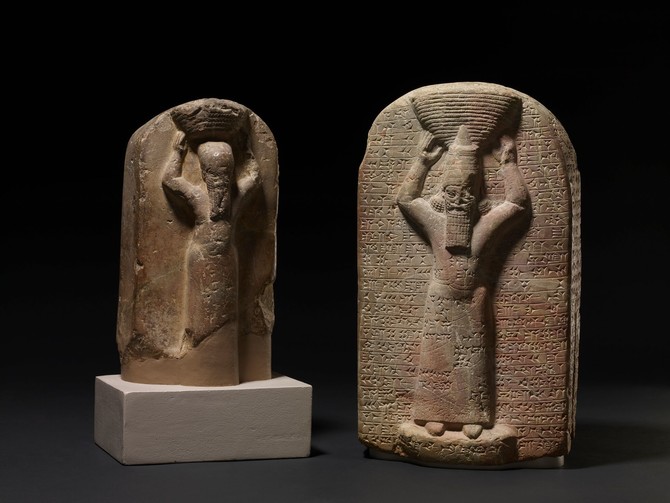
Stone stele depicting Ashurbanipal, right, shown with a ritual basket on his head with cuneiform inscription, South Iraq, Marduk temple (Babylon), 668BC — 665BC. His brother Shamash-shumu-ukin, left, carved with cuneiform inscription, South Iraq, Temple of Nabu (Borsippa), 668BC – 655BC. (Courtesy British Museum)
3 / 3
Granite sphinx of Taharqo, Kawa, Sudan. (Courtesy British Museum)
Updated 20 June 2018
Follow

British Museum reveals secrets of ancient Assyrian ruler

  • Exhibition on King Ashurbanipal reveals treasures from the 7th-century kingdom that stretched across northern Iraq and eastern Mediterranean.
  • Director of the British Museum Hartwig Fischer: “This exhibition will bring visitors face to face with a king whose reign shaped the history of the ancient world.”

LONDON: When Daesh ransacked Mosul Museum in February 2015, the world watched in horror as cultural treasures were pushed from plinths and relics from ancient civilizations smashed to the floor. 

Priceless pieces of Iraq’s history were lost, taking thousands of years of heritage with them while the militant group tried to wipe out pre-Islamic past and destroy all memory of the ancient civilizations Iraq is built on.

Rescuing the artefacts that escaped the group’s savagery and restoring Iraq’s archaeological ancestry has become part of the healing process as the country emerges from the trauma of Daesh rule and pieces its identity back together following a decade of turmoil. 

Programs to train Iraq’s archaeologists in emergency heritage management are being supported by overseas institutions, including the British Museum in London, where a new exhibition will delve into an era when Iraq was at the center of a great Assyrian empire. 

Priceless treasures from the archaeological archives of ancient Assyria will go on display at the museum in November for the first major exhibition on the kingdom’s last great ruler, King Ashurbanipal. 

Described as the most powerful person on earth during his reign in the 7th-century BC, Ashurbanipal ruled with an iron fist from his seat in Nineveh, now northern Iraq. 

He presided over a vast territory that stretched from the shores of the eastern Mediterranean to the summits of western Iraq and was known, according to the exhibition, as a “Warrior. Scholar. Empire-builder. King-slayer. Lion-hunter. Librarian.”


A map showing the extent of the Assyrian Empire (in pink). (Courtesy Paul Goodhead)

His feats on the battlefield, which included conquering Egypt and crushing the state of Elam, established his military might but the Assyrian king also cultivated an intellectual prestige, amassing the largest library in existence to showcase his scholarship.

For Ashurbanipal, the ruthless ruler, harnessing the power of learning to build his status as “King of the World, King of Assyria,” was equally important in cowing his enemies.

Among the notable pieces in his extraordinary collection, which predated the famous Library of Alexandria, was the Epic of Gilgamesh, a poem from ancient Mesopotamia considered the earliest surviving work of great literature.

About 30,000 of these texts are in the hands of the British Museum, where they tell the story of life at Ashurbanipal’s famously extravagant court in ancient cuneiform script, hammered out on clay tablets. 

These are among the 200 rarely-seen objects due to be displayed at the museum, which has brought together pieces from across the world, from the History Museum of Armenia, Yerevan to the Musée du Louvre in Paris to supplement its existing collection of artefacts from the glory days of ancient Assyria. 

Huge stone statues, delicately-carved reliefs, rare wall paintings and elaborate armory give a sense of the opulence of Ashurbanipal’s palace, which stood as a symbol of the vast wealth and influence he wielded, flanked by expansive gardens where an elaborate canal network reached 50 kilometers into the mountains.

Recent speculation has suggested that the Hanging Gardens of Babylon — one of the Seven Wonders of the Ancient World — were in fact those at Nineveh.

Some of the the artefacts have been brought up from a decommissioned basement gallery at the British Museum, where few have had the opportunity to lay eyes on them for 20 years. 

Brought together for the first time, they capture the scale and splendor of the era before Ashurbanipal’s empire fell to the Babylonians and recalls an era when the influence of Assyrian monarchs reached across the world. 

Hartwig Fischer, director of the British Museum, said: “This exhibition will bring visitors face to face with a king whose reign shaped the history of the ancient world.” 

Many of the items on display originate from archaeological sites in Iraq, including Nineveh and Nimrud, cities recently ravaged by Daesh when the group stormed the ancient sites armed with sledgehammers and drills. 

Gareth Brereton, exhibition curator, said: “As present-day Iraq looks to recover the history of damaged sites at Nineveh and Nimrud, this exhibition allows us to appreciate and relive the great achievements of an ancient world and celebrate its legacy.” 


Lina Gazzaz traces growth, memory and resilience at Art Basel Qatar 

Updated 30 January 2026
Follow

Lina Gazzaz traces growth, memory and resilience at Art Basel Qatar 

  • The Saudi artist presents ‘Tracing Lines of Growth’ at the fair’s inaugural edition 

DUBAI: Saudi artist Lina Gazzaz will present a major solo exhibition via Hafez Gallery at the inaugural edition of Art Basel Qatar, which runs Feb. 3 to 7. “Tracing Lines of Growth” is a body of work that transmutes botanical fragments into meditations on resilience, memory and becoming. 

Hafez Gallery, which was founded in Jeddah, frames the show as part of its mission to elevate underrepresented regional practices within global conversations. Gazzaz’s biography reinforces that reach. Based in Jeddah and trained in the United States, she works across sculpture, installation, painting and video, and has exhibited in Saudi Arabia, the US, Lebanon, the UK, Germany, the UAEand Brazil. Her experimental practice bridges organic material and conceptual inquiry to probe ecological kinship, cultural memory and temporal rhythm. 

 Saudi artist Lina Gazzaz. (Supplied)

“Tracing Lines of Growth” is a collection rooted in long-term inquiry. “I started to think about it in 2014,” Gazzaz told Arab News, describing a project that has evolved from her initial simple line drawings through research, experimentation and material interrogation. 

What began as tracing the lines of Royal Palm crown shafts became an extended engagement with the palm’s physiology, its cultural significance and its symbolic afterlives. During the COVID-19 pandemic, she went deeper into that exploration, translating weathered crown shafts into “lyrical instruments of time.” 

Each fragment of “Tracing Lines of Growth” is treated as a cache of human and ecological narratives. Gazzaz describes a feeling of working with materials that “have witnessed civilization,”attributing to them a deep collective memory. 

Hafez Gallery’s presentation text frames the palm as a cipher — its vascular routes once pulsing with sap transformed into calligraphic marks that summon the bodies of ouds, desert dunes and scripted traces rooted in Qur’anic and biblical lore. 

Detail of Gazzaz's work. (Supplied)

“Today, the palm has evolved into a symbol of the land and its people. Throughout the Arabian Peninsula, it is still one of the few agricultural exports; and plays an integral role in the livelihood of agrarian communities,” said Gazzaz. 

The sculptures’ rippling ribs and vaulted folds, stitched with red thread, evoke what the artist hears and sees in the wood. “Each individual line represents a story, and it’s narrating humanity’s story,” she said. 

The works’ stitching is described in the gallery’s materials as “meticulous.” It emphasizes linear pathways and punctuates the sculptures with the “suggestion of life’s energy moving through the dormant material.” 

“(I used) fine red thread — the color of life and energy — to narrate the longevity of growth, embodying themes of balance, fragility, music, transformation and movement. The collection is about the continuous existence in different forms and interaction; within the concept of time,” Gazzaz explained. 

Hand-stitching, in Gazzaz’s practice, highlights her insistence on care and repair, and the human labor that converts cast-off organic forms into carriers of narratives. 

Gazzaz describes her practice as a marriage between rigorous research and intuitive making. “I am a search-based artist... Sometimes I cannot stop searching,” she said. “During the search and finding more and more, and diving more and more, the subconscious starts to collaborate with you too, because of your intention. After all the research, I go with the flow. I don’t plan... I go with the flow, and I listen to it.” 

The artist is far from done with this particular project. “I am now beginning to explore the piece with glass,” she noted. 

Art Basel Qatar’s curatorial theme for its inaugural year is “Becoming.” For Gazzaz, ‘becoming’ is evident in the material and conceptual transformations she stages: discarded palm fragments reconstituted into scores of lived time, stitched lines reactivated as narratives.  

“It’s about balance. It’s about fragility. It’s about resilience,” she said.