

KSA complains to FIFA about Qatar’s BeIN using World Cup as political tool

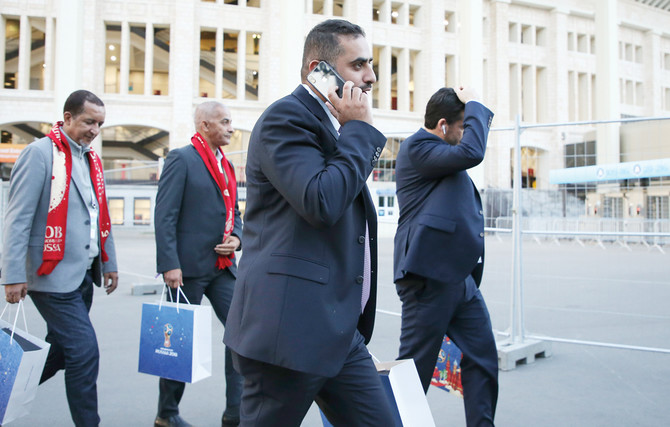
BeIN Sport President Yousef Al-Obaidly is seen at the Luzhniki Stadium in Moscow following the 2018 FIFA World Cup Russia group A match between Russia and Saudi Arabia on June 14. (Getty Images)
Updated 08 March 2019
Follow

KSA complains to FIFA about Qatar’s BeIN using World Cup as political tool

  • The federation called on FIFA in its complaint to take severe sanctions against the Qatari channel and to abolish the rights granted to the network.
  • Some of the biggest names in Arab sport have signed a petition to protest against the “politicization” of World Cup coverage by the Qatar-owned broadcaster. 

DUBAI: The Saudi Football Federation has filed an official complaint to FIFA over the Qatar-owned BeIN Sports network’s use of World Cup broadcasts as a means of spreading political messages aimed at insulting Saudi Arabia and its leaders.

This falls within the network’s ongoing attempts to instigate hatred in the region, it said.

The federation said its complaint calls on FIFA to address the unacceptable abuse by the channel of its tools for politicizing the media. This was clear after the World Cup’s opening match between Saudi Arabia and Russia and contrary to the laws of the international federation, which stresses the need to exclude sport from politics.

The federation called on FIFA in its complaint to take severe sanctions against the Qatari channel and to abolish the rights granted to the network.

Meanwhile, some of the biggest names in Arab sport have signed a petition to protest against the “politicization” of World Cup coverage by the Qatar-owned broadcaster. 

The website sports4everyone.org created the petition and invited fans around the world to urge FIFA President Gianni Infantino to investigate the coverage by the Qatari broadcaster’s Arabic channel.

Among the signatories are Egyptian national football player Ahmed Hassan, Al Arabiya’s Sports Editor Battal Al-Goos, and former Saudi national team captain Yousuf Al-Thunayan.

“The mixing of sport and politics is disgraceful and unethical behaviour, especially with regards to World Cup coverage by the journalists that are present at the channel,” Former Saudi Arabia national team player Khamis Al-Zahrani told Arab News.

“Anything that happens during the match should not leave the pitch, that's the limit. As Saudi supporters, we will always back the Saudi national team no matter the circumstances,” he added.

BeIN Sports holds the rights to broadcast World Cup games across the Middle East and North Africa, although its channels are not available in Saudi Arabia, one of four Arab nations locked in a diplomatic dispute with Qatar over the latter’s alleged ties to terror groups. Doha denies the charges. 

“Sport rises above politics. FIFA tried to keep politics away from games. As fans, we are saddened by BeIN using its permission to telecast sports to transmit its political agenda, violating FIFA rules,” the petition read.

The petition website includes nine clips from BeIN Sports featuring pundits and presenters politicizing the match between Saudi Arabia and the host nation, Russia. 

“Mixing sport and politics in this cheap way has been disgraceful and does not represent respectable Arabs,” Al-Zahrani, who played for Al-Ittihad, said, adding that, ““Hopefully, this petition will fulfil the expectations of all Arabs.”

In one of the station’s broadcasts, a commentator accused Saudi Arabia of “selling out the Palestinian cause,” while in another the host suggested the Kingdom’s top sporting officials will become “prisoners at the Ritz-Carlton,” a reference to the detentions in Riyadh during last year’s anti-corruption drive.

Egyptian media analyst Abdellatif El-Menawy said BeIN had “distorted the global football event” by using it as a political tool against Saudi Arabia.

“This is an infringement of the rules and standards of professional media,” El-Menawy told Arab News on Saturday. 

“BeIN Sports has abandoned neutrality and professionalism,” he added, saying the network’s coverage after Saudi Arabia’s 5-0 defeat by Russia was “gloating” and “sarcastic.”


To infinity and beyond: Grendizer’s 50 years of inspiring Arabs

Updated 27 December 2025
Follow

To infinity and beyond: Grendizer’s 50 years of inspiring Arabs

  • ⁠ ⁠50 years after its creation, the Grendizer anime series continues to capture Arab imagination
  • ⁠ ⁠⁠Arab News Japan speaks to creator Go Nagai, Middle Eastern fans and retells the story behind the UFO Robot tasked with protecting our planet

LONDON: Few cultural imports have crossed borders as unexpectedly, or as powerfully, as Grendizer, the Japanese giant robot that half a century ago became a childhood hero across the Arab world, nowhere more so than in Saudi Arabia.

Created in Japan in the mid-1970s by manga artist Go Nagai, Grendizer was part of the “mecha” tradition of giant robots. The genre was shaped by Japan’s experience during the Second World War, and explored themes of invasion, resistance and loss through the medium of science fiction.

But while the series enjoyed moderate success in Japan, its true legacy was established thousands of kilometers away in the Middle East.

By the early 1980s, “Grendizer” had spread across the Middle East, inspiring fandoms in Saudi Arabia, Kuwait, Iraq and beyond. (Supplied)

The anime “UFO Robot Grendizer” arrived on television in the region in 1979, dubbed into Arabic and initially broadcast in Lebanon during the Lebanese civil war. The story it told of the heroic Duke Fleed, a displaced prince whose planet had been destroyed by alien invaders, struck a chord with children growing up amid regional conflict and occupation by Israel.

Its themes of defending one’s homeland, standing up to aggression and protecting the innocent were painfully relevant in the region, transforming the series from mere entertainment into a kind of emotional refuge.

Much of the show’s impact came from its successful Arabization. The powerful Arabic dubbing and emotionally charged voice-acting, especially by Lebanese actor Jihad El-Atrash as Duke Fleed, lent the show a moral gravity unmatched by other cartoons of the era.

While the series enjoyed moderate success in Japan, its true legacy was established thousands of kilometers away in the Middle East. (Supplied)

The theme song for the series, performed by Sami Clark, became an anthem that the Lebanese singer continued to perform at concerts and festivals right up until his death in 2022.

By the early 1980s, “Grendizer” had spread across the Middle East, inspiring fandoms in Saudi Arabia, Kuwait, Iraq and beyond. For many, it was not only their first exposure to anime, it also delivered lessons on values such as justice and honor.

Grendizer was so influential in the region that it became the subject of scholarly research, which in addition to recognizing the ways in which the plight of the show’s characters resonated with the audience in the Middle East, also linked the show’s popularity to generational memories of displacement, particularly the Palestinian Nakba.

By the early 1980s, “Grendizer” had spread across the Middle East, inspiring fandoms in Saudi Arabia, Kuwait, Iraq and beyond. (Supplied)

Half a century later, “Grendizer” remains culturally alive and relevant in the region. In Saudi Arabia, which embraced the original version of the show wholeheartedly, Manga Productions is now introducing a new generation of fans to a modernized version of the character, through a video game, The Feast of The Wolves, which is available in Arabic and eight other languages on platforms including PlayStation, Xbox and Nintendo Switch, and a new Arabic-language anime series, “Grendizer U,” which was broadcast last year.

Fifty years after the debut of the show, “Grendizer” is back — although to a generation of fans of the original series, their shelves still full of merchandise and memorabilia, it never really went away.


Grendizer at 50
The anime that conquered Arab hearts and minds
Enter
keywords