LONDON: The outlook for Qatari-owned sports broadcaster BeIN in Egypt has worsened after it was hit by a fine of 400 million Egyptian pounds ($22.7 million) for breaching competition rules.
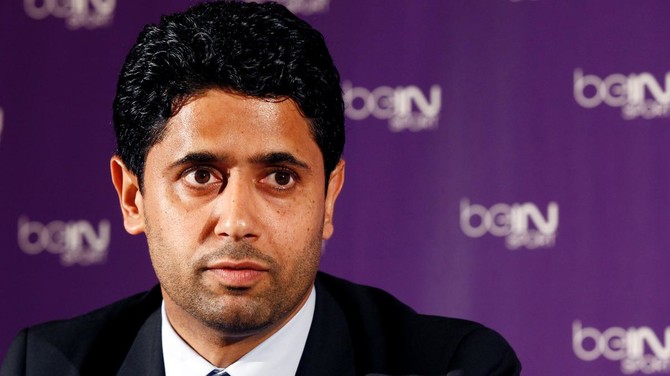
Qatar’s BeIN Sports chief executive Nasser Al-Khelaifi, who is also the president of Paris Saint-Germain, was fined by an Egyptian court on Monday, AFP reported.
The ruling — confirmed by a court on March 12 — comes after BeIN announced on Feb. 20 that it will be broadcasting this year’s Fifa World Cup held in Russia across six of its sports channels, broadcasting live for 14 hours every day of the tournament.
The World Cup is of particular interest in the Middle East this year with four Arab nations; Egypt, Morocco, Tunisia and Saudi Arabia, taking part in the competition for the first time in history.
The fine slapped on BeIN highlights the close scrutiny paid to the granting of lucrative sports media rights in many countries, particularly those with fairly new competition legislation, AFP reported.
According to local press, the Egyptian Competition Authority said BeIN had made Egyptian customers replace their existing satellites in order to access BeIN services during the last African Football Cup held in Gabon.
The authority also raised concerns about the way subscriptions were sold, saying it forced viewers to buy sports bundles which included programming they weren’t interested in watching.
Alex Haffner, partner, sports business group at Fladgate law firm, in London, said that sports media rights often face scrutiny as they can potentially generate huge advertising revenue from advertisers keen to catch the eye of millions of sports fans.
“Competition and other regulatory authorities have historically paid a close interest to sports media rights and, specifically, the way they are tendered, packaged and sold to consumers.
“This is borne of the fact that such rights are typically a powerful medium to reach certain viewers, notably those who are highly prized by advertisers but not always easy to engage with via the medium of broadcast, and therefore tend to have a significant impact on competition in the broadcast markets on which they are exploited,” he said.
It could be additionally challenging where competition law is still in its “infancy,” he said, including Egypt in this category. The North African country introduced its competition law in 2005, but only started fully implementing it in the last few years, said Haffner.
“They have less established precedent to rely on and are more prone to being influenced by external factors. It therefore becomes more difficult to forward plan and map out how those authorities are likely to view particular business practices.
“That said, such ‘newer’ authorities, if treated with due reverence and respect are more likely to be open to closer co-operation and engagement with those they regulate,” he said.
The ruling against BeIN also reflects the wider geopolitical environment, with relations between Qatar and Egypt are already deteriorating due to the continued boycott of Qatar by the Saudi-led coalition of states, which includes Egypt, which began in mid-2017.
The reasons behind the boycott are said to be due to Qatar’s alleged support of terror groups — a claim Qatar denies.
“Egypt-Qatar relations were already very tense,” said Jane Kinninmont, senior research fellow and deputy head, MENA program at Chatham House in London.
“Egypt’s grievances against Qatar include a variety of grievances with Qatari media, primarily Al-Jazeera, so Qatar is likely to see this court case as a politicized decision, whether it is or not.
“However, the boycott has never been absolute. A variety of economic relations have continued, including the presence of Egyptians working in Qatar. This decision may underline the pre-existing tensions but is unlikely to be a game-changer,” she said.
BeIN did not respond to Arab News requests for comment. The Egyptian Competition Authority also did not respond to requests for comment.


![]()
BeIN Sports loses out in Egypt for breach of competition rules
BeIN Sports loses out in Egypt for breach of competition rules


Latest updates




Recommended


© 2026 SAUDI RESEARCH & PUBLISHING COMPANY, All Rights Reserved And subject to Terms of Use Agreement.