3 dead, dozens injured by quake in Osaka in western Japan

1 / 3
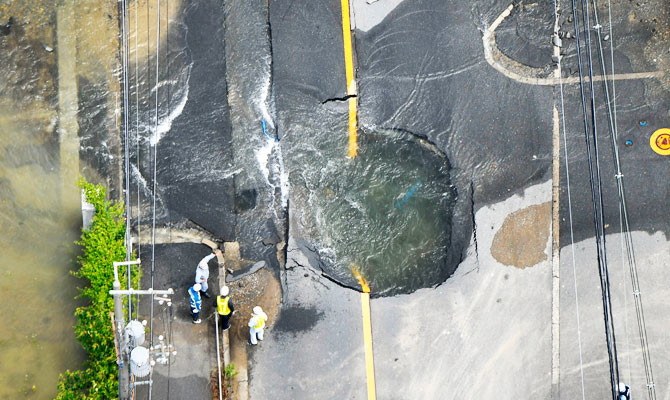
Water floods out from crack in the road, following an earthquake in Takatsuki, Osaka, Monday, June 18, 2018. (AP)
2 / 3
People wait for the resumption of train service which was suspended following an earthquake, at Nijo station, Kyoto, western Japan, on Monday. (AP)
3 / 3
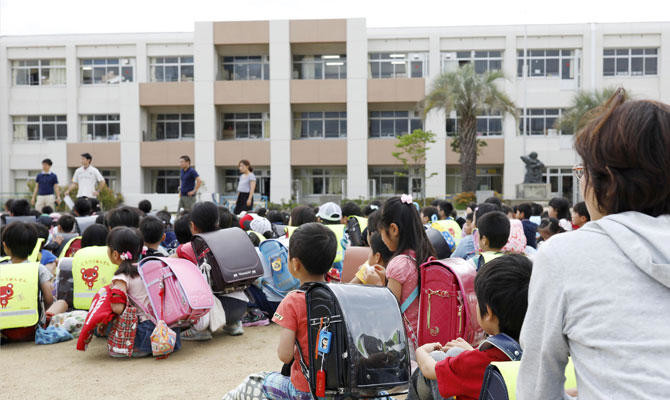
Students sit on a playground after they were evacuated from school building after an earthquake at Ikeda elementary school in Ikeda, Osaka prefecture, western Japan, in this photo taken by Kyodo June 18, 2018. (REUTERS)
Updated 18 June 2018
Follow

3 dead, dozens injured by quake in Osaka in western Japan

  • The tremor caused a blackout for thousands of houses and suspended train operations during the morning commuting hours
  • The quake registered a lower six on the Japanese Shindo scale of up to seven

TOKYO: A magnitude 6.1 earthquake shook Osaka, Japan’s second-biggest metropolis, early on Monday morning, killing three people, halting factory lines in a key industrial area and bursting water mains, government officials and broadcaster NHK said.
No tsunami warning was issued. Prime Minister Shinzo Abe said authorities were assessing damage and that its top priority was the safety of residents.
Live footage showed burst water mains and a house on fire after the quake hit Osaka, which will host next year’s Group of 20 summit, just before 8 a.m. (2300 GMT Sunday) as commuters were heading to work.
The epicenter of the earthquake was just north of Osaka city, said the Japan Meteorological Agency, which originally put the magnitude at 5.9 but later raised it to 6.1.
The quake struck an important industrial area of central Japan. Osaka-based Panasonic said it was halting production at two of its plants — one that produces lighting devices and another for projectors.
Daihatsu Motor Co, a unit of Toyota Motor Corp, said it had suspended production at its factories in Osaka and Kyoto while it checked for damage.
Japanese media including public broadcaster NHK said collapsing walls had killed an 80-year-old man and a 9-year-old girl, and that another man in his 80s was killed after being crushed by a toppling bookcase.
The government confirmed two of the deaths.
“We were sleeping and it woke us up abruptly,” said Kate Kilpatrick, 19, an American who was staying in a hotel in Osaka when the quake hit.
“It was so terrifying because this is my first earthquake. I thought it was a nightmare because I was so confused,” she said. “The whole world was aggressively shaking.”
Kilpatrick, visiting Japan for the first time, said alarms went off almost immediately in the hotel and a loudspeaker told guests to stay away from windows.
Osaka prefecture, which includes the city and surrounding areas, has a population of 8.8 million.
No irregularities were detected at the Mihama, Takahama and Ohi nuclear plants to the north of Osaka, Kansai Electric Power said. More than 170,000 households in Osaka and neighboring Hyogo prefecture lost power temporarily but it was restored within two hours, the utility said.
Sharp Corp. said its directly owned plants in the area were operating as usual, but a joint venture plant with parent Hon Hai Precision Industry said it had halted operations for safety checks.
Honda Motor Co. said production in Suzuka, in nearby Mie prefecture, was halted for checks but no problems were found and operations were back to normal.
A massive magnitude 9.0 quake hit northeastern Japan on March 11, 2011, triggering a huge tsunami that killed some 18,000 people and triggered the world’s worst nuclear disaster in a quarter of a century at Tokyo Electric Power’s Fukushima Daiichi nuclear plant. 


‘I admire Vision 2030’: Bangladesh’s new PM aims for stronger Saudi, GCC ties

Updated 4 sec ago
Follow

‘I admire Vision 2030’: Bangladesh’s new PM aims for stronger Saudi, GCC ties

  • Saudi Arabia congratulates Tarique Rahman on assuming Bangladesh’s top office
  • Relations between Bangladesh and Kingdom were formalized during his father’s rule

DHAKA: After 17 years in exile, Tarique Rahman has taken office as prime minister of Bangladesh, inheriting his parents’ political legacy and facing immediate economic and political challenges.

Rahman led his Bangladesh Nationalist Party to a landslide victory in the Feb. 12 general election, winning an absolute majority with 209 of 300 parliamentary seats and marking the party’s return to power after two decades.

The BNP was founded by his father, former President Ziaur Rahman, a 1971 Liberation War hero. After his assassination in 1981, Rahman’s mother, Khaleda Zia, took over the party’s helm and served two full terms as prime minister — in 1991 and 2001.

Rahman and his cabinet, whose members were sworn in alongside him on Tuesday, take over from an interim administration which governed Bangladesh for 18 months after former premier Sheikh Hasina — the BNP’s archrival who ruled consecutively for 15 years — was toppled in the 2024 student-led uprising.

As he begins his term, the new prime minister’s first tasks will be to rebuild the economy — weakened by uncertainty during the interim administration — and to restore political stability. Relations with the Middle East, particularly Saudi Arabia and other GCC states, are also high on his agenda.

“Saudi Arabia is one of our long-standing friends,” Rahman told Arab News at his office in Dhaka, two days before his historic election win.

“I admire the Saudi Vision 2030, and I am sincerely looking forward to working with the leadership of the Kingdom of Saudi Arabia. BNP always had a great relationship with the Muslim world, especially GCC nations — UAE, Qatar, Bahrain, Kuwait and Oman — and I look forward to working closely with GCC countries and their leadership to build a long-term trusting partnership with mutual interest,” Rahman said.

The Saudi government congratulated him on assuming the top office on Tuesday, wishing prosperity to the Bangladeshi people. 

Bangladesh and Saudi Arabia established formal diplomatic relations in August 1975, and the first Bangladeshi ambassador presented his credentials in late 1976, after Rahman’s father rose to power. That year, Bangladesh also started sending laborers, engineers, doctors, and teachers to work in the Kingdom.

Today, more than 3 million Bangladeshis live and work in Saudi Arabia — the largest expat group in the Kingdom and the biggest Bangladeshi community outside the country.

“I recall that when my father, President Ziaur Rahman, was in office, bilateral relations between our two nations were initiated,” Rahman said. “During the tenure of my mother, the late Begum Khaleda Zia, as prime minister, those relations became even stronger.”

Over the decades, Saudi Arabia has not only emerged as the main destination for Bangladesh’s migrant workers but also one of its largest development and emergency aid donors.

Weeks after Rahman’s mother began her first term as prime minister in 1991, Bangladesh was struck by one of the deadliest tropical cyclones in its history. Riyadh was among the first who offered assistance, and Zia visited Saudi Arabia on her earliest foreign tour and performed Hajj in June 1991.

For Rahman, who had been living in London since 2008 and returned to Bangladesh in December — just days before his mother’s death — the Kingdom will also be one of the first countries he plans to visit.

“I would definitely like to visit Saudi Arabia early in my term,” he said. “Personally, I also wish to visit the holy mosque, Al-Masjid Al-Haram, Makkah, to perform Umrah.”