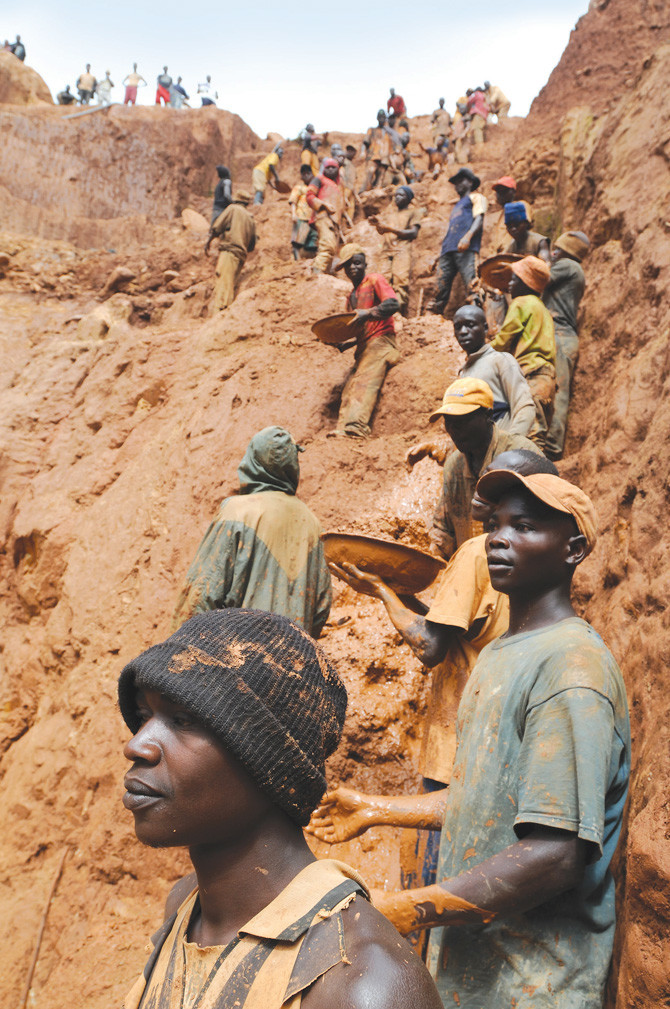

LUBUMBASHI: Feasting on a global demand for cobalt and copper, the mining industry in the Democratic Republic of Congo is flourishing — but two clouds loom over its sunny outlook.
First is the lack of power, which is holding back the development of the minerals processing sector and crimping the country’s ability to reap higher profits from the boom.
DR Congo is Africa’s largest copper producer, and while it is the world’s leading source of cobalt, miners can only export concentrated forms of cobalt at 60-70 percent of the market price because of the energy problem.
“We have an estimated potential of 100,000 MW/year but only produce 3,000 MW/year,” said Michael Shengo, chief of staff for the provincial mining minister for Haut-Katanga earlier this week, as he opened DRC Mining Week, an annual conference in the southeastern town of Lubumbashi.
A massive hydropower project on the River Congo, Inga 3, has the potential to power the entire country and even the continent, but it has been frequently delayed.
Now the project looks to be back on track, thanks to a joint bid by Spanish and Chinese companies: China Three Gorges Corp. and Actividades de Construccion y Servicios SA.
Bruno Kapandji, director of the Agency for the Development and Promotion of the Grand Inga Project, announced the project’s relaunch in front of miners and investors at the conference.
“Our objective is to start the Inga project this year. It could take five to seven years, maybe up to 11 years,” said Kapandji.
Another challenge for the mining industry, which represents 20 to 25 percent of the country’s GDP, is a new fiscal law to raise taxes.
Seven mining companies, known locally as “the G7,” have argued the new code violates terms of the previous version, which provided a 10-year stability clause after any fiscal change. Some of the companies could be preparing for legal action as a result.
One of its most vocal members, Mark Bristow, CEO of gold mining company Randgold Resources, had a warning for other industries operating in the country. “Attracting investment and developing a mining industry is about trust,” he said, “and I see the government is making guarantees to other industries (solar, electricity), and what do they think when they see our guarantees are being taken away?“
Discussing and signing deals is one thing, but implementing and developing them remains an immense challenge.
The World Bank has ranked DR Congo 182nd country out of 190 for doing business, and the French credit insurer Coface rates it at the same level as Libya, Venezuela, Afghanistan and Syria, due to the political uncertainties, corruption and poor governance.
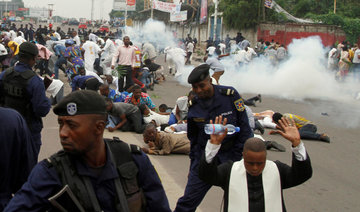
There are glimmers of hope in other sectors in the troubled country, currently in the grips of an Ebola epidemic and a bloody internal conflict.
In the capital Kinshasa, French sports retailer Decathlon has just opened its first store — a gamble in a city of 10 million where many are struggling to pay for essentials such as food and shelter.
Richard Kalinda, a Franco-Congolese, who once said his dream was opening a shop in his home country, said: “I have to reach 0.1 percent of the population. We are marketing for the middle class, people who have a regular income.”
However, Kalinda added they will have to adapt their prices to the country’s average salary.
At the 5th edition of the “French week” organized by the Franco-Congolese Chamber of Commerce, the theme set the tone for those looking to invest in the country: “Securing business, a challenge and a necessity.”
For the chamber of commerce, opening and bringing international capital in DR Congo requires being very well informed.
“Companies often have to confront administrative and procedural challenges that could be called fiscal harassment,” said the French ambassador to DR Congo, Alain Remy in an interview with Mining and Business magazine.
Debt-ridden Gecamines, the state-mining company, announced this week it struck a recapitalization deal with its Anglo-Swiss partner Glencore who agreed on a $150 million payment.
Gecamines had started legal proceedings to dissolve the Kamoto Copper Mine, but Glencore has
reportedly agreed to write off the $5.6 billion debt to safeguard the joint venture.
“We are entering a period for the mining industry that will be profitable for all,” said Yuma, “but only if relations
between foreign investors and the DRC are more equitable. The new code will make that possible, and I call on everyone to conform to it.”