


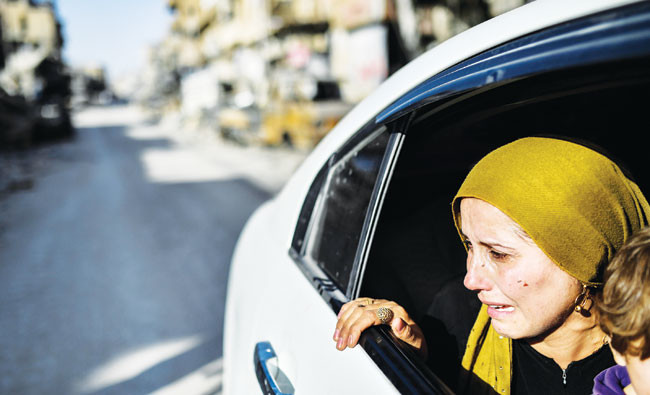
DAMASCUS: Rawan, a 22-year-old medical student at Damascus University, confided in her aunt about her depression, but was shocked at the response.
“You should be ashamed of yourself,” the aunt replied. “A true believer never gets depressed. Don’t speak of this to anyone or they will call you crazy and no one will marry you or even trust you as a physician.”
Like many other Syrians, Rawan decided to keep her depression to herself rather than have her “faith judged and be labeled insane.”
Since the civil war began in 2011, an estimated 400,000 Syrians have been killed and millions more displaced, but the toll the conflict has taken on the mental health of people remains largely unquantifiable.
Even in the relatively liberal and cosmopolitan confines of Damascus, conservative attitudes toward post-traumatic stress disorder (PTSD) and depression hold sway. Few Syrians talk openly about how the bloodshed has affected them psychologically.
This has led to experts both inside and outside Syria warning that the country will face a wide range of social problems — from substance addiction to suicide — for years to come as generations of Syrians struggle to live with the consequences of what they have seen.
Unable to ask her family for help, Rawan’s depression left her convinced that her work as a medical student was pointless.
“Why should I go to college and study hard when I know this war isn’t likely to end soon and there will be no future for me here?” she told Arab News.
Last year, Mazen Hedar, president of the Syrian Association of Psychiatry, told a local newspaper there were only 70 mental health specialists in the country. He claimed 4 percent of the people in Syria suffer from “severe mental illnesses,” while 20-40 percent “suffer from moderate illnesses.”
But with even basic health services left in ruins by the war and fighting still taking place in many areas, the real numbers are impossible to know.
Almost everyone has suffered in some form as a result of what the UN human rights chief Zeid Ra’ad Al-Hussein described as “the worst man-made disaster since World War II” and an “immense tidal wave of bloodshed and atrocity.”
While Damascus has escaped the worst of the violence and much of the city is now relatively safe, people still feel shocked at the way their country has descended into chaos and are anxious about the future.
Layla, a 26-year-old computer engineer based in the city, told Arab News that her family do not trust Syrian health workers.
“Botched surgeries go unpunished and carelessness goes unnoticed — do you think I would trust a psychologist in a culture that still believes he’s a doctor to the crazy and that those with chronic depression, PTSD or schizophrenia belong in a straitjacket? Sorry, no,” she said.
A study of Syrian refugee children in Turkey during late 2012 and early 2013 found that 74 percent “had experienced the death of somebody they cared strongly about.”
The study, conducted by researchers at Bahcesehir University in Turkey, New York University and the Norwegian Institute of Public Health, found 60 percent of children surveyed had symptoms of depression, 45 percent showed signs of PTSD and 65 percent had serious “psychosomatic symptoms.”
Dr. Wael Al-Delaimy of the University of California told Arab News that PTSD can lead to social problems including divorce, unemployment and crime.
He said the level of trauma experienced by people in Damascus could not be compared to the suffering of people elsewhere in the country, where “there is bombing, terrorizing and killing of civilians on a daily basis.”
Al-Delaimy called for Syrian health professionals to adopt a different approach to mental illness, “focusing on prevention and early detection.”


