

Iran ambassador should be summoned ‘every day’ until Zaghari-Ratcliffe released: UK lawmaker

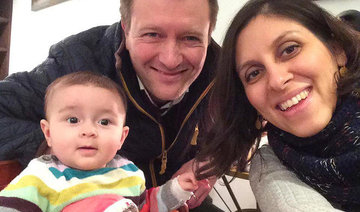
Nazanin Zaghari-Ratcliffe, pictured with her husband Richard, has been in jail for 800 days, having been sentenced to five years after she was accused of spying and plotting to overthrow the Iranian government. (AP Photo)
Updated 12 June 2018
Follow

Iran ambassador should be summoned ‘every day’ until Zaghari-Ratcliffe released: UK lawmaker

  • Foreign secretary should summon Tehran’s diplomat over detention of British-Iranian, says Lord Cormack.
  • Supporters held a vigil Monday outside the Foreign Office in London, lighting 800 candles for every day the 40-year-old charity worker has spent in prison.

LONDON: Iran’s ambassador in London should be made to go to the Foreign Office every day that British-Iranian Nazanin Zaghari-Ratcliffe remains incarcerated, a UK lawmaker said Tuesday.

Zaghari-Ratcliffe has been in jail for 800 days, having been sentenced to five years after she was accused of spying and plotting to overthrow the Iranian government.

Speaking in the House of Lords, the upper house of the UK Parliament, Lord Cormack asked why Foreign Secretary Boris Johnson “does not summon the Iranian ambassador to the Foreign Office every day until Mrs. Zaghari-Ratcliffe is released.”

Zaghari-Ratcliffe has always denied the charges against her and was denied temporary release to celebrate her daughter Gabriella’s fourth birthday on Monday. Instead, Gabriella had to spend her birthday in jail with her mother.

Supporters held a vigil on Monday outside the Foreign Office in London, lighting 800 candles for every day the 40-year-old charity worker has spent in prison.

Responding to Lord Cormack, Lord Ahmad of Wimbledon, a Foreign Office minister, said no opportunity was missed to raise the issue but that Zaghari-Ratcliffe’s continued incarceration was not the ambassador’s decision. “Those calls are made in Tehran,” he said.

“The situation in terms of human rights — and I speak as a human rights minister — is dire, not just for the people of other nationalities or indeed joint nationalities but for Iranians themselves.”

Iran does not recognize the concept of dual nationality — a fact which has caused immense problems for journalists working for the BBC’s Persian service, most of whom also hold dual nationality. This issue was also raised at the House of Lords on Tuesday.

Iranian authorities have launched a criminal investigation into the entire staff of 152 people working for the BBC Persian service, accusing them of crimes against national security.

Tehran has for years allegedly used blackmail and intimidation to harass both the BBC staff and their relatives and associates. The BBC said 20 families of its Persian service staff have received death threats over the past nine years and 86 family members have been called in for questioning by Iranian intelligence agents.

In a video compiled by the BBC, one journalist said her parents’ passports had been canceled, meaning they could not visit her in the UK and another said she was denied permission to see her dying father.

Another female journalist said Iranian agents had threatened to spread rumors about her sex life and disseminate pictures. They had also used the same tactic against men.

The BBC has appealed to the UN to intervene to stop the harassment.

Lord Ahmad on Tuesday told the House of Lords that many BBC staff and their families had suffered hardship because their assets had been frozen.

“We raised the issue before the United Nations Human Rights Council in March and several times with counterparts in the Iranian Foreign Ministry,” he said. “Alastair Burt, minister for Middle East, also raised it on April 29 and we continue to implore upon (sic) the Iranian authorities.”

The subject was introduced into the Lords’ debate on Tuesday by Lord Michael Grade, a former chairman of the BBC.

Twelve million people in Iran listen to the Persian service, which he said was a vital source of impartial news.

The continued targeting of BBC staff was “a very serious state of affairs,” said Lord Grade.

Lord Clarke of Hampstead asked what the British government was doing to ensure the BBC employees under investigation would receive better treatment than Zaghari-Ratcliffe.

Lord Ahmad said that “we are concerned about the charges and wider activities of the Iranian authorities toward the BBC staff and continue to raise it with them.”

The BBC did not respond to a request for comment on the debate.

‘A den of bandits’: Rwanda closes thousands of evangelical churches

Updated 22 December 2025
Follow

‘A den of bandits’: Rwanda closes thousands of evangelical churches

  • A 2018 law introduced new rules on health, safety, and financial disclosures, and requires all preachers to have theological training
  • Observers say the real reason for the closures comes down to control, noting that even those who complied with the law had been shut down 
  • President Kagame has described the church as a relic of the colonial period, a chapter of its history with which the country is still grappling


KIGALI: Grace Room Ministries once filled giant stadiums in Rwanda three times a week before the evangelical organization was shut down in May.
It is one of the 10,000 churches reportedly closed by the government for failing to comply with a 2018 law designed to regulate places of worship.
The law introduced new rules on health, safety, and financial disclosures, and requires all preachers to have theological training.
President Paul Kagame has been vocal in his criticisms of the evangelical churches that have sprouted across the small country in Africa’s Great Lakes region.
“If it were up to me I wouldn’t even reopen a single church,” Kagame told a news briefing last month.
“In all the development challenges we are dealing with, the wars... our country’s survival — what is the role of these churches? Are they also providing jobs? Many are just thieving... some churches are just a den of bandits,” he said.
The vast majority of Rwandans are Christian according to a 2024 census, with many now traveling long and costly distances to find places to pray.
Observers say the real reason for the closures comes down to control.
Kagame’s government is saying “there’s no rival in terms of influence,” Louis Gitinywa, a lawyer and political analyst based in Kigali, told AFP.
The ruling party “bristles when an organization or individual gains influence,” he said, a view also expressed to AFP by an anonymous government official.

‘Deceived’ 

The 2018 law requires churches to submit annual action plans stating how they align with “national values.” All donations must be channelled through registered accounts.
Pastor Sam Rugira, whose two church branches were shut down last year for failing to meet fire safety regulations, said the rules mostly affected new evangelical churches that have “mushroomed” in recent years.
But Kagame has described the church as a relic of the colonial period, a chapter of its history with which the country is still grappling.
“You have been deceived by the colonizers and you let yourself be deceived,” he said in November.
The closure of Grace Room Ministries came as a shock to many across the country.
Pastor Julienne Kabanda, had been drawing massive crowds to the shiny new BK Arena in Kigali when the church’s license was revoked.
The government had cited unauthorized evangelical activities and a failure to submit “annual activity and financial reports.”
AFP was unable to reach Kabanda for comment.

‘Open disdain, disgust’ 

A church leader in Kigali, speaking to AFP on condition of anonymity, said the president’s “open disdain and disgust” for churches “spells tough times ahead.”
“It is unfair that even those that fulfilled all requirements are still closed,” he added.
But some say the clampdown on places of worship is linked to the 1994 Rwandan genocide in which around 800,000 people, mostly ethnic Tutsis, were slaughtered.
Ismael Buchanan a political science lecturer at the National University of Rwanda, told AFP the church could sometimes act as “a conduit of recruitment” for the Democratic Forces for the Liberation of Rwanda (FDLR), the Hutu militia formed in exile in DR Congo by those who committed the genocide.
“I agree religion and faith have played a key role in healing Rwandans from the emotional and psychological wounds after the genocide, but it also makes no sense to have a church every two kilometers instead of hospitals and schools,” he said.
Pastor Rugira meanwhile suggested the government is “regulating what it doesn’t understand.”
It should instead work with churches to weed out “bad apples” and help them meet requirements, especially when it comes to the donations they rely on to survive, he said.