WASHINGTON: The US central bank was due to open a two-day policy meeting Tuesday that markets overwhelmingly expect will produce the second interest rate hike of the year.
But as policymakers seek to hold off inflation in the world’s largest economy, global trade tensions are swirling around the meeting, inflamed by the messy end to last weekend’s contentious Group of Seven summit in Canada.
The potential to disrupt trade and raise prices for key inputs and consumer products will make the already delicate balancing act for Federal Reserve even more difficult.
The vigorous health of American jobs markets has driven unemployment down to levels not seen for 50 years, a time when inflation began an upward course that caused years of pain and took even longer to correct.
Fed policymakers have been gradually raising the benchmark lending rate since December 2015 to keep prices in check without roiling financial markets, and have signaled they will not overreact to a pickup in inflation as long as it is short-lived and only slightly above the two percent goal.
Futures markets on Monday put the odds of a June rate hike at more than 96 percent, bringing the target range for the key rate up a notch to 1.75-2.0 percent.
But the potential for a global trade war adds a major dose of uncertainty to the economic outlook.
US President Donald Trump imposed punishing tariffs on steel and aluminum imports from key suppliers, including G7 partners Canada and Germany, and has threatened even steeper penalties on auto imports.
Higher prices caused by the tariffs also could slow growth of the US economy.
And US trading partners like Canada, Mexico and the European Union have vowed to retaliate against Trump’s aggressive trade actions, and a similar reaction could come from China.
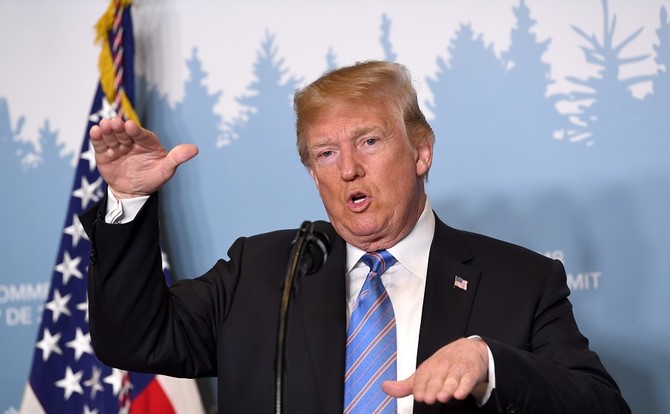
In an unprecedented move, Trump backed out of a joint G7 statement with traditional allies, whom he accused of “robbing” the United States through unfair trade practices, and he lashed out in uncommonly personal terms at Canadian Prime Minister Justin Trudeau.
At their most recent meeting in early May, Fed officials noted the “particularly wide” range of possible outcomes from the trade dispute depending on how Washington and other economies behaved.
But in the meanwhile, “the uncertainty surrounding trade issues could damp business sentiment and spending,” according to the Fed meeting minutes.
Joseph Gagnon, senior fellow at the Peterson Institute for International Economics, said a major trade war involving big-ticket import items like autos could reduce economic potential and lead to job losses.
“That will be like a supply shock where you get more inflation and less growth and the Fed probably won’t know what to do,” he said.
And this would come at a time when inflation risks are rising, including higher oil prices, sweeping tax cuts, and a weaker US dollar.
As a result, economists say a fourth-rate hike in December is increasingly likely.
And while the relationship between low unemployment and rising inflation is less direct than 50 years ago — wages have shown only sluggish growth in recent years — the painful memory of the 1970s is hard to ignore.
“That slippery slope may or may not be there but nobody knows,” said John Ryding, chief economist at RDQ Economics. “So it’s only natural that the Fed continues to take out insurance” in the form of rate hikes, he added.


Trade tensions swirl as US Fed opens policy meeting
Trade tensions swirl as US Fed opens policy meeting

- The potential to disrupt trade and raise prices for key inputs and consumer products will make the already delicate balancing act for Federal Reserve even more difficult
- US trading partners like Canada, Mexico and the European Union have vowed to retaliate against Trump’s aggressive trade actions, and a similar reaction could come from China


New Saudi draft project to regulate direct market entry of listed companies’ subsidiaries
RIYADH: The Saudi Capital Market Authority has launched a draft regulation for the direct listing of subsidiaries of companies already listed on the main market, inviting stakeholders to provide feedback over a 30-day period, according to a statement issued today.
The proposed framework aims to allow subsidiaries of main-market companies to list their shares directly on the main market without undergoing an initial public offering, thereby shortening timelines, streamlining procedures, and reducing the costs associated with listing on the Saudi stock market.
It also seeks to create more investment opportunities in the Saudi financial market, contributing to market depth and product diversification, while maintaining high levels of transparency and protecting investors’ rights.
The proposals enable the issuer and its financial advisor to share information about the company and its financial statements with a select group of potential investors before obtaining CMA approval for the share registration request, allowing them to assess their interest in a direct listing on the main market.
They also allow a specific group of licensed financial advisory firms to prepare research and financial reports, provided these are not published before CMA approval.
The proposed framework emphasizes the importance of proper disclosure by setting out requirements for registering shares on the main market, including submitting a registration document to the CMA.
It also specifies the information that must be included in the registration document, such as the method for determining the reference share price and the risks associated with this method.
Under the draft regulation, securities offering rules, ongoing obligations, and the CMA’s glossary of terms and regulations will be updated to allow this type of listing.
This approach is expected to bring multiple benefits, including maximizing the overall value of the main market with lower risk by listing companies that have greater knowledge and experience of market regulations, as well as deepening the market by increasing the number of listed companies across multiple sectors.


