

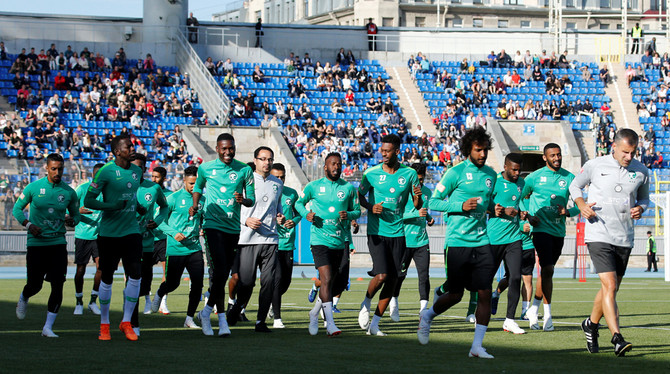

MOSCOW: For Muslims around the world, Thursday is expected to be the last day of Ramadan, yet for players of Saudi Arabia’s national team, the date takes on added significance. The Green Falcons will kick off the World Cup against hosts Russia in front of 80,000 fans in Moscow, watched by an estimated 200 million TV viewers worldwide. It is the country’s first appearance at football’s grandest showpiece since 2006.
Yet while the coming of Eid will be a day of celebration across the Muslim world regardless of the result at Luzhniki Stadium, for Saudi Arabia and the other six majority-Muslim nations competing at the tournament, their preparations this past month have proved challenging. Players, staff and coaches have had to find a balance between the religious obligations associated with Ramadan and the high-intensity training required to arrive at the pinnacle of their careers in peak condition.
With the holy month obligating Muslims to abstain from eating and drinking between daylight hours, teams have had to be creative in their approach to training and friendly matches.
Hector Cuper, the Argentinian coach in charge of Egypt’s national team, last month aired concerns about his team fasting, saying he was “afraid that it could badly affect the players at the World Cup.” His concerns are justified.
A 2007 study by the British Journal of Sports Medicine found that players’ performances “declined significantly for speed, agility, dribbling and endurance” while fasting. In addition, the “shift of food intake and disruption of sleep patterns affect actual and perceived physical performance.” Yet, as Algeria showed at the 2014 World Cup when they reached the knock-out stages despite the entire squad fasting, sometimes it can actually raise levels of performance. 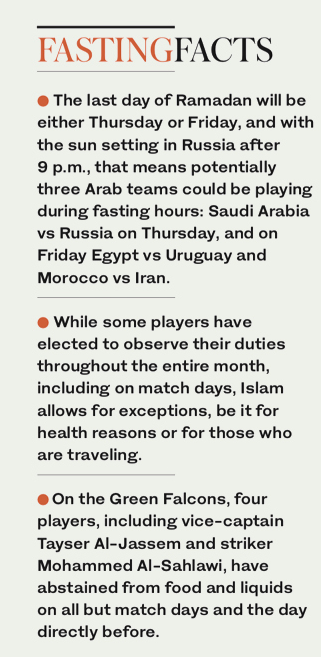
Egyptian team manager Ehab Leheta insists his players are trusted to make their own decision as to whether to fast or not. While some have elected to observe their duties throughout the entire month, even match days, Islam allows for exceptions, either for health reasons or for those who are traveling.
“It’s a very important issue,” said Leheta, who added everything is being done to ensure the holy month and the weeks thereafter go as smoothly as possible for the Egyptian team. “We’ve been planning it since the start of year. We have a nutritional program courtesy of a guy from England who we have brought on board. He has brought great value to the team, starting in Zurich (at our training camp in March) and will continue until the end of the World Cup.”
Mohamed Salah, the Egyptian forward who plays his domestic football with Liverpool in England, elected to break his fast last month after travelling to Kiev for the Uefa Champions League final. However, other players — including those in the Tunisia national team — have fasted the entire month, including during days in which they played World Cup warm-up matches. Ingenuity is required.
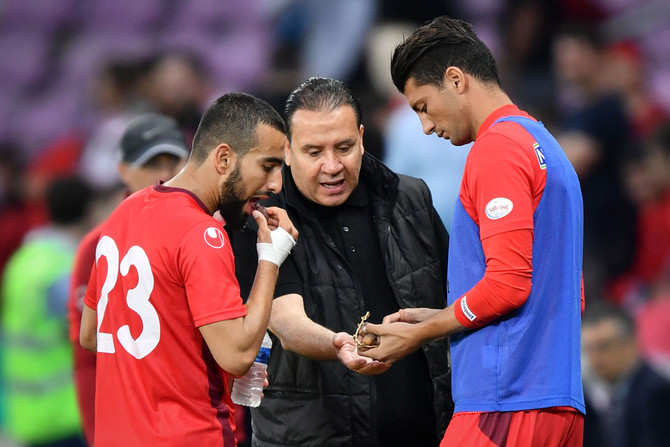
Against Portugal and later Turkey, Tunisia’s goalkeeper Mouez Hassen appeared to feign injury when the sun set, lying down on the pitch to receive medical treatment. With the referee immediately calling a halt to the game, Hassen’s teammates were able to rush to the sidelines to quickly drink water and eat dates. The fast-breaking maneuver seemed to work — against Portugal, Tunisia rallied to draw 2-2, while they also tied 2-2 against Turkey. Their opening game at the World Cup is not scheduled until next Monday, by which time Ramadan will be over.
Midfielder Wahbi Kazri conceded fasting has made Tunisia’s preparations tougher than usual. “It is very difficult,” the 27-year-old told Spanish newspaper Marca. “We cannot eat or drink. It is very complicated to prepare as we want.”
The majority of the Saudi Arabia team and staff have delayed their fast until after the tournament. No more than seven of the 20 Muslim staff are fasting, while four players, including vice-captain Tayser Al-Jassem and striker Mohammed Al-Sahlawi, have abstained from food and liquids on all but match days and the day directly before. Since Friday night’s 2-1 defeat to world champions Germany, however, even the quartet have elected to delay in order to be in peak condition for Thursday’s curtain-raiser.
“When you travel, you can delay the fast — you are not obligated,” Omar Bakhashwain, the Saudi team manager, said recently. “We have played during Ramadan before, it is not a problem. Our qualification was during Ramadan — when we played Japan and Australia — so we know how to deal with it. Also, our league in Saudi has been played throughout the holy month. We can manage these things.”
Mohammed Abdul-Fatah, the Saudi team chef, has worked with various age groups at the country’s football federation for more than a decade. Although the players’ hunger means they desire high-fat foods such as fried potatoes, Abdul-Fatah sticks to staples such as lamb, fish and pasta with boiled potatoes. Occasionally he makes saleeg, the traditional Saudi plate of chicken, served on a bed of white rice, cooked in a milk broth.
 The Saudi delegation arrived on Saturday at their World Cup base in Saint Petersburg, where they will be stationed throughout the tournament. They will fly by private jet to each of their three games, in Moscow, Rostov and Volgograd. Yet while day-length in Riyadh this week is around 13 hours and 38 minutes, St Petersburg is celebrating “White Nights”, a month-long festival in which the sun barely sets. Today’s official day-length is recorded at 18 hours 41 minutes, although the sky remains off-white at 3 a.m.
If it sounds like Russia’s second-largest city might be one of the worst places on earth to be based during fasting hours, it should be noted the city is home to a sizeable Muslim population. There are a reported 20 million Muslims living in Russia and 50,000 sites of Islamic worship, but most pale in comparison to the St Petersburg Mosque, the largest in Europe when it opened its doors in 1921.
A grand building cast in turquoise and located a short walk from the famous Peter and Paul Fortress, it is a hive of activity during the holy month. During Ramadan last year, it welcomed between 1,500 and 2,000 Muslims for iftar each night. Players from Saudi Arabia, Morocco, Iran and
Nigeria are all expected to visit during their time in the city.
“For us, fasting is never a problem, no matter how many hours per day are required,” said Shagimardanov Idar, president of the Association of Muslim Businessmen in Russia. “Muslims who fast don’t have discomfort with this.”
During last year’s Confederations Cup, Idar and the businessmen’s association invited Fifa for iftar, calling it a “big privilege” that secretary general Fatma Samoura — a Senegalese Muslim — attended. He said he expects around 100,000 Muslim fans to visit Russia this month and intends to host an event later this week.
“It will be a nice day or two when Ramadan and the World Cup coincide,” Idar added. “We will organize a special iftar on these days.”


