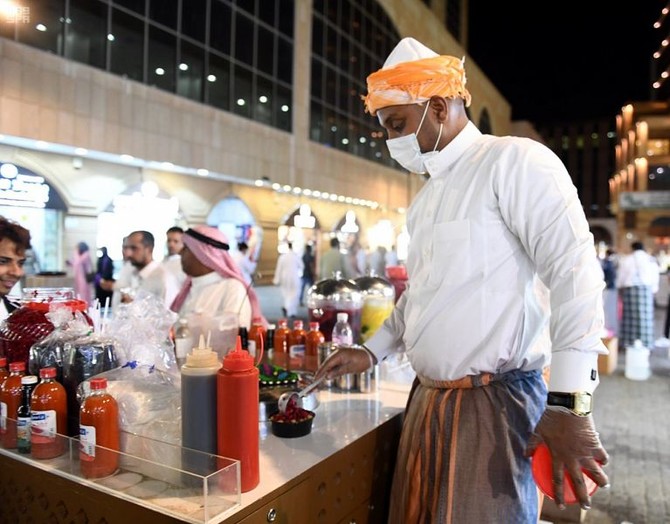
Traditional food stalls attract people of Jeddah during Ramadan

1 / 3
Photo showing a street food stall in Jeddah. (SPA)
2 / 3
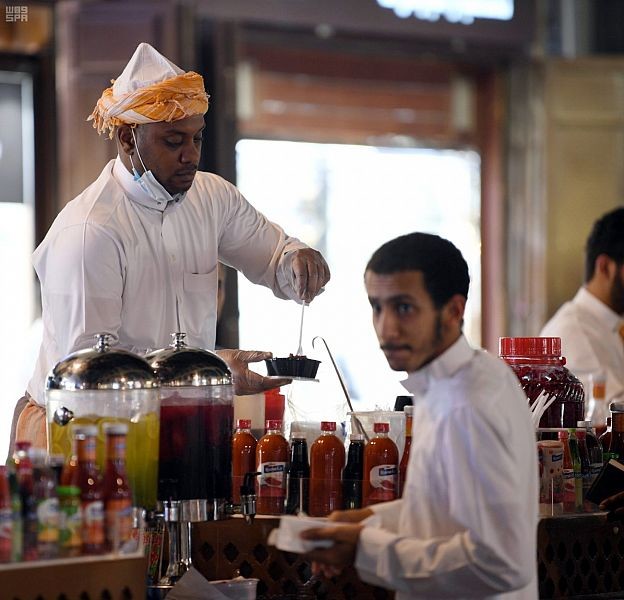
Photo showing a street food stall in Jeddah. (SPA)
3 / 3
Updated 10 June 2018
Follow

Traditional food stalls attract people of Jeddah during Ramadan

JEDDAH: Seasonal food stalls or kiosks, commonly known as Bastas, are among Jeddah’s most popular features during Ramadan.
Makeshift stalls decorated with Hijazi-style designs are set ahead of Ramadan to attract the people of Jeddah, with crowds turning out for a taste of traditional Hejazi food during the holy month nights.
A series of pictures captured by the Saudi Press Agency showed people as they flocked to these Bastas before Iftar, to buy food, and keep up with an old tradition, passed from one generation to the other.
They serve various traditional foods, drinks and desserts from Jeddah, among them are Luqaimat or sweet dumplings, pancake-like Qatayef, Samosas, rice, biscuits, custard and various forms of Kunafa.
For the drinks, they offer Sobia, Tamr Hindi, and magneta colored karkadé, made from Hibiscus tea. Different types of foul or fave beans are on the menu prepared according to Hijazi traditions.


Saudi project clears 2,676 explosive devices in Yemen

Updated 22 February 2026
Follow

Saudi project clears 2,676 explosive devices in Yemen

  • Ousama Al-Gosaibi, Project Masam’s managing director, said the initiative had cleared a total of 544,187 mines since it began in 2018

RIYADH: Members of Saudi Arabia’s Project Masam removed 2,108 explosive devices from various regions of Yemen last week.

The total included 2,484 unexploded ordnances, 149 anti-tank mines, 17 anti-personnel mines and 26 improvised explosive devices, according to a recent report.

The explosives were planted indiscriminately and posed a threat to civilians, including children, women and the elderly.

The demining operations took place in Marib, Aden, Jouf, Shabwa, Taiz, Hodeidah, Lahij, Sanaa, Al-Bayda, Al-Dhale and Saada.

Ousama Al-Gosaibi, Project Masam’s managing director, said the initiative had cleared a total of 544,187 mines since it began in 2018.

Teams are tasked with clearing villages, roads and schools to facilitate the safe movement of civilians and delivery of humanitarian aid.

The project trains local demining engineers, provides them with modern equipment, and offers support to Yemenis injured by the devices.