Frustrated Afghans in a long march for peace

1 / 4
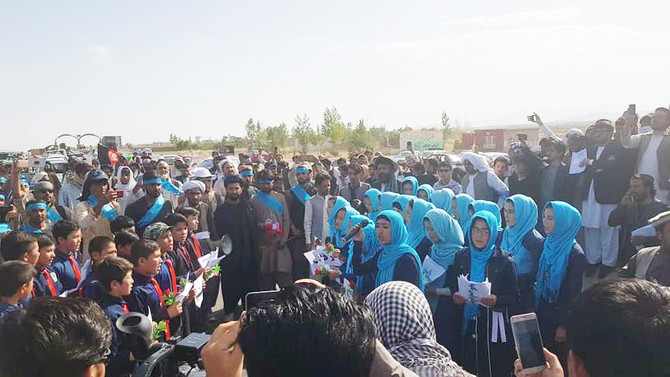
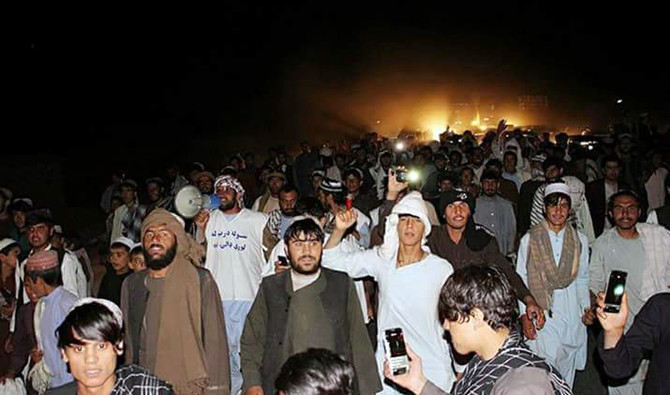
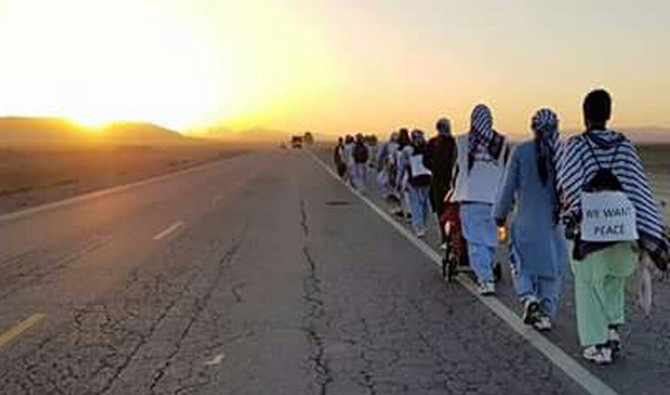
The “convoy of peace” was conceived in March by villagers in the southern Helmand province. (Photo courtesy: Iqbal Khaibar, an organizer of the march)
2 / 4
The “convoy of peace” was conceived in March by villagers in the southern Helmand province. (Photo courtesy: Iqbal Khaibar, an organizer of the march)
3 / 4
The “convoy of peace” was conceived in March by villagers in the southern Helmand province. (Photo courtesy: Iqbal Khaibar, an organizer of the march)
4 / 4
The “convoy of peace” was conceived in March by villagers in the southern Helmand province. (Photo courtesy: Iqbal Khaibar, an organizer of the march)
Updated 10 June 2018
Follow

Frustrated Afghans in a long march for peace

  • For weeks, a growing group has walked from Helmand to neighboring provinces to mobilize public pressure on the government and the Taliban to end the war. 
  • The group plans to march to Kabul to pass on a proposal to the government, the UN and the US-led coalition. Most of the marchers have lost at least one family member to the war.   

KABUL: Under blistering sun, a group of fasting Afghans has been marching for peace for nearly a month, mobilizing people in villages and towns.

The “Convoy of Peace” was conceived in March by villagers in southern Helmand province, after more than a dozen people were killed when an explosives-laden vehicle went off during a wrestling match as part of Afghan new-year celebrations.

The villagers walked for nearly 200 km to talk with government commanders and Taliban members to agree to a truce.

When their message fell on deaf ears, they set up a sit-in tent, then began a nationwide march at the start of Ramadan. 

Braving the heat and attacks, the group has marched from Helmand to the adjacent provinces of Kandahar, Zabul and Ghazni.

The route is part of a Taliban stronghold, and witnesses routine clashes between it and US-backed Afghan forces.

The marchers “have been welcomed by villagers who give them food, shelter and medical care,” Roozi Mohammad Zabuli, a coordinator of civil society groups in Zabul, told Arab News.

“They’re telling the people that peace is in the hands of ordinary people, and that they can achieve it by putting pressure on the warring sides. People are exhausted here and thirsty for peace, and have hailed the initiative.” 

The march began with seven people but now includes 50. One is a sports champion, another has a master’s degree, and two are physically disabled.

Sardar Mohammad re-joined the march after leaving to attend the funeral of his brother, who was killed in an attack in Kandahar. Most of the marchers have lost at least one family member to the war.

Hamidullah Tokhi, a lawmaker from Zabul, said the group prefers to avoid engaging with local authorities because it does not want to be seen to be favoring one side.

“It’s a big initiative. People are happy. You’ll see a gradual but concrete impact on the minds of people that they have to take charge of their own destiny rather than wait for others to bring them peace,” he told Arab News.

“We can call it the start of a revolution. Revolutions always begin with a small number of people and ambitious goals. They have the determination and will to work for peace.”

Government officials and the Taliban endorse the march, saying they will support any move than can bring security to Afghanistan.

The marchers plan to head to Kabul to pass on a proposal to the government, the UN and the US-led coalition for a cease-fire, the establishment of an Islamic government that includes the Taliban, and a timetable for the withdrawal of foreign forces.

“If the two sides don’t accept our demands, we’ll go to other provinces and tell people to join us and mount pressure on who’s at fault,” Iqbal Khaibar, an organizer of the march, told Arab News.

In Kabul, “we’ll be telling the international community humbly: ‘We’re human just like you. All our mothers are mourning here every day. Do your mothers and your blood differ from ours? Let us have peace’,” he added.

Zabuli said: “When there’s national pressure, foreign troops will pull out. We just need to give people the mentality that they have to stand and take charge of their lives and stop the war.”

Khaibar said: “The Taliban says foreign troops should leave then it’ll talk with the government, while foreign troops say there should be peace then they’ll leave. We have to find a solution to this, and that’s exactly what the marchers are after.”


Maduro’s fall tests Venezuela’s ruling ‘club’

Updated 5 sec ago
Follow

Maduro’s fall tests Venezuela’s ruling ‘club’

  • The ousting of Nicolas Maduro as Venezuela’s president puts to the test his “Chavista” factions that have governed the oil-rich nation for 27 years
CARACAS: The ousting of Nicolas Maduro as Venezuela’s president puts to the test his “Chavista” factions that have governed the oil-rich nation for 27 years.
What happens to the so-called “club of five” powerful leftist figures, now that two of its most important members — Maduro and his wife Cilia Flores — have been captured and sent to the United States to face trial?

’Club of five’
Anointed by his mentor Hugo Chavez before the latter’s death in 2013, Maduro kept a tight grip on power until his capture by US forces on Saturday.
Maduro ruled alongside Flores and three other powerful figures: former vice president Delcy Rodriguez — now Venezuela’s interim leader — her brother Jorge, and their rival: hard-line Interior Minister Diosdado Cabello.
“It’s like a club of five,” a diplomatic source in Caracas told AFP under the condition of anonymity.
“They can speak, they have a voice in the government, but Maduro was the one who kept the balance. Now that he’s gone, who knows?“
Maduro and ‘Super Cilita’
The image of Maduro handcuffed and blindfolded as US forces transported him to New York to face trial made headlines around the world.
During months in the crosshairs of US President Donald Trump, who accused him of being a drug trafficker, the 63-year-old former bus driver deflected pressure by dancing to techno music at near-daily rallies, always broadcast live, as he chanted the mantra “No war, yes peace!” — in English.
Frequently underestimated, Maduro managed to eliminate internal resistance and keep the opposition at bay.
Murals, songs and films celebrated him, as did the animated cartoon “Super Moustache,” in which he appeared as a superhero, fighting imperialism alongside “Super Cilita,” who is based on Flores.
Toy figurines of both characters were also produced.
The military swore absolute loyalty to him, led by Defense Minister Vladimir Padrino Lopez.
Though defiant at first and calling for Maduro’s return, Venezuela’s interim leader Rodriguez called for a “balanced and respectful relationship” between the South American country and the United States on Sunday.
“The top level of government has survival as its absolute priority,” Antulio Rosales, political scientist and professor at York University in Canada, told AFP.
The Rodriguez siblings
Rodriguez controlled the economy and the oil industry as vice president while her brother Jorge is the speaker of parliament.
They are known for their incendiary rhetoric, often mixing belligerence, irony and insults against the “enemies of the fatherland.”
But behind the scenes, they are skilled political operators.
Jorge Rodriguez was the chief negotiator with the opposition and the United States, and his sister represented Maduro in various international forums.
Experts also attribute purges within government to them, such as one that sent Tareck El Aissami, a powerful oil minister until 2023, to prison.
Rodriguez took over his post shortly afterwards.
The feared policeman
Diosdado Cabello meanwhile is widely feared in Venezuela. Under his ministry, some 2,400 people were detained during protests that followed Maduro’s disputed re-election in 2024, in a move that cowed the opposition.
Cabello is seen as representing the most radical wing of “Chavismo,” and some see him at odds with the pragmatism of the Rodriguez pair, though both sides have denied this.
Cabello acted as president for a few hours when Chavez was overthrown for two days in 2002.
He accompanied Chavez in a failed coup attempt in 1992. Today he is number two in the Socialist Party behind Maduro.
The US courts have now named Cabello among those wanted for trial alongside Maduro.
They have offered $25 million for his capture.
Having kept a low profile in the hours after Maduro’s capture, he appeared by Rodriguez’s side at her first cabinet meeting as acting president on Sunday.