Land reform is not a threat, South Africa’s Ramaphosa tells white Afrikaners

A group of men prepare a recently pegged-out plot in an open piece of land next to the makeshift illegally established and informal settlement in Khayelitsha, about 35km from the center of Cape Town, on May 17, 2018. (AFP / RODGER BOSCH)
Updated 08 June 2018
Follow

Land reform is not a threat, South Africa’s Ramaphosa tells white Afrikaners

  • Ramaphosa, who replaced scandal-plagued Jacob Zuma in February, has promised to redistribute land to the black majority to address the deep racial inequality that persists more than two decades after the end of apartheid.
  • Ramaphosa, who played a key role in the negotiations that led to the end of white minority rule in 1994, on Thursday urged Afrikaners to approach land reform in the same spirit as the transition to democracy.

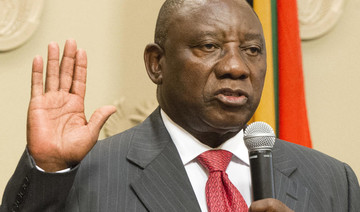
CAPE TOWN: South African President Cyril Ramaphosa told the white Afrikaner community on Thursday that it should not view his government’s land reform plans as a threat, but as a way to harness the country’s economic potential and heal divisions from the past.
Ramaphosa, who replaced scandal-plagued Jacob Zuma in February, has promised to redistribute land to the black majority to address the deep racial inequality that persists more than two decades after the end of apartheid.
He has been at pains to dispel fears among some white South Africans that they could face violent land seizures if the government’s land reform program is bungled.
“Tonight I want to say to all of you: Let us not see the issue of land as a reason to pack up and go,” Ramaphosa told a gathering of the Afrikanerbond, an organization founded 100 years ago to defend the interests of the descendants of mainly Dutch settlers.
“It is an opportunity to build a more just and equitable society that makes full and effective use of the resources we have,” Ramaphosa said, peppering his speech with phrases in Afrikaans, Afrikaners’ mother tongue.
Ramaphosa has embarked on a charm offensive ahead of next year’s national election as he seeks to restore confidence in the ruling African National Congress (ANC) and kick-start economic growth after a decade marred by corruption and mismanagement.
The ANC has faced criticism that its land policies could erode property rights and deter investment, even though privately owned land is not expected to be expropriated until after the election.
Ramaphosa, who played a key role in the negotiations that led to the end of white minority rule in 1994, on Thursday urged Afrikaners to approach land reform in the same spirit as the transition to democracy.
“You are Africans, and we must accept that,” he said, ending his speech to applause from the crowd. “Afrikaners are as integral to the South African nation as any other community that we have.” 


Moderate candidate wins emphatically over a populist in Portugal’s presidential runoff

Updated 5 sec ago
Follow

Moderate candidate wins emphatically over a populist in Portugal’s presidential runoff

LISBON: Center-left Socialist candidate António José Seguro recorded a thumping victory over hard-right populist André Ventura in Portugal’s runoff presidential election Sunday, according to official results with 99 percent of votes counted.
Seguro won a five-year term in Lisbon’s riverside “pink palace” with 66.7 percent of votes, compared with 33.3 percent for Ventura.
The ballot was an opportunity to test the depth of support for Ventura’s brash style, which has struck a chord with voters and helped make his Chega (Enough) party the second-biggest in the Portuguese parliament, as well as gauge the public appetite for Europe’s increasing shift to the right in recent years.
European Commission President Ursula von der Leyen congratulated Seguro and said on social media that “Portugal’s voice for our shared European values remains strong.”
Seguro, a longstanding Socialist politician, positioned himself as a moderate candidate who will cooperate with Portugal’s center-right minority government, repudiating Ventura’s anti-establishment and anti-immigrant tirades.
He won the backing of other mainstream politicians on the left and right who want to halt the rising populist tide.
In Portugal, the president is largely a figurehead with no executive power. Traditionally, the head of state stands above the political fray, mediating disputes and defusing tensions.
However, the president is an influential voice and possesses some powerful tools, being able to veto legislation from parliament, although the veto can be overturned. The head of state also possesses what in Portuguese political jargon is called an “atomic bomb,” the power to dissolve parliament and call early elections.
In May, Portugal held its third general election in three years in the country’s worst bout of political instability for decades, and steadying the ship is a key challenge for the next president.
Ventura, an eloquent and theatrical politician, rejected political accommodation in favor of a more combative stance.
Ventura said he will keep working to bring about a political “transformation” in Portugal.
“I tried to show there’s a different way … that we needed a different kind of president,” he told reporters.
Making it through to the runoff was already a milestone for Ventura and his party, which have recalibrated Portuguese politics.
One of Ventura’s main targets has been what he calls excessive immigration, as foreign workers have become more conspicuous in Portugal in recent years.
“Portugal is ours,” he said.
During the campaign, Ventura put up billboards across the country saying, “This isn’t Bangladesh” and “Immigrants shouldn’t be allowed to live on welfare.”
Although he founded his party less than seven years ago, its surge in public support made it the second-largest party in Portugal’s parliament in the May 18 general election.
Seguro will next month replace center-right President Marcelo Rebelo de Sousa, who has served the constitutional limit of two five-year terms.