

Turkey halts filling Tigris dam after Iraq complains of water shortages

1 / 2
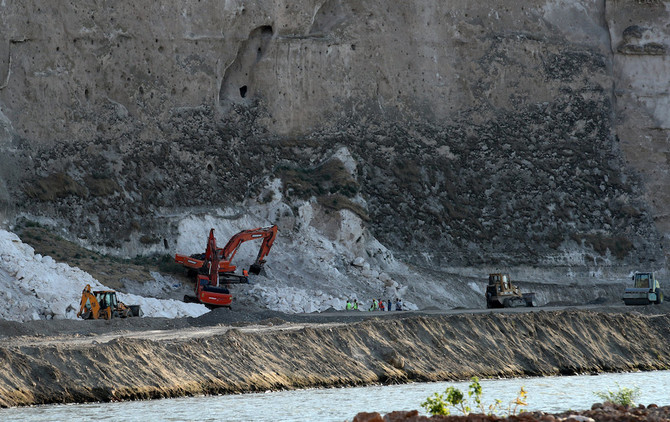
File photo showing the Tigris river flows through the ancient town of Hasankeyf, which will be submerged by the Ilisu dam in southeastern Turkey, September 27, 2017. (Reuters)
2 / 2
File photo showing on going construction work on the Ilisu dam in southeastern Turkey, September 27, 2017. (Reuters)
Updated 07 June 2018
Follow

Turkey halts filling Tigris dam after Iraq complains of water shortages

  • Turkey has been heavily criticized over its water policies and their impact on the environment as thousands of villages were submerged among them a 12,000-year-old town
  • Around 70 percent of Iraq’s water resources flow from neighboring countries, especially in the Tigris and the Euphrates rivers which run through Turkey.

ANKARA/BAGHDAD: Turkey has temporarily stopped filling a huge dam on the Tigris River after complaints from neighboring Iraq, which is suffering water shortages, officials said on Thursday.
Turkey’s ambassador to Baghdad and Iraq’s water minister also said that the two countries had agreed that when Ankara resumes filling the Ilisu dam in July it will still allow sufficient water to flow into Iraq.
The dam, more than 20 years in the making, will generate electricity for a large area of southeast Turkey. But it has been heavily criticized over its impact on the environment and on the tens of thousands of villagers who will be displaced. Its waters will also submerge a 12,000-year-old town.
Turkey started filling the Ilisu dam last week, prompting deep concern over water shortages in Iraq. Ankara had already delayed the planned start by three months at the request of its southern neighbor.
Turkey’s ambassador to Iraq, Fatih Yildiz, said on Twitter that Turkey stopped filling the dam on President Tayyip Erdogan’s orders to address Iraq’s worries.
“As of this moment, Tigris waters are being transferred to Iraq without touching a drop of it in Ilisu,” Yildiz said. “With the second decision to postpone, we have shown once again that we can put our neighbor’s needs ahead of our own.”
The filling will resume on July 1, he said, adding that water will still flow into Iraq in accordance with agreements between the two countries.

“GIGANTIC PROJECT“
Iraq’s Minister of Water Resources Hassan Al-Janabi said Iraq had asked for the postponement and that the two countries had agreed on a way to fill it while still allowing adequate water supplies to Iraq.
“We asked them to postpone until the end of June. Turkey agreed and we were very happy,” he told a news conference in Baghdad. “The way the dam gets filled is very important...and we found a filling method that guarantees Iraq’s interests.”
Around 70 percent of Iraq’s water resources flow from neighboring countries, especially in the Tigris and the Euphrates rivers which run through Turkey.
The dam, which first got Turkish government approval in 1997, is a key part of Turkey’s Southeastern Anatolia Project, designed to improve its poorest and least developed region.
But Western export credit insurers quit the project saying it did not meet international standards on the environment and preservation of cultural heritage. The government later secured credit from three local banks to continue construction.
Erdogan said in an election rally two weeks ago that the 9 billion lira ($2.00 billion) dam, which he described as a “truly gigantic project” would start generating electricity next year.
Once it is filled, Ilisu will completely or partially flood 199 villages and the 12,000 year-old town of Hasankeyf, which is home to 78,000 people, according a report from a campaign group, The Initiative to Keep Hasankeyf Alive.
Hasankeyf was used by the Romans as a fortress to ward off Persians. The town was later destroyed by Mongols and rebuilt in the 11th century by Seljuk Turks. Some of the ancient structures have been moved to a nearby area.
($1 = 4.4950 liras) (Reporting by Tulay Karadeniz Writing by Ali Kucukgocmen Editing by Dominic Evans and Andrew Heavens)


Aoun slams ‘systematic policy of aggression’ as Israeli strikes kill 2, wound journalists in south Lebanon escalation

Updated 4 sec ago
Follow

Aoun slams ‘systematic policy of aggression’ as Israeli strikes kill 2, wound journalists in south Lebanon escalation

  • Lebanese Army: Attacks terrorize civilians and hinder weapons control plan
  • Israeli army spokesperson said military eliminated Abu Ali Salameh, who served as a Hezbollah liaison officer in the area
  • Israeli drones targeted sites with heavy airstrikes, wounding journalists in Qanarit and destroying their equipment, cameras and vehicles

BEIRUT: Two people were killed and several journalists wounded in a series of Israeli attacks on Wednesday targeting southern areas, most of which lie north of the Litani River.

The Lebanese Army Command described the escalation as “impeding the army’s efforts and hindering the completion of its plan to confine weapons to Lebanese territory.” It said that the strikes terrorized civilians, caused deaths and injuries, displaced dozens of families and undermined regional stability.

The day’s security situation was dominated by hours of Israeli escalation, including airstrikes and evacuation warnings targeting villages and populated areas ahead of further bombardment.

The Israeli army said that warplanes carried out precision strikes on civilian vehicles in Bazouriyeh, killing a Hezbollah member. A separate drone strike hit a civilian vehicle on the Zahrani-Mseileh road, killing one person, with Israel claiming the target was another Hezbollah operative.

Israeli army spokesman Avichai Adraee said that the military “eliminated Abu Ali Salameh, who served as a Hezbollah liaison officer” in the village of Yanouh, in southern Lebanon. He accused Salameh of managing Hezbollah activities to “enable the group to operate within civilian areas and on private property, and to establish terrorist infrastructure in the heart of populated civilian areas, through the deliberate and cynical exploitation of the residents to serve Hezbollah’s objectives.”

Adraee claimed that on Dec. 13, Israel alerted Lebanon’s enforcement mechanism about a Hezbollah weapons depot in Yanouh. Salameh allegedly relayed the notification to other Hezbollah members, who then blocked Lebanese army access by staging a gathering while removing weapons from the site.

He said that Salameh also coordinated with the Lebanese army to falsely document the property as weapons-free, even as “suspicious boxes” were removed via a back entrance. Adraee called these actions a violation of Israel-Lebanon understandings, adding that “the Israeli army will continue to take measures to eliminate all threats.”

Israeli artillery also shelled the Harmoun area in the Bint Jbeil district, south of the Litani River, prompting Israeli army warnings — complete with maps — for residents of Qanarit, Kfour in Nabatieh and Jarjouh to evacuate immediately.

Israeli drones then hammered the sites with heavy airstrikes, wounding journalists in Qanarit and destroying their equipment, cameras and vehicles.

The Press Photographers Syndicate said: “Israeli claims of maintaining safe distances offer no protection, just as the warnings issued by the enemy to civilians offer no protection. It seems that cameras are not a red line.”

The statement urged photojournalists “to exercise caution and avoid turning their professional commitment into a reckless gamble.” 

Civilians in the targeted areas reported receiving phone calls from Israel ordering them to clear squares, residential neighborhoods and a mosque.

The Lebanese Army Command confirmed that “Israeli attacks and violations targeted civilian buildings and homes in several areas, most recently in villages in the south, in a blatant violation of Lebanon’s sovereignty and security, the cessation of hostilities agreement, and UN Security Council Resolution 1701.”

Lebanese President Joseph Aoun issued a statement on Wednesday evening condemning the strikes and accused Tel Aviv of “pursuing a systematic policy of aggression” that targeted civilians and violated international humanitarian law, and constituted “a dangerous escalation.”

“This repeated aggressive behavior proves Israel’s refusal to abide by its commitments under the cessation of hostilities agreement and reflects a deliberate disregard for the efforts exerted by the Lebanese state to control the situation on the ground, maintain stability, and prevent the escalation of the confrontation,” he said.

He called on the international community — particularly the agreement’s sponsors — “to assume their legal and political responsibilities and take clear and effective measures to stop these violations and put an end to the policy of impunity.”

The escalation also came as Aoun reaffirmed his commitment to “monopolizing weapons in the hands of the state throughout all Lebanese territory.”

At a meeting of the Higher Supervisory Committee for Lebanon’s border protection program — attended by the US and Canadian ambassadors — Army Commander Gen. Rudolph Haykal stressed the army’s “absolute commitment” to securing borders but called for “qualitative military support” to tackle challenges on the northern and eastern fronts.

The army said that the ambassadors praised “its professionalism and success,” stressing the need to bolster the military institution to enhance its ability to maintain security nationwide. Lebanese military units are currently securing the northern and eastern borders with Syria to combat smuggling, weapons transfers and illegal infiltration.