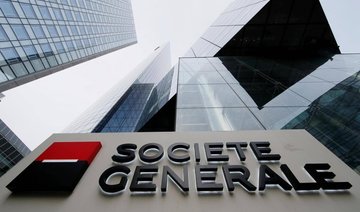
PARIS: France’s second-biggest bank Societe Generale said Monday that it had reached agreements with US and French authorities to settle inquiries into the rigging of Libor interest rates and its dealings in Libya.
The bank did not reveal how much it paid to end the cases, but said that it had already provided for the amount in its accounts and that it would have “no impact on Societe Generale’s results.”
The bank said last month it had set aside one billion euros ($1.2 billion) to settle both the Libor and Libya disputes.
It said the agreements reached with the French financial prosecutor’s office and the US Department of Justice would be submitted to the country’s courts for approval on June 4 and June 5 respectively.
In a statement the bank added that it would provide more details once the settlements were made public by the authorities.
Societe Generale joins a host of other banks that have reached settlements with US tax authorities for attempting to manipulate the London Interbank Offered Rate (Libor), which governs credit costs around the world.
Germany’s largest lender Deutsche Bank paid $240 million to resolve claims that it conspired with other banks to manipulate the rate, while HSBC forked out $100 million.
Barclays, Royal Bank of Scotland, Goldman Sachs and BNP Paribas are among other lenders that have been forced to pay hefty sums to avoid potentially embarrassing court cases.
The legal woes weighing on Societe Generale were compounded by allegations that it channeled bribes to associates of slain Libyan dictator Muammar Qaddafi’s son Seif Al-Islam during Qaddafi’s reign.
Last year, Societe Generale paid nearly a billion euros to settle a case brought by the Libyan Investment Authority (LIA), the country’s sovereign wealth fund.
The LIA accused the French bank of paying at least $58 million to a Panama-registered company called Leinada as part of a “corrupt scheme” to get the LIA to invest billions in Societe Generale and its subsidiaries between 2007 and 2009.
Leinada was at the time headed by an associate of Seif Al-Islam.
While reaching a deal with the Libyan fund to end its long-running lawsuit, Societe Generale remained under investigation in the US and France over the affair.
The announcement by Societe Generale that it had settled with tax authorities marks an end to a scandal which led to the surprise departure of its deputy CEO Didier Valet in March.
Valet was one of two senior executives to step down, along with the bank’s head of retail banking.
The departures rattled investors, casting a pall over Societe Generale’s results in the first quarter, in which it booked higher-than-expected net profits of €850 million.


![]()

SocGen reaches deals to end probes on Libor, Libya
SocGen reaches deals to end probes on Libor, Libya
- The bank said last month it had set aside one billion euros ($1.2 billion) to settle both the Libor and Libya disputes
- Societe Generale joins a host of other banks that have reached settlements with US tax authorities for attempting to manipulate the London Interbank Offered Rate
Latest updates


Recommended


© 2026 SAUDI RESEARCH & PUBLISHING COMPANY, All Rights Reserved And subject to Terms of Use Agreement.