Holy Mosques install lockers for worshippers seeking Itikaf during Ramadan

1 / 3
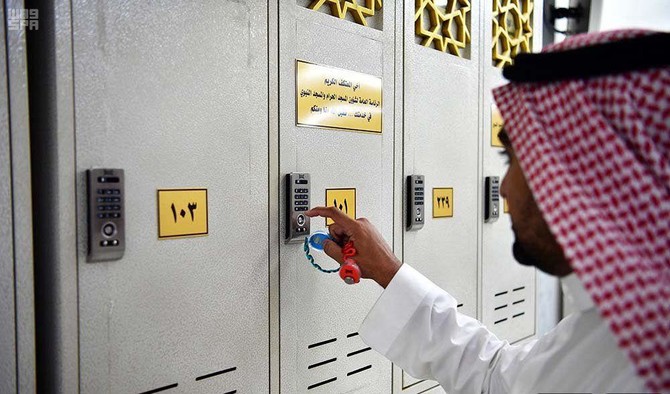
The Two Holy Mosques directorate for Itikaf services has prepared 500 lockers with digital locks to hold the personal belongings of worshippers. (SPA)
2 / 3
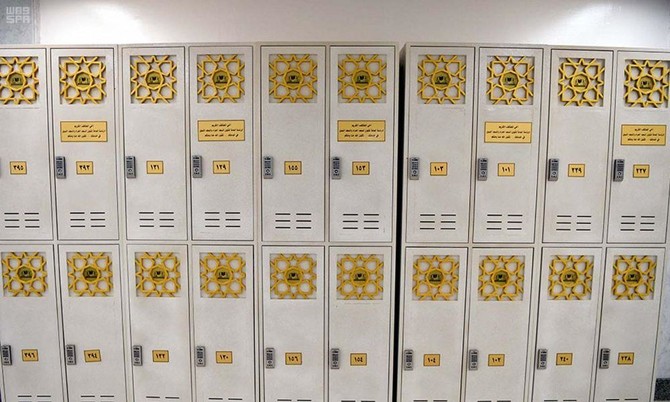
The Two Holy Mosques directorate for Itikaf services has prepared 500 lockers with digital locks to hold the personal belongings of worshippers. (SPA)
3 / 3
The Two Holy Mosques directorate for Itikaf services has prepared 500 lockers with digital locks to hold the personal belongings of worshippers. (SPA)
Updated 03 June 2018
Follow

Holy Mosques install lockers for worshippers seeking Itikaf during Ramadan

JEDDAH: The Two Holy Mosques directorate for Itikaf services has prepared 500 lockers with digital locks to hold the personal belongings of worshippers.
Itikaf is an Islamic practice that consists of spending a number of days in a mosque, devoting oneself to worship. It is very common during the last ten days of the Muslim holy month of Ramadan.
The lockers at the Masjid Al-Haram (Grand Mosque) in Makkah include charger plugs, in addition to distributing a bag that includes a pillow, prayer mat and towels, as well as cleaning supplies.
The Itikaf area at the King Fahed mosque extension includes six entrance gates.
Tour guides are also present at each gate to assist worshippers and distribute handouts with Itikaf regulations.
The area can accommodate up to 1,500 Itikaf worshippers.


Saudi space technology plays growing role in conflict and disaster zones: NSG executive

Hassan Al-Johani, vice president of business development at Neo Space Group, speaks to Arab News at the World Defense Show.
Updated 7 sec ago
Follow

Saudi space technology plays growing role in conflict and disaster zones: NSG executive

  • Company analyzes damage from natural disasters, including flash floods

RIYADH: Saudi-built space systems are moving beyond data collection to play a direct role in operational decision-making, particularly in high-stakes situations like conflict zones and natural disasters, according to one industry executive.

Hassan Al-Johani, vice president of business development at Neo Space Group, spoke on the sidelines of the World Defense Show in Riyadh, which has Arab News as a media partner, about how the company’s technology is used in real-life scenarios.

Al-Johani pointed to disaster management as an example of how integrated space services can directly influence outcomes on the ground.

The company uses high-resolution Earth observation imagery in optical, radio and infrared spectrums, to analyze damage from natural disasters, including flash floods.

He said this information can then be turned into actionable intelligence and shared directly with teams operating in affected areas, allowing them to assess damage to roads and determine the best routes for delivering equipment and emergency aid.

“We can utilize that in geospatial intelligence and communicate it to teams in the field using advanced satellite communications,” Al-Johani said.

The company’s satellite technology allows people to communicate in crisis-hit areas when traditional communication infrastructure has been damaged.

He added: “Even when communication fails, even when there’s disruption in infrastructure, we have the ability to understand what has happened, but also communicate it to people (who) need to take decisions in real time to save lives and property.”

Demonstrations at the World Defense Show, he said, were designed to show how this integrated approach worked in practice.

“We are not promoting one domain or one technology, but rather a unified architecture that brings together the best of the latest technologies,” he said.

The company’s technology has military uses, allowing users to determine the best locations for deploying troops and equipment, and its satellite technology allows secure communications in war zones.

He also highlighted the technical design choices behind ensuring continuity of service, particularly in contested or disrupted environments.

Artificial intelligence, he added, is increasingly part of the company’s system.

“We’re not utilizing just traditional geospatial intelligence, but rather AI-powered intelligence,” Al-Johani said.

This layered approach, he explained, is intended to reduce dependence on any single system or data source.

He added: “If one layer fails, then you have other layers to supplement and ensure the continuity of the value delivered to the clients.”

Beyond technology, Al-Johani said discussions at the World Defense Show reflected a broader shift in how Saudi Arabia approaches the space and defense sectors.

“Saudi Arabia has demonstrated that we are not looking to be buyers, but rather partners and builders,” he said.

“That means that we have to have an engaging dialogue with partners from around the world, understanding which parts of the ecosystem we need to build on.”

He said this approach ultimately supported local capability building and long-term sector development, adding that it was targeted at “finding a meaningful partnership that delivers win-win for everyone, (and) ultimately contributes to building this country, this industry and the space sector.”