African migrants report torture, slavery in Algeria

Updated 30 May 2018
Follow

African migrants report torture, slavery in Algeria

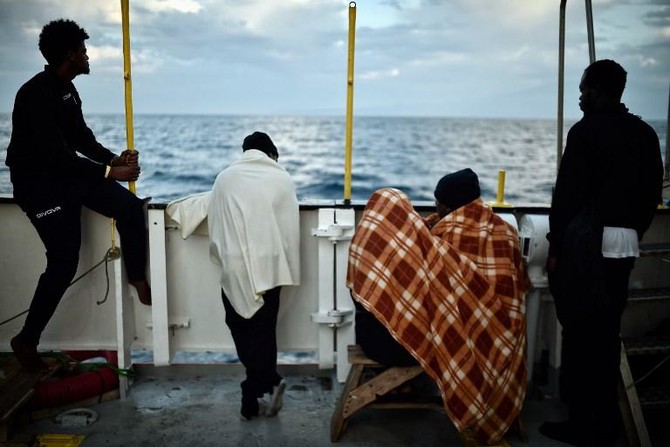
DAKAR: Dozens of Africans say they were sold for labor and trapped in slavery in Algeria in what aid agencies fear may be a widening trend of abusing migrants headed for a new life in Europe.
Algerian authorities could not be reached for comment and several experts cast doubt on claims that such abuses are widespread in the north African country.
The tightly governed state has become a popular gateway to the Mediterranean since it became tougher to pass through Libya, where slavery, rape and torture are rife.
Amid a surge in anti-migrant sentiment, Algeria since late last year has sent thousands of migrants back over its southern border into Niger, according to the United Nations Migration Agency (IOM), where many tell stories of exploitation.
The scale of abuse is not known, but an IOM survey of thousands of migrants suggested it could rival Libya.
The Thomson Reuters Foundation heard detailed accounts of forced labor and slavery from an international charity and a local association in Agadez, Niger’s main migrant transit hub, and interviewed two of the victims by telephone.
“The first time they sold me for 100,000 CFA francs ($170),” said Ousmane Bah, a 21-year-old from Guinea who said he was sold twice in Algeria by unknown captors and worked in construction.
“They took our passports. They hit us. We didn’t eat. We didn’t drink,” he told the Thomson Reuters Foundation. “I was a slave for six months.”
Accounts of abuse are similar, said Abdoulaye Maizoumbou, a project coordinator for global charity Catholic Relief Services. Of about 30 migrants he met who were deported from Algeria, about 20 said they had been enslaved, he said.
In most cases, migrants said they were sold in and around the southern city of Tamanrasset shortly after entering the country, often by smugglers of their own nationality, he said.
Some said they were tortured in order to blackmail their parents into paying the captors, but even when the money arrived they were forced to work for no pay, or sold, said Maizoumbou.
One man told the Thomson Reuters Foundation he slept in a sheep pen and suffered beatings if an animal got sick or dirty.
“They would bring out machetes and I would get on my knees and apologize and they would let it go,” said Ogounidje Tange Mazu, from Togo.
The IOM in Algeria has received three reports this year from friends and relatives of African migrants held hostage and forced to work in the country. “It’s probably just an indication that it is happening. How big it is we don’t know,” said its chief of mission Pascal Reyntjens.

TWO SIDES TO THE STORY
Several analysts considered it unlikely that slavery was widespread in Algeria, since the country has a functioning judiciary and strong police force — unlike Libya.
Algerian authorities could not be reached for comment, but a senior official said last week the country is facing a “surge of migration” and needs more help.
In a statement this month, the government rejected reports from a UN human rights team that its mass deportations of migrants were inhuman, saying that it is doing what is necessary to ensure the safety of its citizens.
“I would be very surprised that (slavery) would be allowed to happen in Algeria,” said Issandr El Amrani, North Africa project director for the International Crisis Group.
“The situation is just not comparable to Libya,” he added.
But in the ghettos of Agadez, Niger’s main transit hub, some people told a different story.
“What happens in Algeria surpasses what happens in Libya,” said Bachir Amma, a Nigerien ex-smuggler who runs a football club and a local association to inform migrants of the risks.
Migrants in Libya are often starved and beaten by armed groups, and there have been reports of “open slave markets” where migrants are put on sale, according to the UN human rights office.
Amma said he had spoken with more than 75 migrants back from Algeria, the majority of whom described slave-like conditions.
“NGOs don’t know about this because they’re too interested in Libya,” he told the Thomson Reuters Foundation.
In 2016, the IOM surveyed about 6,300 migrants in Niger, most of whom had returned from Algeria and Libya. Sixty-five percent of those who had lived in Algeria said they had experienced violence and abuse, compared to 61 percent in Libya.
An estimated 75,000 migrants live in Algeria, the IOM said.


Autopsy finds Cuban immigrant in ICE custody died of homicide due to asphyxia

Updated 2 sec ago
Follow

Autopsy finds Cuban immigrant in ICE custody died of homicide due to asphyxia

  • Witness: Lunas Campos was handcuffed as at least five guards held him down and one put an arm around his neck and squeezed until he was unconscious
  • The US Immigration and Customs Enforcement said Diaz was detained by ICE earlier this month during the immigration crackdown in Minneapolis
WASHINGTON: A Cuban migrant held in solitary confinement at an immigration detention facility in Texas died after guards held him down and he stopped breathing, according to an autopsy report released Wednesday that ruled the death a homicide.
Geraldo Lunas Campos died Jan. 3 following an altercation with guards. US Immigration and Customs Enforcement said the 55-year-old father of four was attempting suicide and the staff tried to save him.
But a witness said last week that Lunas Campos was handcuffed as at least five guards held him down and one put an arm around his neck and squeezed until he was unconscious.
His death was one of at least three reported in little more than a month at Camp East Montana, a sprawling tent facility in the desert on the grounds of Fort Bliss, an Army base.
The autopsy report by the El Paso County Medical Examiner’s Office found Lunas Campos’ body showed signs of a struggle, including abrasions on his chest and knees. He also had hemorrhages on his neck. The deputy medical examiner, Dr. Adam Gonzalez. determined the cause of death was asphyxia due to neck and torso compression.
The report said witnesses saw Lunas Campos “become unresponsive while being physically restrained by law enforcement.” It did not elaborate on what happened during the struggle but cited evidence of injuries to his neck, head and torso associated with physical restraint. The report also noted the presence of petechial hemorrhages — tiny blood spots from burst capillaries that can be associated with intense strain or injury — in the eyelids and skin of the neck.
Dr. Victor Weedn, a forensic pathologist who reviewed the autopsy report for AP, said the presence of petechiae in the eyes support the conclusion that asphyxia caused the death. Those injuries suggest pressure on the body and are often associated with such deaths, he said.
He said the contusions on Lunas Campos’ body may reflect physical restraint and the neck injuries were consistent with a hand or knee on the neck.
The autopsy also found the presence of prescription antidepressant and antihistamine medications, adding that Lunas Campos had a history of bipolar disorder and anxiety. It made no mention of him attempting suicide.
Government provided changing accounts of what happened
ICE’s initial account of the death, which included no mention of an altercation with guards, said Lunas Campos had become disruptive and staff moved him into a cellblock where detainees are held away from others.
“While in segregation, staff observed him in distress and contacted on-site medical personnel for assistance,” the agency said in its Jan. 9 statement. “Medical staff responded, initiated lifesaving measures, and requested emergency medical services.”
Lunas Campos was pronounced dead after paramedics arrived.
Last Thursday, after Lunas Campos’ family was first informed the death was likely to be ruled a homicide, Department of Homeland Security spokesperson Tricia McLaughlin amended the government’s account, saying he had attempted suicide and guards tried to help him.
“Campos violently resisted the security staff and continued to attempt to take his life,” she said. “During the ensuing struggle, Campos stopped breathing and lost consciousness.”
After the final autopsy report was released Wednesday, McLaughlin issued a statement emphasizing that Lunas Campos was “a criminal illegal alien and convicted child sex predator.”
New York court records show Lunas Campos was convicted in 2003 of sexual contact with a person under 11, a felony for which he was sentenced to one year in jail and placed on the state’s sex offender registry. Lunas Campos was also sentenced to five years in prison and three years of supervision in 2009 after being convicted of attempting to sell a controlled substance, according to the New York corrections records. He completed the sentence in January 2017.
“ICE takes seriously the health and safety of all those detained in our custody,” McLaughlin said Wednesday, adding that the agency was investigating the death. DHS has not responded to questions about whether any outside law enforcement agency was also investigating.
Deaths put a spotlight on Camp East Montana
The AP reported in August that the $1.2 billion contract to build and operate Camp East Montana, expected to become the largest detention facility in the US, was awarded to a private contractor headquartered in a single-family home in Richmond, Virginia. The company, Acquisition Logistics LLC, had no prior experience running a corrections facility and has subcontracted with other companies to help operate the camp.
It was not immediately clear whether the guards present when Lunas Campos died were government employees or those of a private contractor.
A final determination of homicide by the medical examiner would typically be critical in determining whether any guards are held criminally or civilly liable. The fact that Lunas Campos died on an Army base could limit state and local officials’ legal jurisdiction to investigate.
Lunas Campos was among the first detainees sent to Camp Montana East, arriving in September after ICE arrested him in Rochester, New York, where he lived for more than two decades. He was legally admitted to the US in 1996, part of a wave of Cuban immigrants seeking to reach Florida by boat.
ICE said he was picked up in July as part of a planned immigration enforcement operation due to criminal convictions that made him eligible for removal.
In addition to Lunas Campos, ICE announced that on Dec. 3 an immigrant from Guatemala held in Camp East Montana died after being transferred to a El Paso hospital for care. While the cause of death was still pending, the agency said Francisco Gaspar-Andres, 48, was suspected to have died of liver and kidney failure.
On Sunday, ICE announced that Victor Manuel Diaz, a 36-year-old immigrant from Nicaragua, died at Camp East Montana on Jan. 14 of a “presumed suicide.” The agency said Diaz was detained by ICE earlier this month during the immigration crackdown in Minneapolis.
Unlike with the two prior deaths, Diaz’s body wasn’t sent to the county medical examiner in El Paso. McLaughlin said Wednesday that the autopsy for Diaz is being performed at the Army medical center at Fort Bliss. DHS again did not respond to questions about whether any agency other than ICE will investigate the death.
Rep. Veronica Escobar, a Democrat whose district includes El Paso, called on DHS Secretary Kristi Noem and acting ICE Director Todd M. Lyons to brief Congress about the recent deaths.
“DHS must preserve all evidence — including halting their effort to deport the witnesses,” Escobar said Wednesday. “I reiterate my call for Camp East Montana to be shut down and for the contract with the corporation running it to be terminated.”