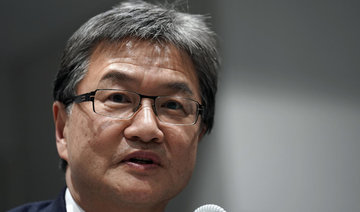
OSLO: The father of Otto Warmbier, the US student who died after being held in North Korea, said Tuesday he favored US talks with Pyongyang, a move he hoped would bring “the world’s most barbaric dictatorship...out of its hole.”
Otto Warmbier was arrested in North Korea for a petty offense and held for more than a year before he was released in a comatose state in 2017.
Warmbier, aged 22, died shortly after he was flown home unconscious. Although North Korea claimed he had contracted botulism in detention, the US has since alleged that he was tortured in custody.
US President Donald Trump is planning to hold a historic summit with North Korea’s leader Kim Jong Un, scheduled for June 12 in Singapore.
“The diplomatic track with negotiations, I support them,” Otto’s father Fred Warmbier said at the Oslo Freedom Forum, an annual gathering of human rights activists in the Norwegian capital.
“Not talking to North Korea has helped foster the world’s most threatening, barbaric dictatorship. I don’t know if talking to them is going to change them but at least it will bring them out of their hole and force them to engage.”
The diplomatic efforts have however not prevented Warmbier and his wife Cynthia from pursuing legal action against North Korea.
The couple has accused the Pyongyang regime in a US court of murder and torture of their son, who was sentenced to 15 years of hard labor for stealing a propaganda poster.
“I’m going to do everything in my power to force them to be answerable to what they did to my son,” Fred Warmbier said.

Dad of late N.Korea prisoner backs US talks with Pyongyang
- Otto Warmbier was arrested in North Korea for a petty offense
- He was held for more than a year before he was released in a comatose state in 2017.
Nigerian president vows security reset in budget speech
- Government plans to buy 'cutting-edge' equipment to boost the fighting capability of military
ABUJA: Nigeria’s president vowed a national security overhaul as he presented the government budget, allocating the largest share of spending to defense after criticism over the handling of the country’s myriad conflicts.
Nigeria faces a long-running insurgency in the northeast, while armed “bandit” gangs commit mass kidnappings and loot villages in the northwest, and farmers and herders clash in the center over dwindling land and resources.
President Bola Tinubu last month declared a nationwide security emergency and ordered mass recruitment of police and military personnel to combat mass abductions, which have included the kidnapping of hundreds of children at their boarding school.
He told the Senate that his government plans to increase security spending to boost the “fighting capability” of the military and other security agencies by hiring more personnel and buying “cutting-edge” equipment.
Tinubu promised to “usher in a new era of criminal justice” that would treat all violence by armed groups or individuals as terrorism, as he allocated 5.41 trillion naira ($3.7 billion) for defense and security.
Security officials and analysts say there is an increasing alliance between bandits and extremists from Nigeria’s northeast, who have in recent years established a strong presence in the northwestern and central regions.
“Under this new architecture, any armed group or gun-wielding non-state actors operating outside state authority will be regarded as terrorists,” said Tinubu, singling out, among others, bandits, militias, armed gangs, armed robbers, violent cult groups, and foreign-linked mercenaries.
He said those involved in political or sectarian violence would also be classified as terrorists.
On the economic front, Tinubu hailed his “necessary” but not “painless” reforms that have plunged Nigeria into its worst economic crisis in a generation.
He said inflation has “moderated” for eight successive months, declining to 14.45 percent in the last month from 24.23 percent in March this year.
He projected that the budget deficit will drop next year to 4.28 percent of GDP from around 6.1 percent of GDP in 2023, the year he came into office.