ZURICH: Nestle plans to eliminate up to 500 information technology jobs at its Swiss home base as its shifts work to an existing tech hub in Spain and other locations, the food and beverage giant said on Tuesday.
None of the group’s Swiss production sites will be affected by the plan, which is being presented to staff for consultation, it said in a statement.
Its Nespresso coffee business also plans to establish operational centers in Spain and Portugal to benefit from existing Nestle e-commerce and supply chain hubs, and intends to create a center for boutique operations in Italy too.
“It is Nespresso’s intention to offer roles in these centers to all of the 80 employees impacted by the proposed change,” it added. These were in addition to the 500 Swiss IT jobs at risk.
Nestle said it remained committed to its Swiss base, where it employed more than 10,100 people in 2017.
It said this month it planned to combine its scientific research operations into a single Swiss unit in an attempt to speed up development of new products at a time when competition from smaller rivals is intensifying.
Under pressure from activist shareholder Daniel Loeb to increase investor returns, Nestle has been keeping a close eye on costs.
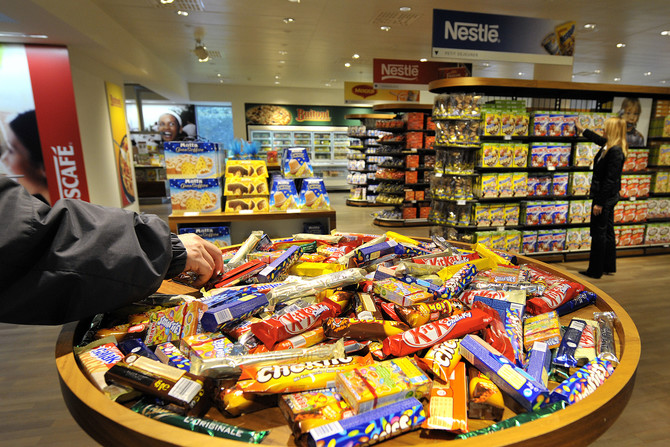
People speak to one another next to a sign of the Nescafe brand at the headquarters of Swiss food giant’s Nestle on October 20, 2016 in Vevey. Sales of Swiss food giant Nestle rose slightly in the first 9 months of 2016, in a “more sluggish” environment, which led the group to strongly revise downwards its expectations for the full 2016 year. According to a statement released October 20, the group recorded a one-percent increase in sales over the first nine months of 2016 to 65,500,000,000 francs ($66 billion).

Nestle plans to cut up to 500 IT jobs in Switzerland
- Its Nespresso coffee business also plans to establish operational centers in Spain and Portugal
- Nestle has been keeping a close eye on costs, under pressure from activist shareholder Daniel Loeb to increase investor returns
Saudi Arabia’s foreign reserves rise to a 6-year high of $475bn
RIYADH: Saudi Arabia’s foreign reserves climbed 3 percent month on month in January to SR1.78 trillion, up SR58.7 billion ($15.6 billion) from December and marking a six-year high.
On an annual basis, the Saudi Central Bank’s net foreign assets rose by 10 percent, equivalent to SR155.8 billion, according to data from the Saudi Central Bank, Argaam reported.
The reserve assets, a crucial indicator of economic stability and external financial strength, comprise several key components.
According to the central bank, also known as SAMA, the Kingdom’s reserves include foreign securities, foreign currency, and bank deposits, as well as its reserve position at the International Monetary Fund, Special Drawing Rights, and monetary gold.
The rise in reserves underscores the strength and liquidity of the Kingdom’s financial position and aligns with Saudi Arabia’s goal of strengthening its financial safety net as it advances economic diversification under Vision 2030.
The value of foreign currency reserves, which represent approximately 95 percent of the total holdings, increased by about 10 percent during January 2026 compared to the same month in 2025, reaching SR1.68 trillion.
The value of the reserve at the IMF increased by 9 percent to reach SR13.1 billion.
Meanwhile, SDRs rose by 5 percent during the period to reach SR80.5 billion.
The Kingdom’s gold reserves remained stable at SR1.62 billion, the same level it has maintained since January 2008.
Saudi Arabia’s foreign reserve assets saw a monthly rise of 5 percent in November, climbing to SR1.74 trillion, according to the Kingdom’s central bank.
Overall, the continued advancement in reserve assets highlights the strength of Saudi Arabia’s fiscal and monetary buffers. These resources support the national currency, help maintain financial system stability, and enhance the country’s ability to navigate global economic volatility.
The sustained accumulation of foreign reserves is a critical pillar of the Kingdom’s economic stability. It directly reinforces investor confidence in the riyal’s peg to the US dollar, a foundational monetary policy, by providing SAMA with ample resources to defend the currency if needed.
Furthermore, this financial buffer enhances the nation’s sovereign credit profile, lowers national borrowing costs, and provides essential fiscal space to navigate global economic volatility while continuing to fund its ambitious Vision 2030 transformation agenda.