LONDON: Food giant Nestle plans to combine its scientific research operations into a single unit in an attempt to speed up development of new products at a time when competition from smaller rivals is intensifying.
The world’s biggest packaged food maker, with brands including Nescafe coffee and Perrier water, has been struggling with slowing sales growth for years. Now it is also under pressure from activist shareholder Daniel Loeb to increase investor returns.
To better compete, the Swiss company told Reuters it would merge its Nestle Research Center and Nestle Institute of Health Sciences (NIHS) into one organization called Nestle Research.
The new entity, to be announced later on Thursday, will continue to be based in Lausanne, Switzerland and will employ around 800 people.
The reorganization, effective July 1, will not involve job cuts or the closure of facilities, a spokesman said.
By linking the “blue-sky” research done at NIHS with the more commercially focused Research Center, it hopes to accelerate the translation of scientific discoveries into marketable products.
It also hopes this will help it compete with smaller, nimbler rivals who have been eating away at the market share of Nestle and other big firms like Danone, Unilever, Kraft Heinz and Kellogg.
Nestle Chief Technology Officer Stefan Palzer acknowledged earlier this month that his company had to keep pace with rising demand for goods that are organic, gluten-free or vegan.
“Big trends are embraced by smaller companies a bit more actively than the big companies,” Palzer told Reuters before Nestle’s streamlining plans had been finalized.
“We are adjusting our portfolio, doing many innovations and renovations to make the portfolio more relevant and to address those trends, but smaller companies are more agile.”
In the US — the world’s biggest packaged food market — small challenger brands could account for 15 percent of a $464 billion sector in a decade’s time, up from about 5 percent last year, Bernstein Research predicted last year.
The combination of research units is the latest move by Palzer aimed at speeding up development and ensuring research efforts are commercially viable.
Palzer, who took over Nestle’s innovation and research and development operations in January, is also supplementing long-term research projects with incremental product launches made faster by experimenting with new ideas more quickly.
Last month, for example, Palzer and colleagues got the idea for a vegetarian or vegan food product while on a business trip.
“Thursday we had an idea, Friday we returned to Switzerland and Monday evening I was able to taste the first prototype,” Palzer said. “Wednesday, this prototype was shown to the executive board, and Friday it was in the global pipeline.”
He declined to give more details of the product, except to say it is currently being assessed by the operations team to see how long it will take to produce and on what machinery.
Other steps include efforts to apply specific developments to more products, such as Nestle’s recent designer sugar crystals launched in low-sugar Milkybars in March, which will go into other products in the future.
The importance of agility was underlined by Nestle’s recent struggle to capitalize on resurgent demand for frozen foods.
The company says it reformulates one third of its product portfolio every year.
Nestle spent 1.72 billion Swiss francs ($1.73 billion) on R&D last year, down slightly from 2016 but up 22 percent from 2012. The company’s sales fell 2.6 percent over the same period.
As a percentage of sales, its expenditure has fluctuated only a little, but demands on the unit have increased.
Wells Fargo analyst John Baumgartner said that across 10 large publicly traded US food companies, median expenses for R&D and advertising have declined 20 percent over the past five years.
“As voids of ideas and marketing have emerged, start-ups have been more responsive to consumer needs, won the culture and created the emotional connections that drive sales,” he said in a recent note.
Palzer said some industry peers had been outsourcing innovation to cut costs, relying on acquisitions of small brands or partnerships with suppliers.
But he said it was critical for Nestle to maintain scientific expertise in-house to keep its own portfolio fresh and to be an attractive partner for collaboration with others. Nestle does R&D around the world, involving around 5,000 people.
Fundamental scientific research will remain key at Nestle, Palzer said, but he also highlighted the value of external partnerships and acquisitions that can bring in new research or capabilities more easily.
Scientific research and innovation itself is not necessarily the reason why big breakthroughs tend to be rare for multinational companies, said Shaun Browne, investment banker at Houlihan Lokey, who advises food companies on deals.
“They often don’t have the patience or passion that is really required,” Browne said. “Often these things are one individual who is just totally determined and passionate about their product and sees it through.”


Nestle streamlines R&D to speed up product innovation

Nestle streamlines R&D to speed up product innovation

Global Markets: Stocks set for tough week, oil eyes strong gains as Middle East war rages
- Oil prices set for largest weekly rise since Russia’s invasion of Ukraine
- Stocks take a beat, but Asia shares set for 6 percent weekly fall
- Yields jump as global rate expectations turn hawkish
SINGAPORE: A slight pullback in oil prices on Friday offered some reprieve to battered global stocks, though share markets in Asia remained on track for their sharpest weekly drop in six years as the conflict in the Middle East showed few signs of easing.
Oil prices, headed for their largest weekly gain since Russia launched its full-scale invasion of Ukraine in February 2022, slipped on news that the US government is weighing potentially intervening in the futures market to blunt rising prices.
Still, they remained up close to 20 percent for the week.
Brent crude futures last traded at $84.73 per barrel, on track for a 17 percent weekly rise. US crude retreated from a 20-month high and was last at $80 a barrel, taking its weekly gain to more than 19 percent.
“What we see is ... markets (consolidating) for a time, chopping around current levels, as a ‘wait and see’ approach takes (precedence) for the time being,” said Michael Brown, senior research strategist at Pepperstone.
The US-Israel war on Iran convulsed global markets this week and left investors seeking the safety of cash, as they sobered up to the fact that the conflict could drag on longer than initially anticipated.
Traders also moved to price in more hawkish rate expectations from major central banks, spooked by the prospect of a resurgence in inflation if the spike in energy prices persists.
Yields on US Treasuries have shot up some 18 basis points this week, their most in nearly a year, while the dollar was set for its largest weekly gain in 16 months.
“The range of plausible outcomes (of the war) has expanded to include both the possibility of an exceptionally constructive resolution and a highly destructive one,” said Daleep Singh, chief global economist at PGIM Fixed Income.
“Markets are being asked to price a much fatter set of tails with very little reliable information about the likelihood of each, or the path in between.”
EUROSTOXX 50 futures were up 0.95 percent in Asia on Friday, while FTSE futures and DAX futures rose 0.5 percent and 0.8 percent, respectively.
Nasdaq futures added 0.27 percent, while S&P 500 futures rose 0.16 percent.
High-flying stocks tumble
MSCI’s broadest index of Asia-Pacific shares outside Japan last traded 0.2 percent higher, though it was set to fall 6 percent for the week, which would mark its steepest weekly drop since March 2020.
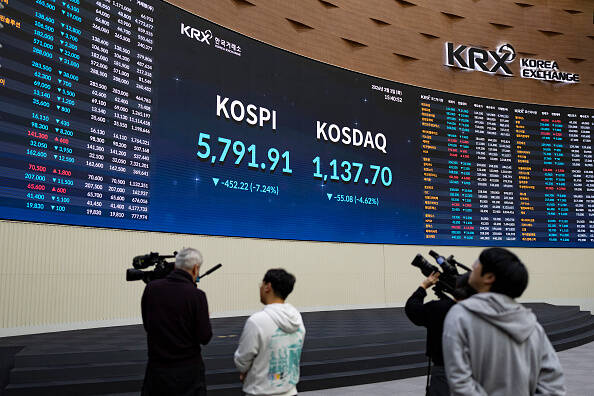
Japan’s Nikkei was up 0.6 percent but on track for a 5.5 percent weekly loss, while South Korea’s Kospi was headed for its largest weekly fall in six years with a 10.5 percent slide.
The market rout this week sent even high-flying technology stocks and indexes such as the Kospi tumbling, as investors scrambled to book profits to cover losses elsewhere.
“When the dollar rallies and US yields rise, funding conditions are tightening, which will often exacerbate broader moves particularly if there’s leverage involved,” said Ben Bennett, head of Asia investment strategy at L&G Asset Management.
Dollar is king
The dollar has emerged as one of few winners this week in volatile sessions that have dragged stocks, bonds and, at times, even safe-haven precious metals lower.
The rally in the dollar hit pause on Friday, but it was still on track for a weekly gain of close to 1.5 percent, bolstered by safe-haven demand and reduced US rate-easing expectations.
The euro, which remains vulnerable to a spike in energy prices, was set to fall 1.8 percent for the week, while sterling was headed for a 1 percent weekly drop.
Investors are now pricing in about 40 basis points of easing from the Federal Reserve this year, down from 56 bps a week ago , while odds for a rate cut from the Bank of England this month have fallen to 22 percent from a near certainty just last week.
The European Central Bank is seen hiking rates by year-end.
The shifting rate expectations have, in turn, pushed up global bond yields, and in Asia on Friday, the yield on the benchmark 10-year US Treasury was steady at 4.1421 percent, having risen some 18 bps this week.
The two-year yield has jumped 20 bps for the week.
Elsewhere, spot gold was steady at $5,118.79 an ounce, though it was headed for a 3 percent weekly fall as rising yields and a stronger dollar eclipsed the yellow metal’s safe-haven appeal.


