

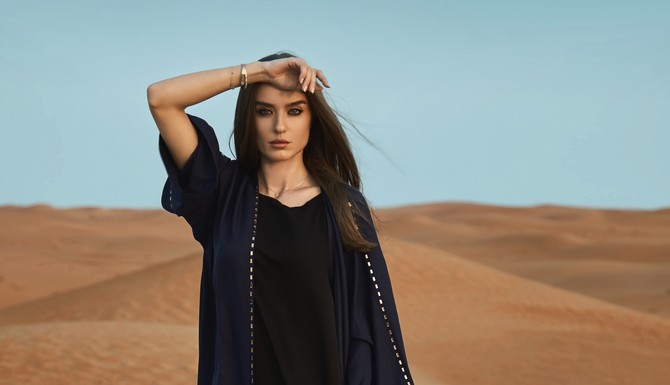

DAMMAM: Murcyleen Peerzada might have set out to become Bollywood’s next big thing, but life had different plans. After a successful run as assistant director on the 2011 Salman Khan blockbuster, “Ek tha Tiger,” Peerzada was gearing up to make her acting debut with the acclaimed Yash Raj Films (YRF) production house.
Two years and a life-altering incident later, she left the film industry to pursue a different calling — obtaining Islamic knowledge and, eventually, becoming a female orator at the Islamic Relief Fund (IRF).
“Gaining knowledge about Islam brought about a change in my career choices and my lifestyle,” Peerzada says. While fashion was still an important part of her life, combining her passion with her new lifestyle was proving to be a challenge. The former stylist and assistant costume designer sought out fashionable modest wear and abayas. The Indian market did not cater to this niche market, and her attempts to buy tailor-made clothes didn’t prove successful. It was only on her travels to Dubai that Peerzada found a wide variety of abayas and apparel that was modest and fashionable.
The modest fashion movement was just starting to take off and further provided an impetus for Peerzada to tap into this market. Fast-forward to last year and Peerzada launched India’s first abaya label, the “Murcyleen Peerzada” label, catering to the Indian and Middle Eastern market. Her first collection, inspired by fairy-tales, made its debut at the 2017 Dubai Modest Fashion Week. The collection comprises modest evening dresses in pastel colors — peachy pinks, Tiffany-blues, and resplendent greys, embellished with delicate lacework and netting, beadwork and pearls, faux feathers and fringes — making for a royal, princess-like collection. There are also pieces inspired by fairy-tale villains: Dramatic and bold, marked by spikes and faux fur.
Her clothes are ideal for more formal iftar or suhoor gatherings, and although you may be tired from a day of fasting, you will look queenly in her regal collection.
Apart from the modest collection, Peerzada’s abaya line — particularly the “Healthy Abaya” — has garnered attention. The designer developed an abaya that permits UV rays to penetrate through the fabric, allowing women to get more exposure to sunlight.
A study carried out in 2014 at the King Faisal Specialist Hospital and Research Center in Riyadh looked at 10,700 patients and concluded that 83 percent of women had a vitamin D deficiency. Similarly, according to the Dubai Health Authority’s most recent study, 85 percent of women in the UAE are at risk.
“(We sometimes) wear two layers of clothing when we go out — regular clothes and an abaya on top. That doesn’t let the sunrays penetrate through to our skin and can lead to a deficiency or increase the risk,” Peerzada told Arab News. The abaya is made of Microsolv cloth, a light-weight and porous fabric.
Peerzada, who divides her time between Dubai and India, will soon be launching modest outfits that are made of the same fabric. Currently, outfits from existing collections can be customized in Microsolv cloth upon request. Through her label, Peerzada hopes to redefine what an abaya means in the Indian and Middle Eastern market — fashion forward, yet modest.


