Dhaka relishes traditional ‘Dhakaia iftar’ in Ramadan

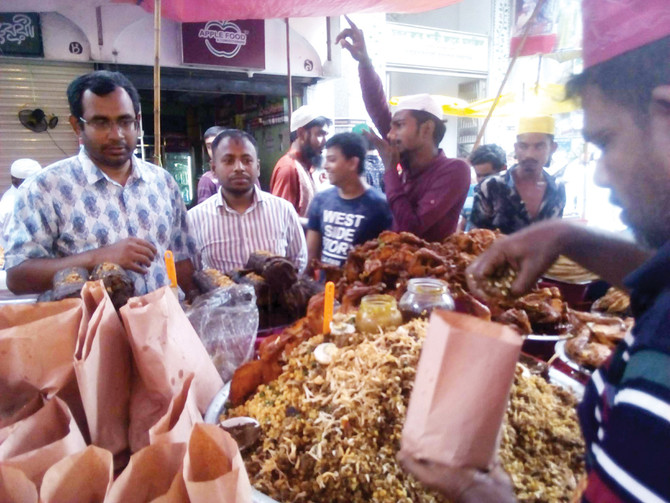
Chawak Bazar Iftar market vendors on a busy Wednesday afternoon. (AN photo)
Updated 25 May 2018
Follow

Dhaka relishes traditional ‘Dhakaia iftar’ in Ramadan

  • While much has changed in Dhaka, its tasty Ramadan dishes have stayed the same in the 400-year old city established by the Mughal dynasty.
  • The exquisite variety of kebabs attracts food lovers from far and wide, reminding them of the existence of Mughals through different food menus — offering tikka, shutli, jaali, shami, irani and other kinds of kebabs.

DHAKA: “To me it’s like a festival. During Ramadan, all of us friends regularly gather at my house and have the ‘Dhakaia Iftar’ together,” said Abdullah Alamin, 48, a city dweller of old Dhaka.

While much has changed in Dhaka, these tasty dishes have stayed the same in the 400-year old city established by the Mughal dynasty.

“Chawak Bazar Iftar market of old Dhaka has a history of more than 100 years. Many things of the area have changed with the passage of time but the Chawak Bazar Iftar remains unchanged,” said renowned historian Muntasir Mamun, a professor at Dhaka University.

Chawak Bazar became the city center of Dhaka during the Mughal regime in the early-16th century. The iftar bazar is a continuity of the retail market set up since then, Muntasir said.

During Ramadan, people from all over Dhaka get something more to add to their regular iftar menu.

In Chawak Bazar, vendors in makeshift shops offer a variety of iftar items. These include “boro baper polai khai” (only the son of an influential father eats this), shahi jilapi, shahi paratha, beef, chicken, mutton, pigeon, quail roast, keema roll, keema paratha, doi bora, borhani.

The exquisite variety of kebabs attracts food lovers from far and wide, reminding them of the existence of Mughals through different food menus — offering tikka, shutli, jaali, shami, irani and other kinds of kebabs.

Boro baper polai khai is the most popular iftar item among the locals. People from old Dhaka can simply not complete their iftar without having a piece of it. This is an exclusive food of the city made of chicken, minced meat, potatoes, brain, chira, egg, spices and ghee.

“This is a traditional food of old Dhaka. I saw my grandfather enjoying eating boro baper polai khai,” said Hajji Joinal Molla, 79, who has been living in the Lalbag area of old Dhaka for many years.

“We love to treat our special guests with this dish,” Joinal said.

Most of the 200 vendors at the market are second- or third-generation businesses. 

“My 11-year-old son is very fond of shami kebab at Chawak Bazar. Today he has invited some of his friends to our house, which brought me here to this iftar market,” said Shamsuddin Ahmed, 55, a resident of Uttara, new Dhaka.

“These traditional Iftar items have become an integral part of our iftar culture,” Shamsuddin said.


Ramadan recipes: a taste of southern Italy with Linguine alla Nerano

Updated 04 March 2026
Follow

Ramadan recipes: a taste of southern Italy with Linguine alla Nerano

DUBAI: Chef Francesco Cortorillo, head chef at Dubai’s Scalini, shares a signature interpretation of the iconic southern Italian dish Linguine alla Nerano, celebrating the seasonality of zucchini and the subtle, elegant flavors of Provolone del Monaco DOP.

“Linguine alla Nerano is a dish that captures the elegance of Italian simplicity. When prepared with care, it delivers extraordinary depth from just a handful of ingredients,” he said.

Ingredients (serves 4) 


400g linguine.

700g zucchini.

120g Provolone del Monaco DOP.

40g Parmigiano Reggiano, finely grated.

Extra virgin olive oil, as needed.

Fresh basil leaves.

Salt, freshly ground black pepper.

Method 

Prepare the zucchini

Wash the zucchini and slice thinly, about 2 to 3 millimeters thick.

Heat a generous amount of extra virgin olive oil in a wide pan and fry the zucchini in batches until golden and lightly crisp.

Remove and drain on paper towels. Season lightly with salt while still warm.

Once cooled, set aside with a few fresh basil leaves.

This resting time is essential, allowing the zucchini to release their aroma into the oil.

Cook the pasta

Bring a large pot of well-salted water to the boil. Cook the linguine until very al dente. Reserve plenty of the pasta cooking water before draining.

Build the sauce

In a large pan, gently warm a small amount of the zucchini frying oil, lightly crushed. Add the fried zucchini and a ladle of pasta water to create a light base. Add the linguine and finish cooking directly in the pan, stirring gently.

Cream the pasta

Remove the pan from the heat. Gradually add the Provolone del Monaco and Parmigiano Reggiano, stirring continuously. Add pasta water slowly until a smooth, creamy sauce forms.

The sauce should coat the pasta without becoming heavy or stringy. Finish with fresh basil and, if desired, a touch of black pepper.