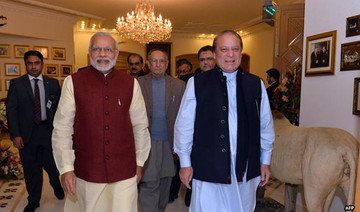
ISLAMABAD: Pakistan has expressed serious concerns about Saturday’s inauguration by Indian Prime Minister Narendra Modi of the Kishanganga Hydroelectric Project (KHEP) in Indian-administered Kashmir.
The inauguration is a “violation of the Indus Waters Treaty” that regulates the sharing of the river’s water, said Pakistan’s Foreign Ministry.
“Despite several rounds of bilateral negotiations and mediations under the auspices of the World Bank, India continued with the construction of the project. This intransigence… clearly threatens the sanctity of the treaty.”
As the treaty’s custodian, the World Bank must urge India to address Pakistan’s reservations about the KHEP, the ministry added.

Pakistan expresses concern over Indian hydroelectric project
- The inauguration is a “violation of the Indus Waters Treaty,” said Pakistan’s Foreign Ministry.
- As the treaty’s custodian, the World Bank must urge India to address Pakistan’s reservations about the KHEP, the ministry added
Pakistani students stuck in Afghanistan permitted to go home
- The border between the countries has been shut since Oct. 12
- Worries remain for students about return after the winter break
JALALABAD: After three months, some Pakistani university students who were stuck in Afghanistan due to deadly clashes between the neighboring countries were “permitted to go back home,” Afghan border police said Monday.
“The students from Khyber Pakhtunkhwa (northwest Pakistan) who were stuck on this side of the border, only they were permitted to cross and go to their homes,” said Abdullah Farooqi, Afghan border police spokesman.
The border has “not reopened” for other people, he said.
The land border has been shut since October 12, leaving many people with no affordable option of making it home.
“I am happy with the steps the Afghan government has taken to open the road for us, so that my friends and I will be able to return to our homes” during the winter break, Anees Afridi, a Pakistani medical student in eastern Afghanistan’s Nangarhar province, told AFP.
However, worries remain for the hundreds of students about returning to Afghanistan after the break ends.
“If the road is still closed from that side (Pakistan), we will be forced to return to Afghanistan for our studies by air.”
Flights are prohibitively expensive for most, and smuggling routes also come at great risk.
Anees hopes that by the time they return for their studies “the road will be open on both sides through talks between the two governments.”