

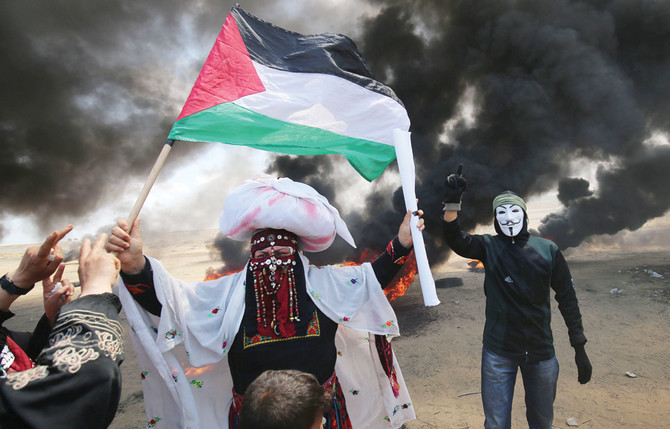

GAZA/LONDON: The UN Human Rights Council (UNHRC) on Friday voted to send a team of international war crimes investigators to Gaza to investigate the violent protests that have left more than 100 people dead.
An international commission of inquiry is the UNHRC’s highest level of investigation.
But if the intention was to give hope to Palestinians after six weeks of violent confrontation along the border between Gaza and Israel, it has not entirely succeeded. In a heated tirade, Manuel Hassassian, Palestine’s envoy to Britain, dismissed the UNHRC resolution as “PR and propaganda with no kind of political weight.”
Speaking to Arab News from the West Bank, a clearly emotional Hassassian said: “All these resolutions from all the international organizations but there is nothing concrete ever on the ground. There is no implementation whatsoever.”
Even if the UN did send war crimes investigators, their movements and access would be controlled by the Israelis because they are in charge of the borders, Hassassian said.
“The Israelis are not going to let them be mobile enough to get around all the areas where there was naked aggression. I am really depressed. I am in the West Bank and what I am seeing with my own eyes is total apartheid. And in Gaza, there are two million people living in subhuman conditions.
“Israel and the United States seem to be above international law, but when there is any violation by the Arab world, immediately there are sanctions imposed. If this is the model of democracy that you want, then stop preaching to us about the rule of law.”
Only two of the council’s 47 members, the US and Australia, voted against the resolution, while 29 voted in favor and 14 abstained, including Britain, Switzerland and Germany.
The resolution calls for a probe into all alleged violations and abuses “including those that may amount to war crimes.”
The violence has claimed more than 100 Gazan lives. Sixty Palestinians were killed and thousands injured on Monday alone. That was the day that the US embassy transferred from Tel Aviv to Jerusalem and also the eve of the 70th anniversary of the Nakba, in which hundreds of thousands of Palestinians were ejected from their homes and lands as the state of Israel came into being.
The UN vote was welcomed by Palestinian officials and campaigners.
Issam Younis, director of the Al-Mezan Center for Human Rights, said: “This decision is very important, especially after the UN Security Council failed to issue a condemnation of the occupation because there must be accountability. These were repeated assaults on civilians. The road to justice is long and not achieved by knockout, but by total points.”
Opening the session on Friday, UN human rights chief Zeid Ra’ad Al-Hussein slammed the “wholly disproportionate” use of force by Israeli troops, insisting that many of those injured and killed on Monday were “completely unarmed’ yet were “shot in the back, in the chest, in the head and limbs with live ammunition.”
He added: “Some of the demonstrators threw Molotov cocktails, used slingshots to throw stones, flew burning kites into Israel and attempted to use wire-cutters against the two fences between Gaza and Israel.
But these actions alone do not appear to constitute the imminent threat to life or deadly injury which could justify the use of lethal force.” Yet there was “little evidence” of any attempt by the Israelis to minimize casualties, he said.
It has also emerged that Kuwait circulated a draft resolution to members of the UN Security Council calling for an “international protection mission” to be sent to protect Palestinian civilians.
According to AFP, which obtained a copy of the draft, it does not specify what form such a mission should take.
Israel immediately condemned the UNHRC’s decision. A statement from the foreign ministry said it “proves once again that it is an anti-Israeli body dominated by hypocrisy and absurdity.”
Gazans began queuing at dawn on Friday after Egyptian president Abdel Fattah El-Sisi declared the Rafah border crossing between Gaza and Egypt would be opened during Ramadan, in a move widely thought to be part of a deal to persuade Gazans to tone down their protests. Hamas leader Ismail Hanuyeh visited Egypt on Sunday but Hamas denies it has come under pressure from Cairo.


