

Arab League demands probe into Israel’s ‘blatant crimes’ against Palestinians

1 / 2
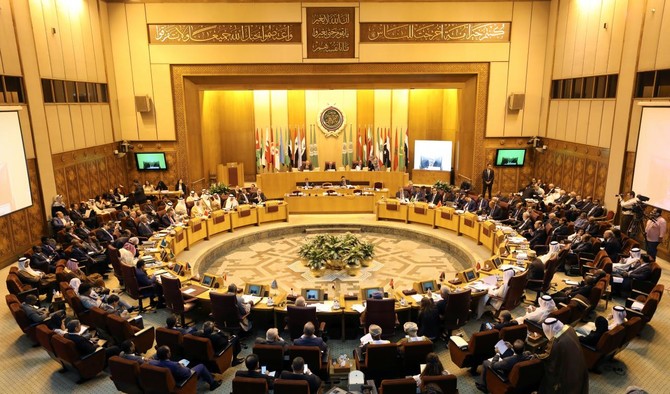
The Arab League is meeting to discuss developments in Gaza and Jerusalem. (Reuters)
2 / 2
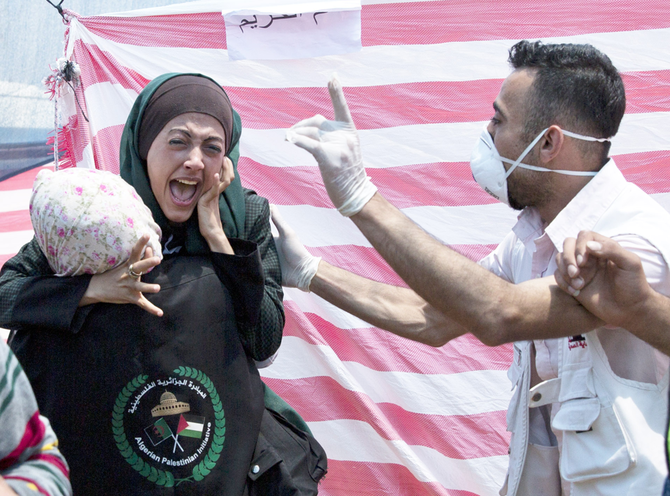
Tens of thousands of protesters have gathered along Gaza’s border with Israel since March 30, calling for Palestinian refugees to be able to return to their homes now inside Israel. AFP
Updated 18 May 2018
Follow

Arab League demands probe into Israel’s ‘blatant crimes’ against Palestinians

  • Saudi FM: US embassy move to Jerusalem is illegal according to international law
  • Kuwait FM: The inability of the UN Security Council to carry out its mission has allowed Israeli violations.

CAIRO/GAZA CITY: The Arab League has called for an investigation into the “crimes” of Israeli forces, following the deaths of scores of demonstrators at the Gaza border, with the Saudi foreign minister reiterating his country’s support for Palestinian rights.

In the deadliest day of violence in Gaza since the end of the 2014 conflict, Israeli forces on Monday killed about 60 Palestinians protesting against the move of the US Embassy in Israel from Tel Aviv to Jerusalem.

Arab League chief Ahmed Aboul Gheit, speaking at an extraordinary meeting of Arab foreign ministers in Cairo, demanded an independent investigation into the violence. 

“We call for a credible international investigation into the crimes committed by the occupation,” he said. 

“We are facing a state of blatant aggression against international law and legitimacy, which was embodied by the US embassy’s transfer in the occupying state to Jerusalem.”

Saudi Arabia’s Foreign Minister, Adel Al-Jubeir, said the Kingdom will not hesitate to support the Palestinians’ fight for their legitimate rights.

In his opening speech to the Arab League, Al-Jubeir said the Kingdom deplored the US administration’s decision to move its embassy to Jerusalem, a step that represented “a significant bias against the historical and permanent rights of the Palestinian people in the city.”

“The Palestinian issue is our first issue and will remain so until the Palestinian people obtain all their legitimate rights, foremost of which is the establishment of an independent state with East Jerusalem as its capital,” he said. 

Al-Jubeir said the Kingdom condemned the targeting of Palestinian civilians by Israeli occupation forces and urged the international community to “shoulder its responsibilities to stop the violence and protect the Palestinian people.” Saudi Arabia “refuses to move its embassy to Jerusalem,” he added.

Palestinian Foreign Minister Riyad Al-Maliki on Thursday suggested that Arab countries should recall their ambassadors to the US in response to Washington moving its embassy.

“There is no harm in Arab states collectively recalling their ambassadors in Washington to their capitals for consultations,” Al-Maliki said in televised remarks at the Arab League.

Tens of thousands of protesters have gathered along Gaza’s border with Israel since March 30, calling for Palestinian refugees to be able to return to their homes now inside Israel.

Israeli forces have killed about 116 Palestinians since the protests began, with one Israeli soldier reported wounded.

The deaths of up to 60 protesters on Monday has divided opinion in Gaza. While there is widespread anger at Israel, there is also disillusionment with Hamas, the dominant political faction in the strip.

Ghada Al-Serhi, a 39-year-old mother of two, told Arab News she had taken part in weekly demonstrations with her husband and brothers.

“Any people under occupation must suffer until liberation is achieved,” she said. “Yes, there are many victims, but should we continue to live under oppression, in a situation that does not meet the minimum standards for a meaningful life? Israel is the occupier. We must face them.”

However, 25-year-old Mohammed Al-Riyashi said he did not support the protests because they are “an easy way for Israel to kill young people.”

He told Arab News: “We do not need more wounded and disabled people. We need someone who will save us from the tragic situation in which we live — from the difficult conditions in which we live — not someone who will make life even more difficult and cruel.”


Delivery drivers dodge debris to keep Gulf fed under Iranian attacks

Updated 7 sec ago
Follow

Delivery drivers dodge debris to keep Gulf fed under Iranian attacks

  • Thousands of couriers on motorcycles have been working full throttle to ensure food, home supplies and whatever else a customer might need is available
  • UAE President Mohamed bin Zayed Al-Nahyan walked with his massive entourage through Dubai Mall pausing for an occasional selfie

DUBAI: As air raid sirens wail and explosions echo off glass skyscrapers, Gulf delivery drivers have emerged as unlikely heroes, providing a lifeline to frightened residents sheltering from Iranian attacks.
Airports, embassies, residential areas and military installations across the region have come under fire from daily salvos of Iranian missiles and drones since the war between the Islamic republic, Israel and the US broke out on Saturday.
While weaving through Gulf metropolizes’ traffic was never entirely safe, delivery drivers now face danger from the skies with the risk of falling debris from drones and interceptors.
Nonetheless, thousands of couriers on motorcycles have been working full throttle to ensure food, home supplies and whatever else a customer might need is available with the tap of an app.
During the war’s first hours, Agyemang Ata was in a mall in Dubai, waiting for an order when the first explosions rang out, but the 27-year-old has no plans to leave.
“My mom, sister and family have been calling me but I told them I am OK, they don’t need to worry about me,” Ata told AFP.
“I will stay here and work. Dubai is a safe place for me.”
To most residents, drivers like Ata were just an anonymous army keeping the hassles of daily life at bay — and to some, another traffic hazard on already busy streets.
Now, however, people are heralding their vital role, with many on social media describing them as “heroes” risking their lives to keep the Gulf running.
Further north in Kuwait, driver Walid Rabie said the fear was constant.
“We carry our lives along with the orders,” he told AFP
At least seven civilians have been killed in the Gulf since Iran began its attacks — many of them foreign laborers, who make up a large part of the region’s workforce.
Washington said six US service members have also been killed, four of them in Kuwait.

‘I have struggled’

The UAE has seen a disproportionate number of attacks, with the Ministry of Defense saying authorities have worked to intercept more than 900 drones and about 200 missiles fired at their territory.
“I’m afraid, I won’t lie,” said Franklin, a delivery driver in Dubai.
The need to earn a living outweighs other anxieties over the war, but maintaining his regular pace has been difficult under the new circumstances, and the number of orders has dropped.
“Before, I used to complete between 10 and 15 orders a day,” he explained. “But since this started, I have struggled to get even eight.”
The life of the drivers cuts a stark contrast to the region’s numerous influencers on social media, who have continued to party during the war, or to the city’s well-heeled expats, some of whom have dropped six figures on chartered flights out of neighboring countries to escape.
In Bahrain, where the sounds of explosions have continued for a sixth day, a foreign worker at a food delivery company said the situation was worrying at first but he has begun to get used to it — especially since he needs the job.
“I go out to work almost every day. I follow the news and hope the crisis will end,” said Ajit Arun, 32.
“We take precautions while driving, especially when the sirens sound.”
Across the Gulf, governments have implored their citizens and residents to avoid posting misinformation about the war and rely on official channels for news.
Others have sought to present an image of normality.
UAE President Mohamed bin Zayed Al-Nahyan walked with his massive entourage through Dubai Mall pausing for an occasional selfie.
But on the city’s streets, the reality of war weighed heavily, casting questions for some over future plans to stay in the Gulf.
“If things continue like this, I cannot risk my life,” said Franklin. “It would be better for me to return to my country.”