

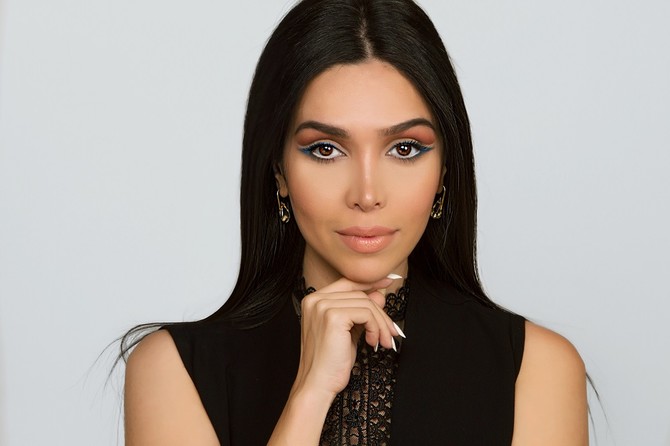
Make-up artist Samira Olfat talks Oprah, social media and Harleys

The UAE-based Iranian makeup artist and MaxFactor ambassador talks Oprah, social media and Harleys. (Supplied)
Updated 15 May 2018
Follow

Make-up artist Samira Olfat talks Oprah, social media and Harleys

Make-up artist Samira Olfat spoke to Arab News on the sidelines of Beautyworld Middle East and revealed that she loves motorbikes, champions social media and is a big believer in the power of women...

One of my biggest idols is Oprah. Sometimes people blame the family they were born into for their failure to achieve their dreams — but that’s not the case, and Oprah’s a great example of that. If you read about where she came from, and the things that happened to her, then look at where she is today — the most powerful woman in the world.

I believe you need to have a healthy body to be able to achieve what you want. So I love doing yoga and pilates; I love working out and meditating.

People think that I’m very girly, because I’m always in heels, always wearing dresses. But I have a tomboy side as well. I used to ride a Harley around. It was pretty fun, but pretty scary too. I ordered it customized — full matt-black. I had long braids coming out of my helmet, so it was obvious I was a girl. It was a bit intimidating for people, I think.

Social media is so important right now. It’s as important as the real job. There are (amazing) professionals I’ve known for the past 15 years who, because they don’t have a very strong platform on social media, don’t get credit. Before, people would get to know you through word of mouth, because your work was good. Now, you can be the most amazing makeup artist in the world, but if you don’t have a lot of Instagram followers, then no magazine’s going to come and interview you.

So many women still have to prove themselves to people who don’t believe in them. Honestly? Look around you. Look at these women who are CEOs and mothers, handling several jobs in one day. Looking after a home is a full-time job. Being a mother is a full-time job. Being a CEO — or an employee — is a full-time job. Women can handle several jobs at the same time, and usually they’re only being paid for one. What more do people want?

Women are so often labelled ‘emotional,’ like that’s a negative thing. But if you’re not emotionally smart, then you can’t handle a company as well. If you look at companies where a woman is the boss, the energy is so much better. It’s so much happier.


Review: ‘Sorry, Baby’ by Eva Victor

Eva Victor appears in Sorry, Baby by Eva Victor, an official selection of the 2025 Sundance Film Festival. (Supplied)
Updated 27 December 2025
Follow

Review: ‘Sorry, Baby’ by Eva Victor

  • Victor makes a deliberate narrative choice; we never witness the violence of what happens to her character

There is a bravery in “Sorry, Baby” that comes not from what the film shows, but from what it withholds. 

Written, directed by, and starring Eva Victor, it is one of the most talked-about indie films of the year, winning the Waldo Salt Screenwriting Award at Sundance and gathering momentum with nominations, including nods at the Golden Globes and Gotham Awards. 

The film is both incisive and tender in its exploration of trauma, friendship, and the long, winding road toward healing. It follows Agnes, a young professor of literature trying to pick up the pieces after a disturbing incident in grad school. 

Victor makes a deliberate narrative choice; we never witness the violence of what happens to her character. The story centers on Agnes’ perspective in her own words, even as she struggles to name it at various points in the film. 

There is a generosity to Victor’s storytelling and a refusal to reduce the narrative to trauma alone. Instead we witness the breadth of human experience, from heartbreak and loneliness to joy and the sustaining power of friendship. These themes are supported by dialogue and camerawork that incorporates silences and stillness as much as the power of words and movement. 

The film captures the messy, beautiful ways people care for one another. Supporting performances — particularly by “Mickey 17” actor Naomi Ackie who plays the best friend Lydia — and encounters with strangers and a kitten, reinforce the story’s celebration of solidarity and community. 

“Sorry, Baby” reminds us that human resilience is rarely entirely solitary; it is nurtured through acts of care, intimacy and tenderness.

A pivotal scene between Agnes and her friend’s newborn inspires the film’s title. A single, reassuring line gently speaks a pure and simple truth: “I know you’re scared … but you’re OK.” 

It is a reminder that in the end, no matter how dark life gets, it goes on, and so does the human capacity to love.