

‘Dignity is priceless’: UNRWA chief talks to Arab News about funding, pride in helping Palestinians under Israeli blockade

Palestinians throw stones at a tank during clashes with Israeli troops, at the town of Nablus on the West Bank, in 2003. (Getty Images)
Updated 16 May 2018
Follow

‘Dignity is priceless’: UNRWA chief talks to Arab News about funding, pride in helping Palestinians under Israeli blockade

  • The US decision to withhold $65 million presented the UN refugee agency with its toughest challenge
  • More than 400: Palestinian cities and towns destroyed by Israeli forces or repopulated between 1948 and 1950.

JERUSALEM: For Pierre Krahenbuhl, the commissioner general of the United Nations Relief and Works Agency (UNRWA), it was a rare piece of good news during the biggest crisis in the history of his organization.

During the Arab League summit in the Saudi city of Dhahran, King Salman announced a $50 million contribution to help support the UN agency responsible for the care of Palestinian refugees. Within days the UAE had followed suit.

“I was deeply appreciative of the amount and that was made at such a senior level and I was pleased that there was close interaction with the leadership of the UAE who followed suit in making a similar amount of support within a week,” said Krahenbuhl, a Swiss national who was appointed by UN Secretary General Ban Ki Moon in 2014.  

The donations came after months of uncertainty about a gaping hole in the agency’s funding. On Jan. 16, Donald Trump announced that Washington would withhold $65 million out of the first tranche of the $125 million of contributions for 2018. The decision placed in doubt the provision of services such as health care and education to tens of thousands of Palestinians.

In a wide-ranging exclusive interview with Arab News, Krahenbuhl discussed UNRWA’s financial status, relations with the US, and the status of Palestine refugees in Gaza, Syria, Lebanon and Jordan.

Speaking from his humble East Jerusalem office, he said the US decision was a major disappointment  to the UN agency. 

“In past years, the US contributed an average of $350 million per year. They have always been a generous and stable partner to UNRWA.”  

Last year Washington gave the UN agency $364 million. “My understanding is that in Congress the amount is still there, but that will require a political decision to get it released, and we don’t presently expect that to happen.”

With a huge $446 million deficit in 2018, UNRWA went back to the international community that had given it a mandate to serve Palestinian refugees. An international emergency fundraising conference sponsored by Sweden, Jordan and Egypt was quickly convened in mid-March in Rome. More than 25 foreign ministers or deputy foreign ministers attended, as well as the UN Secretary General and the Palestinian prime minister. 

“The message of this high-level attendees was important politically. Their presence reflected that UNRWA is an organization that needs to be protected,” said the commissioner general.

In the few months since the Trump announcement, UNRWA has managed to gather funds of more than $200 million. Of this, $100 million was raised at the conference held in Rome on March 15, as countries such as Qatar, Turkey, India, Norway and Canada made contributions. While the vast majority of the support so far has come from member states, Krahenbuhl is confident of being able to raise a lot more money from private individuals and national organizations.

Shortly after the announcement was made by Trump, UNRWA officials realized that they needed a campaign with a powerful message.

“Many ideas where thrown around and it was energizing to see Palestine refugees, student parliaments, and our staff brainstorming to come up with a strong slogan.”

The consensus fell on a simple but powerful one: “Dignity is priceless.”

The campaign was launched within days of Trump’s announcement. “It is important to stress concepts such as dignity and rights. I know that no Palestinian refugee wants to trade food for a solution. No money can buy dignity and respect of their rights. The campaign has opened space for us.”

The UN agency that normally deals with member states all of a sudden was able to portray a strong concept that was very human.

“With the campaign people rediscovered another side of our mandate. For instance, in Indonesia people were surprised that we have 98 percent of our staff are Palestine refugees.”

The UN official added that UNRWA will make a powerful fundraising appeal during Ramadan. The agency has become eligible to receive Zakat funds and it
plans to engage with various nationalist institutions.

“I was in Turkey and met  President Erdogan who committed to mobilize the national Turkish institutions. We are diversifying
well, both in terms of sources and ways of fundraising.”

Despite his efforts to raise money for the UN agency, Krahenbuhl said that the most challenging effect of years of wars and siege is felt on the emotional level — particularly in Gaza where years of Israeli siege have pushed the economic and humanitarian situation to a new low in recent months.

“The psychological effects are deep and devastating; our medical colleagues talk about an epidemic of psycho-social conditions in Gaza.”

 Krahenhuhl explains that due to the blockade and conflict there is no hope on the horizon. “They go to school, but 65 percent will not get a job and 90 percent of our students have never left Gaza. We have 270,000 students studying in Gaza.” 

The UN official is concerned about the long-term emotional effects on the population of Gaza. 

“We give food to one million people, a population who are highly educated and who used to run their own businesses. They lost all that because of the blockade. I am proud we can help them.”
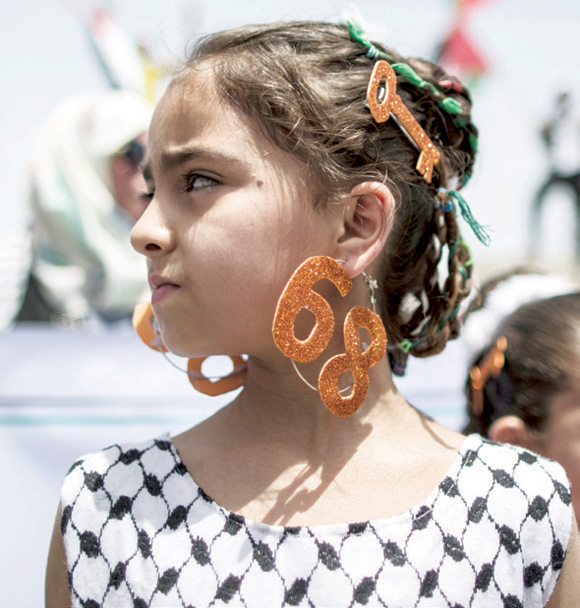


Between 250,000 and 350,000: The number of Palestinians expelled from their homes by Zionist paramilitaries between the passage of the UN partition plan in November 1947 and Israel’s declaration of independence on May 14, 1948.


Iraq’s political future in limbo as factions vie for power

Updated 21 December 2025
Follow

Iraq’s political future in limbo as factions vie for power

  • The government that eventually emerges will be inheriting a security situation that has stabilized in recent years

BAGHDAD: Political factions in Iraq have been maneuvering since the parliamentary election more than a month ago to form alliances that will shape the next government.
The November election didn’t produce a bloc with a decisive majority, opening the door to a prolonged period of negotiations.
The government that eventually emerges will be inheriting a security situation that has stabilized in recent years, but it will also face a fragmented parliament, growing political influence by armed factions, a fragile economy, and often conflicting international and regional pressures, including the future of Iran-backed armed groups.
Uncertain prospects
Prime Minister Mohammed Shia Al-Sudani’s party took the largest number of seats in the election. Al-Sudani positioned himself in his first term as a pragmatist focused on improving public services and managed to keep Iraq on the sidelines of regional conflicts.
While his party is nominally part of the Coordination Framework, a coalition of Iran-backed Shiite parties that became the largest parliamentary bloc, observers say it’s unlikely that the Coordination Framework will support Al-Sudani’s reelection bid.
“The choice for prime minister has to be someone the Framework believes they can control and doesn’t have his own political ambitions,” said Sajad Jiyad, an Iraqi political analyst and fellow at The Century Foundation think tank.
Al-Sudani came to power in 2022 with the backing of the Framework, but Jiyad said that he believes now the coalition “will not give Al-Sudani a second term as he has become a powerful competitor.”
The only Iraqi prime minister to serve a second term since 2003 was Nouri Al-Maliki, first elected in 2006. His bid for a third term failed after being criticized for monopolizing power and alienating Sunnis and Kurds.
Jiyad said that the Coordination Framework drew a lesson from Al-Maliki “that an ambitious prime minister will seek to consolidate power at the expense of others.”
He said that the figure selected as Iraq’s prime minister must generally be seen as acceptable to Iran and the United States — two countries with huge influence over Iraq — and to Iraq’s top Shiite cleric, Grand Ayatollah Ali Al-Sistani.
Al-Sudani in a bind
In the election, Shiite alliances and lists — dominated by the Coordination Framework parties — secured 187 seats, Sunni groups 77 seats, Kurdish groups 56 seats, in addition to nine seats reserved for members of minority groups.
The Reconstruction and Development Coalition, led by Al-Sudani, dominated in Baghdad, and in several other provinces, winning 46 seats.
Al-Sudani’s results, while strong, don’t allow him to form a government without the support of a coalition, forcing him to align the Coordination Framework to preserve his political prospects.
Some saw this dynamic at play earlier this month when Al-Sudani’s government retracted a terror designation that Iraq had imposed on the Lebanese Hezbollah militant group and Yemen’s Houthi rebels — Iran-aligned groups that are allied with Iraqi armed factions — just weeks after imposing the measure, saying it was a mistake.
The Coalition Framework saw its hand strengthened by the absence from the election of the powerful Sadrist movement led by Shiite cleric Muqtada Sadr, which has been boycotting the political system since being unable to form a government after winning the most seats in the 2021 election.
Hamed Al-Sayed, a political activist and official with the National Line Movement, an independent party that boycotted the election, said that Sadr’s absence had a “central impact.”
“It reduced participation in areas that were traditionally within his sphere of influence, such as Baghdad and the southern governorates, leaving an electoral vacuum that was exploited by rival militia groups,” he said, referring to several parties within the Coordination Framework that also have armed wings.
Groups with affiliated armed wings won more than 100 parliamentary seats, the largest showing since 2003.
Other political actors
Sunni forces, meanwhile, sought to reorganize under a new coalition called the National Political Council, aiming to regain influence lost since the 2018 and 2021 elections.
The Kurdish political scene remained dominated by the traditional split between the Kurdistan Democratic Party and Patriotic Union of Kurdistan parties, with ongoing negotiations between the two over the presidency.
By convention, Iraq’s president is always a Kurd, while the more powerful prime minister is Shiite and the parliamentary speaker Sunni.
Parliament is required to elect a speaker within 15 days of the Federal Supreme Court’s ratification of the election result, which occurred on Dec. 14.
The parliament should elect a president within 30 days of its first session, and the prime minister should be appointed within 15 days of the president’s election, with 30 days allotted to form the new government.
Washington steps in
The incoming government will face major economic and political challenges.
They include a high level of public debt — more than 90 trillion Iraqi dinars ($69 billion) — and a state budget that remains reliant on oil for about 90 percent of revenues, despite attempts to diversify, as well as entrenched corruption.
But perhaps the most delicate question will be the future of the Popular Mobilization Forces, a coalition of militias that formed to fight the Daesh group as it rampaged across Iraq more than a decade ago.
It was formally placed under the control of the Iraqi military in 2016 but in practice still operates with significant autonomy. After the Hamas-led attack in southern Israel on Oct. 7, 2023 sparked the devastating war in Gaza, some armed groups within the PMF launched attacks on US bases in the region in retaliation for Washington’s backing of Israel.
The US has been pushing for Iraq to disarm Iran-backed groups — a difficult proposition, given the political power that many of them hold and Iran’s likely opposition to such a step.
Two senior Iraqi political officials, who spoke on condition of anonymity because they weren’t authorized to comment publicly, said that the United States had warned against selecting any candidate for prime minister who controls an armed faction and also cautioned against letting figures associated with militias control key ministries or hold significant security posts.
“The biggest issue will be how to deal with the pro-Iran parties with armed wings, particularly those... which have been designated by the United States as terrorist entities,” Jiyad said.