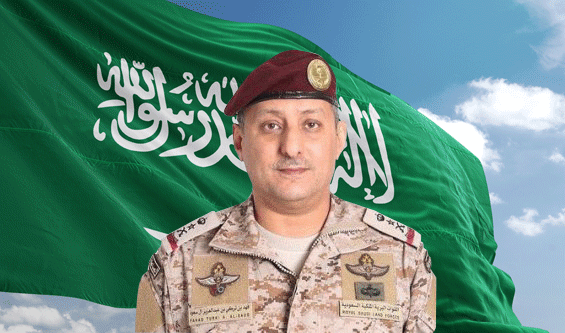
FaceOf: Prince Fahad bin Turki bin Abdul Aziz, commander of the joint forces of the Saudi-led Arab coalition in Yemen

Prince Fahad bin Turki. (AN Photo)
Updated 15 May 2018
Follow

FaceOf: Prince Fahad bin Turki bin Abdul Aziz, commander of the joint forces of the Saudi-led Arab coalition in Yemen

  • Prince Fahad is the new commander of the joint forces of the Saudi-led Arab coalition to restore the legitimate government in Yemen
  • The coalition is also working with the international community to stop recruiting children to fight in Yemen

He is the new commander of the joint forces of the Saudi-led Arab coalition to restore the legitimate government in Yemen. Prince Fahad bin Turki bin Abdul Aziz Al-Saud was appointed to lead the forces through a royal decree on Feb. 26. 

Before joining the coalition forces, he was the commander of the Royal Saudi Ground Forces, commander of paratroopers units and special forces. He also served as special operations commander of the coalition.

Prince Fahad bin Turki recently received Yemeni President Abed Rabbo Mansour Hadi when he visited the joint forces command of the coalition. 

They discussed the Yemeni army’s field operations and reviewed the coalition’s military operations in the country. 

During the meeting, President Hadi praised the role of the coalition, the national army, and the Yemeni people for rejecting and countering the Iranian-backed Houthi militias. 

The coalition is also working with the international community to stop recruiting children to fight in Yemen.

In January 2018, the foreign ministers of the coalition members announced a $1.5 billion humanitarian aid package for Yemen.

Prince Fahad bin Turki is the son of Prince Turki bin Abdul Aziz, who is the former deputy minister of defense and aviation, and the 21st son of King Abdul Aziz, the first monarch and founder of Saudi Arabia. 

 He joined the military service in 1983 and was awarded a diploma from the US Army Field Artillery School at Fort Benning, Georgia, in 1984. 

He also received a master’s degree in International Business Administration (MIBA) from the US International University in June 1983.


Foreign ministers chair Saudi-Omani coordination council meeting in Muscat

Updated 23 December 2025
Follow

Foreign ministers chair Saudi-Omani coordination council meeting in Muscat

MUSCAT: Saudi Foreign Minister Prince Faisal bin Farhan met with Oman’s Foreign Minister Sayyid Badr bin Hamad Al-Busaidi on Monday.

They reviewed bilateral relations between their nations and ways to enhance and develop them across various fields. Additionally, they discussed regional and international developments.

The ministers co-chaired the third meeting of the Saudi-Omani Coordination Council in the Omani capital, Muscat, with the participation of the heads of the Council’s subsidiary committees and the two heads of the Council’s General Secretariat teams.

The meeting comes as an affirmation of the keenness of Saudi and Omani leaders to strengthen ties and advance them toward greater prosperity for both nations.

In his remarks during the meeting, Prince Faisal affirmed that gathering builds on the previous council meeting, held last year in AlUla, and on its positive and fruitful outcomes within the framework of the approved recommendations and initiatives. 

He stressed the importance of continuing the work of the council’s subsidiary committees to complete the necessary procedures to implement the remaining initiatives, and of the General Secretariat’s role in follow-up and in addressing any challenges that may hinder implementation.

He also underscored the importance of developing and enhancing trade relations, stimulating investment, and strengthening cooperation between the public and private sectors.

He also praised the ongoing work to establish and launch the Coordination Council’s electronic platform, which aims to connect all committee work and initiatives to facilitate follow-up on the Council’s progress. 

Al-Busaidi affirmed in his remarks the qualitative progress in relations between the two countries and the notable development witnessed across numerous sectors toward achieving economic integration and enhancing intra-trade and joint investments. 

The Omani foreign minister also highlighted deeper cooperation in the security and judicial fields, as well as the cultural and tourism sectors, noting the advanced and continuous political cooperation, consultation, and coordination on regional and international issues.