ISLAMABAD: Pakistan’s northwestern province of Khyber Pakhtunkhwa Transport and Mass Transit Department has launched the Sakura Women Bus Service with financial assistance from the Government of Japan along with technical implementing partnership with UNOPS and UNWOMEN.
UNOPS helps the UN and its partners provide peace and security, humanitarian and development solutions while UNWOMEN works for women.
“With the aim of providing a public transport service safe to women and girls, a total of 14 buses have been procured. Seven buses will be allocated to each of the two districts of Mardan and Abbottabad,” UNOPS said in a press release on May 11, 2018 after the launch of the service.
Although the service is meant for women only, boys under the age of 12 can also utilize the transport service when they are accompanied by their mothers or sisters.
At the launching ceremony Samita Khawar, country manager UNOPS Pakistan, highlighted the fact that “sexual harassment of women is not limited to the workplace. It can and does occur when a woman leaves home for work or studies. Working women and female students experience sexual harassment from men working as drivers and conductors/ticket collectors in public transport.”
She added UNOPS considers it an honor to have supported and worked in close partnership with the Department of Transport, Government of Khyber Pakhtunkhwa (KP), the Japanese Government and UN WOMEN on this empowered project.
The project has been initiated in response to an increasing demand for an efficient and reliable public transport system in the districts that is safe for women.
For women, commuting to their workplaces or colleges or universities remains a challenge.
“Public transportation is the cheapest and practical route adopted by the women, but, traveling with the fear of harassment and having to face it every day brings down their productivity drastically and also substantially curbs their mobility and their access to public spaces,” the UNOPS statement reads.
Takashi Kurai, Ambassador of Japan, expressed the hope that Sakura Women Buses will help the women of KP not only move from one place to another but also depart for a new stage in their lives.
“I believe this safer transportation will provide women with more freedom in movement. I am glad that Japan could assist KPK government in promoting the empowerment of women by providing the Sakura buses in collaboration with UNOPS and UNWOMEN,” Ambassador Takashi said.
Kamran, provincial secretary of the Transport and Mass Transit Department, Government of Khyber Pakhtunkhwa, thanked the Government of Japan, UNOPS and UN WOMEN for supporting this initiative.
“The initiative of Sakura Women Buses is already getting a good response from the ladies of KP, and they are looking forward to it. This is the first brick of a bigger vision, in which many more buses will be included into the public transport domain,” Kamran said.
Sangeeta Thapa, deputy representative, UN WOMEN, emphasized that “Women and girls face various forms of violence when accessing public transport, which restricts their mobility and in turn has a profound impact on their economic independence as well as their emotional and physical wellbeing.”
The United Nations Office for Project Services (UNOPS) is an operational arm of the United Nations, helping a range of partners implement around $1.4 billion worth of peace-building, humanitarian and development projects every year.


![]()
![]()
![]()

KP launches transport service for women with the help of UN agencies
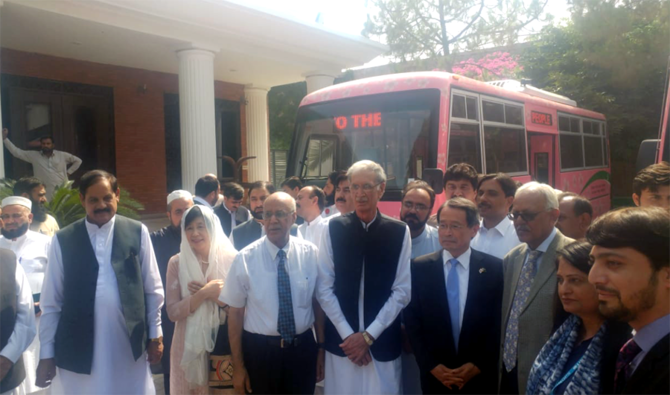
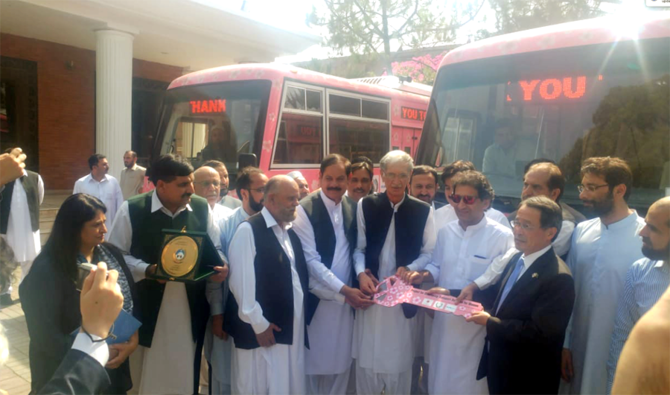
KP launches transport service for women with the help of UN agencies
- The service was launched with the aim of providing safe public transport for women and girls in the northwestern province of Pakistan
- Boys under the age of 12 can also utilize the transport service when they are accompanied by their mothers or sisters

Latest updates


© 2026 SAUDI RESEARCH & PUBLISHING COMPANY, All Rights Reserved And subject to Terms of Use Agreement.