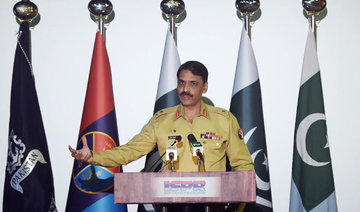
ISLAMABAD: Pakistan’s Chief of Army Staff, General Qamar Javed Bajwa, has made Forbes magazine’s annual list of The World’s Most Powerful People for the first time, ranked 68th.
Placement on the 75-strong chart is based on four factors: the number of people the person has power over; the financial resources they control; their influence in multiple spheres; and how actively they wield their power to change the world.
“Javed Bajwa joins the world’s most powerful at a time when the rift between India and Pakistan is improving, partly thanks to his efforts,” Forbes wrote. “Although the president is his boss on paper, Pakistan’s Chief of Army Staff is de facto the most powerful person in the nuclear-armed state.
“Two years into his tenure as the head of the world’s sixth-largest army, Bajwa has established himself as a mediator and proponent of democracy.”
Chinese President Xi Jinping tops the list, while Russian President Vladimir Putin and US President Donald Trump are ranked second and third, respectively.
Bajwa is one of 17 new entrants on the list. Of these, Saudi Crown Prince Mohammad bin Salman, the Kingdom’s de facto leader, is the only one who made the top 10, at number eight. Indian President Narendra Modi is ninth on the list and French President Emmanuel Macron is 12th. German Chancellor Angela Merkel, the only woman in the top 10, was ranked fourth.
Forbes’ annual ranking identifies one person out of every 100 million “whose actions mean the most”.
“There are nearly 7.5 billion humans on planet Earth, but these 75 men and women make the world turn,” the magazine said.

Pakistani army chief ranked 68th-most powerful person in world by Forbes magazine
- General Qamar Javed Bajwa is one of 17 new entrants on the annual list
- “Javed Bajwa joins the world’s most powerful at a time when the rift between India and Pakistan is improving, partly thanks to his efforts,” Forbes wrote
Russia attacks two Ukrainian ports, damaging three Turkish-owned vessels
- Kyiv says Russia used drones and missiles for strikes
- Moscow vowed retaliation for Kyiv’s attacks on tanker fleet
KYIV: Russia attacked two Ukrainian ports on Friday, damaging three Turkish-owned vessels including a ship carrying food supplies, Ukrainian officials and one ship owner said, days after Moscow threatened to cut “Ukraine off from the sea.”
Last week, Russian President Vladimir Putin vowed retaliation against Kyiv’s maritime drone attacks on Moscow’s “shadow fleet” tankers thought to be used to export oil, which Kyiv says is Russia’s main source of funding for its almost four-year-old war.
The attack on Friday came hours after Turkish President Tayyip Erdogan told Putin that a limited ceasefire for energy facilities and ports could be beneficial.
Ukrainian President Volodymyr Zelensky posted photos which showed a large fire burning aboard a ship in the port of Chornomorsk in Odesa region, with firefighters tackling the blaze.
“This proves once again that Russians not only fail to take the current opportunity for diplomacy seriously enough, but also continue the war precisely to destroy normal life in Ukraine,” he said.
That vessel’s owner, Cenk Shipping, said the Cenk T vessel had been subject to attack around 1600 Ukraine time (1400 GMT).
There were no casualties among the crew, and damage was limited, it added.
Reuters verified the moment of the attack seen on a video published on X. The vessel in the clip matched Cenk T, and the cranes and buildings matched satellite imagery of the Chornomorsk port.
Fabian Hinz, research fellow for defense and military analysis at the International Institute for Strategic Studies, said the weapon seen was a Russian Geran-2 drone in its loitering configuration.
Russia’s defense ministry did not immediately reply to a Reuters request for comment.
“The strike is aimed at civilian logistics and commercial shipping,” Ukraine’s Deputy Prime Minister Oleksiy Kuleba said.
Navigation safety targeted
Russia attacked Ukrainian ports with drones and ballistic missiles, Kuleba added.
He said that one employee of a private company had been injured in a separate attack on Odesa port, and that a cargo loader had been damaged there.
Ukraine’s navy spokesperson told Reuters that three vessels were damaged in total, all Turkish-owned. But the spokesperson did not provide additional details.
Turkiye’s foreign ministry confirmed damage in the Chornomorsk port, adding that there were no reports of injured Turkish citizens.
Reuters was able to verify the vessel by the design and name of the bow that matched file imagery of the Cenk T vessel.
“We reiterate the need for an arrangement whereby, in order to prevent escalation in the Black Sea, attacks targeting navigational safety as well as the parties’ energy and port infrastructure are suspended,” the ministry’s statement said.
The three large Black Sea ports in the Odesa region are a key economic artery for Ukraine, which is a major commodities exporter.
In addition to the attacks on Moscow’s “shadow fleet” tankers, Ukraine has ramped up pressure on Russia by hitting targets in the Caspian Sea this week, including vessels allegedly carrying military equipment and a major oil rig.