

‘Stab in the back’ splits Iraq’s Shiites

In this May 1, 2018 file photo, Iraq Prime Minister Haider al-Abadi, speaks during a campaign rally in Baghdad, Iraq. (AP Photo/Hadi Mizban, File)
Updated 12 May 2018
Follow

‘Stab in the back’ splits Iraq’s Shiites

  • Al-Maliki and Abadi rift puts the future of Dawa Party in doubt
  • The main Shiite party has dominated Iraqi government since the fall of Saddam Hussein in 2003. 

BAGDHDAD: When Iraqis vote on Saturday in the parliamentary elections, they may not just decide the political future of Prime Minister Haider Abadi — the results could also determine the fate of his Dawa party.

The main Shiite party has dominated Iraqi government since the fall of Saddam Hussein in 2003. 

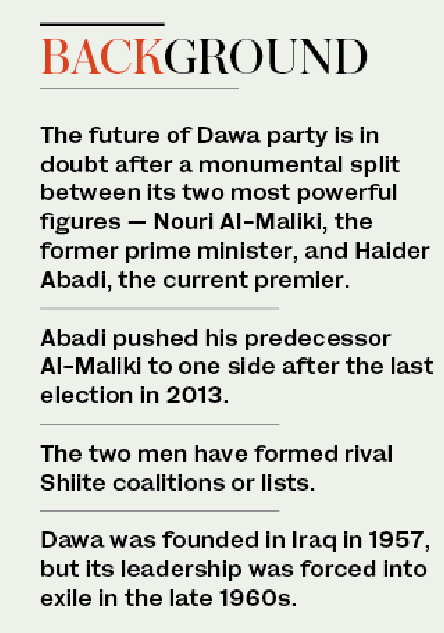
But its future is in doubt after a monumental split between its two most powerful figures — Nouri Al-Maliki, the former prime minister, and Abadi, the current prime minister, who pushed his predecessor to one side after the last election in 2014. 

Despite being members of the same party, the two men have formed rival Shiite coalitions or lists. Al-Maliki heads the State of Law coalition while Abadi established the Al-Nassir list in January.

Campaigning has seen an unprecedented and bitter electoral battle between the two blocs. If Abadi fails to secure a second term, the party may implode.

Dawa was founded in Iraq in 1957, but its leadership was forced into exile in the late 1960s after the Baathist regime began arresting and executing its members.

Its fortunes changed after the US-led invasion in 2003. It led the first Iraqi government of the post-Saddam era in 2005, and has retained the position of prime minister in the two subsequent elections through winning the largest number of parliamentary seats.

But in 2014, the party and Iraqi politics were shaken when senior Dawa leaders ignored the 700,000 votes Al-Maliki had won and made Abadi the next prime minister. 

During Al-Maliki’s tenure, rampant corruption spread through government departments, especially within the security establishment. Al-Maliki was also responsible for a raft of sectarian policies in Sunni-dominated areas that fueled anti-government resentment. That anger made it easier for Daesh to seize a third of Iraqi territory in the north and west after the dramatic collapse of the Iraqi army in June 2014.

Abadi became prime minister by circumventing the 2014 election outcome and not from reaching an agreement, a prominent Dawa leader and one of Al-Maliki’s inner circle told Arab News.

“Al-Maliki heard about the assigning of Abadi to form the government from the TV. It was humiliating, painful and a stab in the back.” 
The Dawa leader said Abadi would be vetoed by the leaders of Al-Maliki’s State of Law coalition if he tries to form a government.

The State of Law Coalition won 92 seats out of 325 in 2014 and topped the results in 10 provinces, including Baghdad, but this was not enough to secure him a third term.

While Al-Maliki was negotiating to secure his post, Daesh were advancing toward Baghdad, and thousands of civilians and soldiers were being slaughtered. The Shiite clergymen in Najaf, who represent the highest religious authority in Iraq, said they would not support Al-Maliki. 

Abadi, who was a member of the team formed by Al-Maliki to win support from other blocs, realized, along with other Dawa leaders, that Al-Maliki’s way was blocked and the alternative was to present a compromise candidate.

“The loss of the post of prime minister meant the end of the Dawa party. They had to act quickly and offer an alternative,” a former minister and Dawa advisers, told Arab News.

Al-Maliki filed a lawsuit against President Fuad Masum “for violating the constitution”, but a few weeks later he gave up and announced his support for Abadi under pressure from the local and international community.

He continued, however, to use his influence within the government to undermine Abadi whenever the opportunity arose. “Abadi has broken the prestige of the state,” the official close to Al-Maliki said. “He is weak and his performance is unsatisfactory, so he deserves what he is exposed to.”

Meanwhile, Abadi sidelined a large number of military leaders loyal to Al-Maliki and limited the powers of many senior officials appointed by his predecessor. The conflict between the two men came to a head when they both decided to run for the 2018 elections on separate lists, neither of using the name of the Dawa party.

Abadi ran into trouble a day after announcing his coalition when Iran-backed militia groups decided to pull out.

Several Dawa leaders underestimated the risks of splitting the party between two separate lists. They believed the two men would come together after the elections, but this scenario seems increasingly unlikely. “Dawa will not lose if the State of Law and Al-Nassir win many seats, unless one of them (Al-Maliki and Abadi) insists on getting the (prime minister) post,” Sami Al-Askari, a prominent member of State of Law and one of Al-Maliki’s close associates told Arab News.

“Accepting Abadi (as a part of State of Law) is not at all discussed.  They (Al-Maliki and Abadi) can come together on condition that they withdraw their candidature (for the PM post) or seek to nominate an independent individual from outside Dawa.

“This (scenario) is also related to the number of votes. If Abadi wins a very high number of votes, which is not expected, then maybe he has a chance.”

The absence of a clear vision of the outcome of the elections, casts a shadow on all the Dawa leaders . Its fate seems to be hanging on whether Al-Maliki look for revenge against Abadi or favor the interests of the party and its members.

“There is real fear for Dawa. The party will end if the two men insist on becoming prime minister,” Al-Maliki’s inner-circle member said.

“Al-Maliki has the same concerns and is keen to save Dawa, but the question is whether these concerns are enough to restrain him or not.”


Trump tells Iranians ‘help on its way’

Updated 4 sec ago
Follow

Trump tells Iranians ‘help on its way’

  • US president says Iranians should 'keep protesting' and that he canceled all meetings with Iranian officials
  • Successive nights of mass protests nationwide may have killed thousands, NGO says
PARIS: US President Donald Trump urged Iranians on Tuesday to keep protesting against the country’s theocratic leadership, telling them “help is on its way” as international outrage grows over a crackdown one rights group said has likely killed thousands.
Iranian authorities insisted they had regained control after successive nights of mass protests nationwide since Thursday that have posed one of the biggest challenges to the clerical leadership since the 1979 Islamic revolution that ousted the shah.
Rights groups accuse the government of fatally shooting protesters and masking the scale of the crackdown with an Internet blackout that has now lasted almost five days.
New videos on social media, whose location AFP verified, showed bodies lined up in the Kahrizak morgue just south of the Iranian capital, with the corpses wrapped in black bags and distraught relatives searching for loved ones.
International phone links were restored on Tuesday, but only for outgoing calls, according to an AFP journalist, and the quality remains spotty, with frequent interruptions.
Trump, who has repeatedly threatened Iran with military intervention, said Iranians should continue their nationwide protests, take over institutions and record the names of “killers and abusers.”
“Iranian Patriots, KEEP PROTESTING,” Trump wrote on his Truth Social platform. “I have canceled all meetings with Iranian Officials until the senseless killing of protesters STOPS. HELP IS ON ITS WAY.”
It was not immediately clear what meetings he was referring to or what the nature of the help would be.
European nations also signalled their anger, with France, Germany and the United Kingdom among the countries that summoned their Iranian ambassadors to protest what French Foreign Minister Jean-Noel Barrot called “state violence unquestioningly unleashed on peaceful protesters.”
“The rising number of casualties in Iran is horrifying,” said EU chief Ursula von der Leyen, vowing further sanctions against those responsible.

- ‘In the thousands’ -

The Norway-based NGO Iran Human Rights (IHR) said it had confirmed 734 people killed during the protests, including nine minors, but warned the death toll was likely far higher.
“The figures we publish are based on information received from fewer than half of the country’s provinces and fewer than 10 percent of Iran’s hospitals. The real number of those killed is likely in the thousands,” the director of Norway-based NGO Iran Human Rights (IHR) Mahmood Amiry-Moghaddam said.
Fears have also grown that the Islamic republic could use the death penalty to crack down on the protests after Tehran prosecutors said Iranian authorities will press capital charges of “moharebeh,” or “waging war against God,” against some suspects arrested over recent demonstrations.
“Concerns are mounting that authorities will once again resort to swift trials and arbitrary executions to crush and deter dissent,” Amnesty International said.
IHR highlighted the case of Erfan Soltani, 26, who was arrested last week in the Tehran satellite city of Karaj and who, according to a family source, has already been sentenced to death and is due to be executed as early as Wednesday.
Iranian state media has said dozens of members of the security forces have been killed, with their funerals turning into large pro-government rallies. Authorities have declared three days of national mourning for those killed.
Amir, an Iraqi computer scientist, returned to Baghdad on Monday and described dramatic scenes in Tehran.
“On Thursday night, my friends and I saw protesters in Tehran’s Sarsabz neighborhood amid a heavy military presence. The police were firing rubber bullets,” he told AFP in Iraq.

‘Last days’

The government on Monday sought to regain control of the streets with mass nationwide rallies that supreme leader Ayatollah Ali Khamenei hailed as proof that the protest movement was defeated, calling them a “warning” to the United States.
In power since 1989 and now 86, Khamenei has faced significant challenges, most recently the 12-day war in June against Israel, which resulted in the killing of top security officials and forced him to go into hiding.
“When a regime can only hold on to power through violence, then it is effectively finished,” said German Chancellor Friedrich Merz during a trip to India. “I believe that we are now witnessing the last days and weeks of this regime.”
Analysts, however, have cautioned that it is premature to predict the immediate demise of the theocratic system, pointing to the repressive levers the leadership has, including the Revolutionary Guards Corps (IRGC), which are charged with safeguarding the Islamic revolution.
“These protests arguably represent the most serious challenge to the Islamic republic in years, both in scale and in their increasingly explicit political demands,” Nicole Grajewski, professor at the Sciences Po Center for International Studies in Paris, told AFP.
She said it was unclear if the protests would unseat the leadership, pointing to “the sheer depth and resilience of Iran’s repressive apparatus.”