BAGHDAD: Women standing for election in Iraq have withdrawn as candidates after being shamed, threatened and smeared by opponents.
More than 20 candidates, mostly women, quietly withdrew from the election race in the last few days, candidates and observers told Arab News, and that number is expected to rise before the vote on Saturday.
 One woman candidate, who decided to withdraw from the election, said opponents had threatened to fabricate a scandalous video of her and publish it online.
“I’m not ready to tarnish my reputation and the reputation of my family for political gain,” she told Arab News. “My reputation is more expensive than the Parliament itself. If the price of getting a seat is to go into this mud, then my choice is to withdraw.”
With campaigning now in the last week, fierce rivalries between the big electoral lists has descended into mud slinging and the use of smear campaigns to destroy opponents by painting them as immoral.
The targets have mostly been women, who in a conservative society such as Iraq, are considered more susceptible to political damage from shaming tactics.
The main tools being used are videos and images showing the women candidates in inappropriate or sexual situations.
At least four videos have been widely circulated in social media, appearing to show a number of candidates in compromising positions.
The most widely shared video targeted a professor with a leading position in the alliance, which is headed by Iraqi Prime Minister Haider Abadi. She was forced to withdraw her candidacy and referred to the investigation.
A new fake, sexually explicit video spread on Monday showed another female candidate.
Unknown secular female candidates and small electoral lists have been most targeted in the smear campaigns. The explicit images and videos have been published and circulated on social media on pages funded and linked to influential politicians.
Sawsan Farouq, a candidate of the secular Tamadoun electoral list, announced her withdrawal from the race on Sunday. In a short speech delivered on her Facebook account, she blamed it on pressure. She did not elaborate, but many pictures showing her in lingerie have been circulated on social media.
Secular candidates accuse Islamist parties and lists of being involved in the smear campaigns.
“The masses are angry at the Islamic parties and began to turn against them and support the secular ones,” Shorouq Al-Abaiji, a prominent secular candidate and spokeswoman of Tamadoun, told Arab News. “This has concerned these (Islamic) parties so they resorted to dirty and cheap tools by fabricating videos and films of some candidates.”
The smear campaigns have taken a big toll on Abadi, a moderate Shiite Islamist who had allied himself with some of the female secularists who have been targeted.
“The (negative) practices of the election campaigns this time are immoral and have gone too far,” Ali Al-Adeeb, a prominent Shiite leader of the ruling Dawa Party, told Arab News.
“All the electoral lists and parties have participated in these (smear) campaigns, but Abadi is the most affected one so far.”
About 7,000 candidates from different sects, religions, ethnicities and political parties are competing for 329 seats representing 18 provinces in the next Parliament.
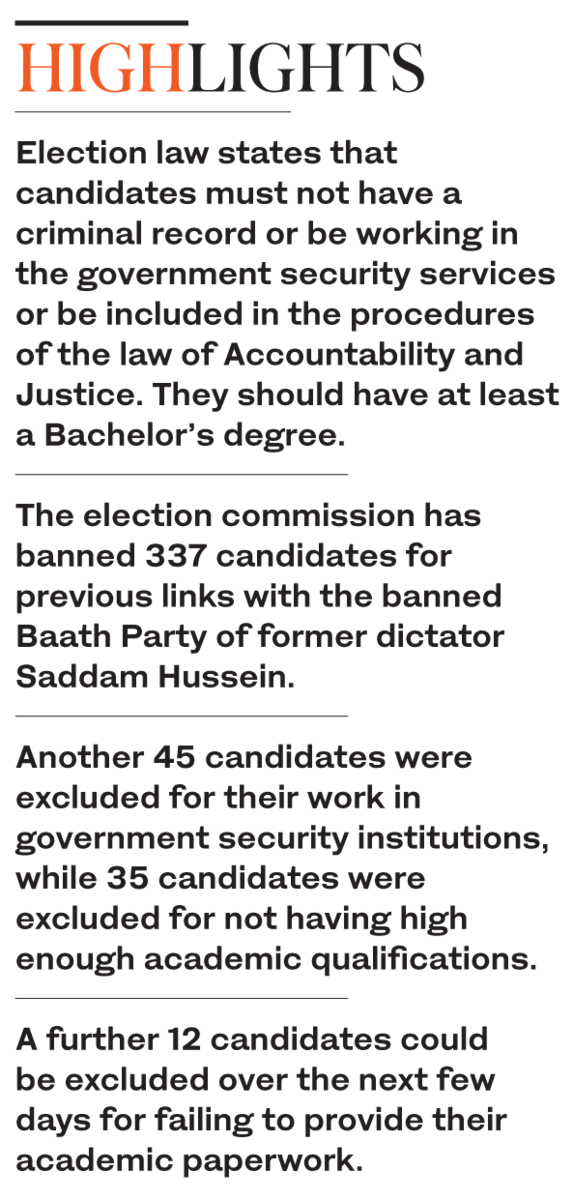
At least 56 candidates belonging to different electoral coalitions and affiliations have formally withdrawn their candidacy during the past few weeks, Iraq’s Independent High Election Commission said.
The billionaire Khamis Al-Khanjar, the sponsor of Al-Qarar alliance — led by Osama Al-Najafi, the Sunni Vice President, is the most prominent withdrawal so far.