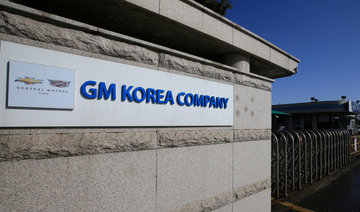
SEOUL: US auto giant General Motors and Seoul have agreed on a multi-billion-dollar bailout for the firm’s troubled South Korean unit, a government minister said Thursday.
GM is the largest US automaker and one of the biggest players in the global industry but its South Korean subsidiary is loss-making and has seen production fall by almost half in the last decade.
Earlier this year GM Korea announced a plan to shut down Gunsan, one of its four plants in the country, and lay off some 2,000 personnel, sparking a prolonged strike and negotiations with the authorities.
Workers and management reached a deal last month on job and welfare payment cuts and a wage freeze across the firm, paving the way for Thursday’s announcement.
The US parent will inject $6.4 billion into GM Korea and the state-owned Korea Development Bank (KDB) will plow in another $750 million, finance minister Kim Dong-yeon told journalists.
GM will invest $2 billion in facilities over 10 years and spend $1.6 billion on corporate restructuring and operational costs.
An existing $2.8 billion loan to GM Korea will be converted into preference shares, saving the unit 150 billion won ($110 million) in interest every year.
GM currently owns 77 percent of GM Korea and KDB has a 17 percent stake, with the remaining shares held by China’s SAIC Motor.
The firm was rebuilt from the wreckage of local automaker Daewoo, which went bankrupt in 2000.
But production has fallen from 940,000 cars in 2007 to 520,000 last year, when GM Korea lost some $139 million in South Korea.
“We hope that GM Korea carries out this bailout package faithfully so that it may become a success story,” Kim said.
“If GM Korea fails to turn around, 150,000 jobs will be threatened and some 3,000 suppliers will be in difficulties,” he added.
Under the deal, GM will remain in South Korea for at least 10 years, with KDB regaining veto power over GM’s rights to sell assets in the country.
GM also pledged to allocate two new models to its Korean plants.
In its first-quarter results last month GM took a $942 million hit for the cost of closing the Gunsan facility.

General Motors, Seoul agree to $7 billion bailout for South Korea unit
Egypt targets tripling sports sector’s GDP share by 2032, minister says
RIYADH: Egypt plans to raise the contribution of its sports sector to 3 percent of gross domestic product by 2032, up from about 1.34 percent currently, the minister of youth and sports revealed.
Speaking at the Akhbar El-Youm Economic Conference, Ashraf Sobhy said the country aims to expand the number of sports services companies to 4,500 from around 600, part of broader efforts to commercialise the sector and attract private capital, according to Asharq.
The session underscored the Egyptian state’s commitment to enhancing the economic value of sports, viewing it as a catalyst for sustainable development and a key pillar in strengthening the country’s soft power, Sobhy said.
He noted that the strategy aligns with broader global trends in the sports industry.
According to figures cited during the session, the global sports market is projected to grow from $485 billion in 2023 to $652 billion by 2028, representing an annual growth rate of 6.1 percent. Global sports tourism revenues are also expected to rise sharply, reaching $2.32 trillion by 2032, up from $685 million in 2024, according to Asharq.
A statement released by the Ministry of Youth and Sports stated: “Sobhy explained that investing in youth is a national priority, noting that the ministry is working to link youth development with entrepreneurship, empowering young people to transform their innovative ideas into viable and competitive sports and economic projects that can thrive regionally and internationally.”
The statement added that developing sports infrastructure and improving the efficiency of clubs and national teams are among the ministry’s top priorities in the current phase, helping to produce athletes capable of representing Egypt in international competitions and achieving sustainable sporting success.
During the session, Sobhy said support for the athletics industry and esports has become essential amid global changes, noting that the ministry is adopting policies to encourage investment in these fast-growing fields, open new employment opportunities and attract capital.
He also said hosting international championships and implementing good governance mechanisms in the sports sector help strengthen confidence in Egypt’s sports system and enhance the country’s position as a regional and international destination for sports investment and event organisation.
Sobhy added that international experiences in the Gulf states, the US, the UK and France offer successful models for maximising economic returns from sports, through private-sector partnerships, the development of sports industries and the application of corporate governance within sports organisations.