Almost 2,500 General Motors Korea workers apply for voluntary redundancy package

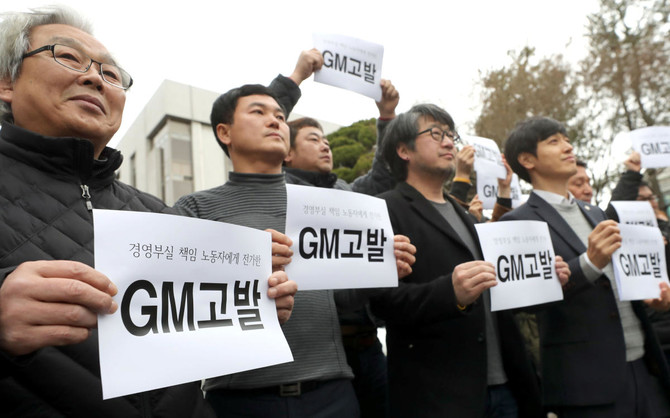
Members of a civic group attend a protest demanding prosecutors in Gunsan to investigate General Motors Korea over its decision to shut down a plant in the city. (Yonhap via Reuters)
Updated 05 March 2018
Follow

Almost 2,500 General Motors Korea workers apply for voluntary redundancy package

SEOUL: Almost 2,500 workers at General Motors’ South Korean unit, equivalent to 15 percent of its staff, have applied for a redundancy package that the US automaker is offering as part of a drastic restructuring, union officials said.
GM shocked South Korea last month when it said it was closing down one plant and would decide on the fate of three others in the coming weeks — decisions that hang on potential financial support from Seoul and the amount of concessions it can gain from unions.
At the Gunsan factory which is due to be shut down, 941 out of some 2,000 workers applied for the redundancy package, the officials said, declining to be identified as the information has not been publicly released.
GM Korea declined to comment.
A GM document seen by Reuters showed that over the longer-term, the US automaker aims to cut 5,000 South Korean jobs but keep production steady if Seoul agrees to its $2.8 billion proposal for the loss-making operation.
Under the redundancy package, which had an application deadline of March 2, workers are being offered three times their annual base salary, money for college tuition and more than $9,000 toward a new car.
GM Korea plans to hold another round of talks with the union on Wednesday where the two sides may discuss the fate of the workers at the Gunsan plant who did not apply for the package as well as the automaker’s proposals on wages.
The union is under much pressure to make concessions. South Korea’s auto association added its voice on Friday, arguing that workers’ wages at GM were high.
“We should not miss the golden time for labor reform,” the Korea Automobile Manufacturers Association said in a statement.
The South Korean government is expected to start due diligence on GM Korea this week as it weighs whether to spend taxpayers’ money to rescue the unit.


As world fractures, experts weigh in on the politics of AI at WGS

Updated 26 sec ago
Follow

As world fractures, experts weigh in on the politics of AI at WGS

  • e& group CEO Hatem Dowidar said there was increasing pressure to choose between the Chinese and US ecosystems

DUBAI: Across three days of rigorous debate at the World Government Summit in Dubai, experts from some of the world’s largest tech and telecommunication companies debated what the future political landscape of artificial intelligence development would be.

Speaking at the summit on Thursday, e& group CEO Hatem Dowidar said there was increasing pressure to choose between the Chinese and US ecosystems, which could have impacts on the sovereign capabilities of countries, like Gulf Cooperation Council member states, which thus far have stayed in the middle.

“I think the fracture and the pressure today is if you use this technology, you cannot use the other. You must separate them completely and this is something that never happened before,” Dowidar said.

He warned that whilst people around the world currently have access to both the leading large language models in the US and China, ChatGPT and Deepseek, this would not always be the case, and middle powers would need to develop their own capability to maintain their sovereignty.

“Europe is trying to find its own way as well, because Europe — having been caught now in the middle — they don’t have platforms, they don’t have the data center capability,” he said.

“So now, Europe is focusing a lot on building sovereign capability, sovereign data centers to run AI applications within Europe.”

Dowidar said the GCC had been ahead of the curve in this regard, having worked out early on that sovereign capability would be necessary in the new multipolar world and subsequently investing heavily in local infrastructure and capability.

“We were lucky here in the region that already — I would say a couple of years ago —we have kind of ironed out how this works,” he said.

“I think that everyone will try to see how they can either utilize the global platforms in a sovereign manner, or they end up trying to push to develop their own platforms.” 

This sentiment was echoed by Chamath Palihapitiya, the founder and managing partner of Social Capital, who said that China’s dedication to open-source models — whose code is released under a license granting users rights to view, study, modify, and redistribute it freely — could make Chinese AI more popular in the long run for nations looking to keep some level of sovereignty.

“I do think that there are a handful of American open-source models that are quite good. I think Nvidia’s models are excellent. But in fairness, the Chinese open-source models are just superb,” he told the summit on Wednesday.

“It’s going to be important for every country to make their own decisions about their own sovereignty, and in that realm, I think the open-source models provide the clearest path, because it just gives you total transparency to what’s happening underneath the hood.”

This was reiterated by Joseph Tsai, the chairman and co-founder of Alibaba Group, who said Chinese open-source systems would be favored by middle powers — but warned they had yet to find a way to be economically self-sufficient. 

“Because countries care about the sovereignty aspect and care about their data privacy, you can take an open-source model and deploy it on your own infrastructure … giving you ownership and control” he said.

“But it remains to be seen how economically all the model companies are going to make it sort of sustainable with an open-source approach … This is the biggest challenge for the Chinese firms.”