

Lebanese elections bring Syria’s allies back to Parliament

1 / 2
Supporters of a civil society movement rally in front of the Ministry of Interior in Beirut contesting the unofficial results in the Lebanese capital on May 7, 2018. (AFP / Anwar Amro)
2 / 2
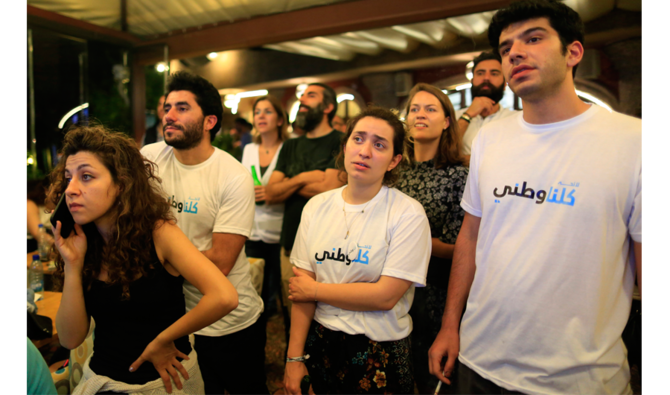
Supporters and volunteers of the coalition Kulna Watani or (We are all Patriots) gather at a Beirut shisha cafe as they watch television ahead of an expected announcement of elections results in Beirut, Lebanon, on May 6, 2018. (AP Photo/Hassan Ammar)
Updated 08 May 2018
Follow

Lebanese elections bring Syria’s allies back to Parliament

  • The gains for parties and politicians who support Hezbollah’s possession of weapons, and agree with the party fighting to defend Assad’s regime from his rebelling population, will mean dire days ahead for the divided country.
  • The post-election celebration by Hezbollah militants, who managed to hang their flag on a Rafiq Hariri statue, can only point to tough days ahead to unite a divided Lebanese population.

LONDON: Election results in Lebanon show the country has once again tilted in the direction of an era of Syrian and Iranian control.

Hezbollah and its political allies won just more than half the seats in Parliament, boosting the Iranian-backed group fiercely opposed to Israel, and underlining Tehran’s growing regional clout. 

The elections have put an end to the movement born after the assassination of the former Prime Minister Rafiq Hariri in 2005 to free Lebanon from its enslavement to foreign governments.

Lebanon, as a result, is once again part and parcel of the so called Tehran-led Shiite crescent from Iran through Iraq and Syria to Lebanon. 

Three tactics were used by Hezbollah and its allies to wipe out once and for all the movement that opposed them. 

Firstly, there was the new complex and sectarian-based election system adopted last year that made no sense to the disillusioned Lebanese electorate. More than 50 percent of registered voters stayed away from the ballot boxes, more than at the last election nine years ago.

The second was the use of assassination as a tool to silence dissent. Over the past 14 years, Hezbollah, the Assad regime in Syria, and Iran allegedly conspired to reduce the March 14 coalition’s majority in the Lebanese Parliament, according to several UN resolutions and the findings of an international tribunal for Lebanon. 

The assassinations removed six MPs, politicians and journalist as well as army and interior-security generals. The trial of four Hezbollah operatives accused of planning and executing the car bomb that killed Rafiq Hariri has been ongoing for four years at the special tribunal at the Hague.

Since then, intimidation was used in a variety of ways to silence anti-Hezbollah politicians as well as areas and communities critical of the militia — the regional pawn of Iran, which declares itself the anti-Israeli resistance group. 

People linked to the March 14 movement were often harassed by thugs belonging to Hezbollah at rallies, and many were left to fend for themselves as Lebanon’s army and security forces remained neutral for fear of clashing with the heavily armed militia.

This was evident on May 7, 2008, when neighborhoods of Beirut and other anti-Hezbollah cities woke up to a takeover by Hezbollah militants while Lebanon’s army and police forces stood by, further eroding the authority of the Lebanese state. 

The gains for parties and politicians who support Hezbollah’s possession of weapons, and agree with the party fighting to defend Assad’s regime from his rebelling population, will mean dire days ahead for the divided country.

Their gains risk complicating Western policy in Lebanon, which is banking on foreign aid and loans to revive its stagnant economy and receiving US military support.

An Israeli minister said the outcome showed the Lebanese state was indistinguishable from Hezbollah, signalling the risk of Israel striking Lebanon’s government in a future war.

The post-election celebration by Hezbollah militants, who managed to hang their flag on a Rafiq Hariri statue, can only point to tough days ahead to unite a divided Lebanese population.

In Lebanon, the day-to-day problems will continue. Electricity will still be in short supply, garbage-processing plants will continue to be woefully inadequate. Elections in Lebanon have never solved the problem of corruption across all public sectors.

No one knows when Hezbollah’s militias are likely to withdraw from Syria, and a Saad Hariri government is unlikely to challenge the group to hand over its weapons or stop its stockpiling of ballistic missiles earmarked to destroy Israel, but clearly used to destroy Syria in the interim. 

The election may just have been another parliamentary vote in a small country, but in Lebanon, where wars are waged by proxies, and the divides run deep between secular and religious, Christians, Shias and Sunnis, one thing is certain — the results will further bury hope that the country will be free from outside interference for years to come.


Trump warns Iran of ‘very traumatic’ outcome if no nuclear deal

Updated 55 min 56 sec ago
Follow

Trump warns Iran of ‘very traumatic’ outcome if no nuclear deal

  • Speaking a day after he hosted Netanyahu at the White House, Trump said he hoped for a result “over the next month”

WASHINGTON: US President Donald Trump threatened Iran Thursday with “very traumatic” consequences if it fails to make a nuclear deal — but Israeli Prime Minister Benjamin Netanyahu said he was skeptical about the quality of any such agreement.
Speaking a day after he hosted Netanyahu at the White House, Trump said he hoped for a result “over the next month” from Washington’s negotiations with Tehran over its nuclear program.
“We have to make a deal, otherwise it’s going to be very traumatic, very traumatic. I don’t want that to happen, but we have to make a deal,” Trump told reporters.
“This will be very traumatic for Iran if they don’t make a deal.”
Trump — who is considering sending a second aircraft carrier to the Middle East to pressure Iran — recalled the US military strikes he ordered on Tehran’s nuclear facilities during Israel’s 12-day war with Iran in July last year.
“We’ll see if we can get a deal with them, and if we can’t, we’ll have to go to phase two. Phase two will be very tough for them,” Trump said.
Netanyahu had traveled to Washington to push Trump to take a harder line in the Iran nuclear talks, particularly on including the Islamic Republic’s arsenal of ballistic missiles.
But the Israeli and US leaders apparently remained at odds, with Trump saying after their meeting at the White House on Wednesday that he had insisted the negotiations should continue.

- ‘General skepticism’ -

Netanyahu said in Washington on Thursday before departing for Israel that Trump believed he was laying the ground for a deal.
“He believes that the conditions he is creating, combined with the fact that they surely understand they made a mistake last time when they didn’t reach an agreement, may create the conditions for achieving a good deal,” Netanyahu said, according to a video statement from his office.
But the Israeli premier added: “I will not hide from you that I expressed general skepticism regarding the quality of any agreement with Iran.”
Any deal “must include the elements that are very important from our perspective,” Netanyahu continued, listing Iran’s ballistic missile program and its support for armed groups such as the Palestinian movement Hamas, Yemen’s Houthi rebels and Hezbollah in Lebanon.
“It’s not just the nuclear issue,” he said.
Despite their differences on Iran, Trump signaled his strong personal support for Netanyahu as he criticized Israeli President Isaac Herzog for rejecting his request to pardon the prime minister on corruption charges.
“You have a president that refuses to give him a pardon. I think that man should be ashamed of himself,” Trump said on Thursday.
Trump has repeatedly hinted at potential US military action against Iran following its deadly crackdown on protests last month, even as Washington and Tehran restarted talks last week with a meeting in Oman.
The last round of talks between the two foes was cut short by Israel’s war with Iran and the US strikes.
So far, Iran has rejected expanding the new talks beyond the issue of its nuclear program. Tehran denies seeking a nuclear weapon, and has said it will not give in to “excessive demands” on the subject.