CAIRO: New radar scans have provided conclusive evidence that there are no hidden rooms inside King Tutankhamun’s burial chamber, Egypt’s antiquities ministry said Sunday, bringing a disappointing end to years of excitement over the prospect.
Mostafa Waziri, Secretary General of the Supreme Council of Antiquities, said an Italian team conducted extensive studies with ground-penetrating radar that showed the tomb did not contain any hidden, man-made blocking walls as was earlier suspected. Francesco Porcelli of the Polytechnic University of Turin presented the findings at an international conference in Cairo.
In 2015, British Egyptologist Nicholas Reeves proposed, after analysis of high-definition laser scans, that queen Nefertiti’s tomb could be concealed behind wall paintings in the famed boy king’s burial chamber. The discovery ignited massive interest, with officials first rushing to support the theory but then later distancing themselves and ultimately rejecting it.
The ministry says two previous scans by Japanese and American scientists had proved inconclusive, but insists this latest ground-penetrating radar data closes the lid on the tomb having such hidden secrets.
“It is concluded, with a very high degree of confidence, said Dr. Porcelli, the hypothesis concerning the existence of hidden chambers or corridors adjacent to Tutankhamun’s tomb is not supported by the GPR data,” it said in its statement.
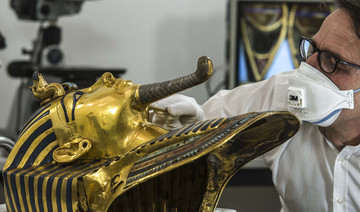
The ministry has been gradually moving King Tut’s belongings to a new museum outside Cairo near the Giza Pyramids to undergo restoration before they are put on display. The transfer of the priceless belongings has become a particularly sensitive issue; In 2014 the beard attached to the ancient Egyptian monarch’s golden mask was accidentally knocked off and hastily reattached with an epoxy glue compound, sparking uproar among archaeologists.
The fourth International Tutankhamun Conference in Cairo where Porcelli presented the findings, the most extensive radar survey of the site to date, was attended by a wide range of Egyptologists and archaeologists from the world over.
During the conference, Antiquities Minister Khaled Al-Anani said that the first phase of the new museum, including King Tut’s halls, will be completed by the end of this year but the date for the museum’s “soft opening” has yet to be decided. The museum currently hosts more than 43,200 artifacts of which over 4,500 belong to King Tut alone, and its grand opening is planned for 2022.


Egypt says no hidden rooms in King Tut’s tomb after all

Egypt says no hidden rooms in King Tut’s tomb after all
- Francesco Porcelli of the Polytechnic University of Turin presented the findings at an international conference in Cairo
- In 2015, British Egyptologist Nicholas Reeves proposed, after analysis of high-definition laser scans, that queen Nefertiti’s tomb could be concealed behind wall paintings in the famed boy king’s burial chamber

Cairo book fair breaks visitor records
- Strong Saudi participation underscores KSA’s prominent role in Arab cultural landscape
- Egyptian writer Naguib Mahfouz, who was awarded the Nobel Prize in Literature in 1988, was selected as the fair’s featured personality
CAIRO: The 57th edition of the Cairo International Book Fair has attracted record public attendance, with the number of visits reaching nearly 6 million, up from a reported 5.5 million previously.
Egypt’s Minister of Culture Ahmed Fouad Hanou said: “This strong turnout reflects the public’s eagerness across all age groups to engage with the exhibition’s diverse cultural and intellectual offerings.”
Hanou said the event included “literary and intellectual activities, meetings with thinkers and creative figures, and thousands of titles spanning various fields of knowledge.”
The Egyptian writer Naguib Mahfouz, who was awarded the Nobel Prize in Literature in 1988, was selected as the fair’s featured personality, coinciding with the 20th anniversary of his death.
The exhibition’s official poster features a famous quote by Mahfouz: “Who stops reading for an hour falls centuries behind.”
A total of 1,457 publishing houses from 83 countries participated in the fair. Mahfouz’s novels occupied a special place, as Egypt’s Diwan Library showcased the author’s complete works, about 54 books.
“The pavilion of the Egyptian National Library and Archives witnessed exceptionally high attendance throughout the fair, showcasing a collection of rare and significant books.
Among the highlights was the book “Mosques of Egypt” in Arabic and English, Dr. Sherif Saleh, head of financial and administrative affairs at the Egyptian National Library and Archives, told Arab News.
The fair ended on Tuesday with a closing ceremony that featured a cultural performance titled “Here is Cairo.”
The event included the announcement of the winners of the fair’s awards, as well as the recipient of the Naguib Mahfouz Award for Arabic Fiction.
Organizers described this year’s edition as having a celebratory and cultural character, bringing together literature, art, and cinema.
Romania was the guest of honor this year, coinciding with the 120th anniversary of Egyptian-Romanian relations.
At the Saudi pavilion, visitors were welcomed with traditional coffee. It showcased diverse aspects of Saudi culture, offering a rich experience of the Kingdom’s heritage and creativity.
There was significant participation from Saudi Arabia at the event, highlighting the Kingdom’s prominent role in the Arab cultural arena.
Saudi Arabia’s participation aimed to showcase its literary and intellectual output, in alignment with the objectives of Vision 2030.
The Kingdom’s delegation was led by Saudi Arabia’s Ambassador to Egypt Saleh bin Eid Al-Hussaini. Also in attendance were Dr. Abdul Latif Abdulaziz Al-Wasel, CEO of the Literature, Publishing and Translation Commission, and Dr. Hilah Al-Khalaf, the commission’s director-general.
The King Abdulaziz Public Library placed the Encyclopedia of Saudi Arabia in a prominent position at the pavilion. The encyclopedia, consisting of 20 volumes, is organized according to the Kingdom’s culturally diverse regions.
Founded in 1980 by King Abdullah, the library was established to facilitate access to knowledge and preserve heritage collections. Over the years, it has grown into one of the Kingdom’s most important cultural institutions.
Internationally, the library has strengthened ties between Saudi Arabia and China, including the opening of a branch at Peking University and receiving the Crown Prince Mohammed bin Salman Award for Cultural Cooperation between the two nations.
Regionally, the library has played a pivotal role in the Arab world through the creation of the Unified Arabic Cataloging Project, one of the most important initiatives contributing to knowledge accessibility and alignment with global standards.


