



LONDON: Palestinian homes were being demolished in waves when Rachel Corrie, a 23-year-old American peace activist, arrived in Rafah, Gaza, at the height of the second intifada in January 2003.
Her mother, Cindy, recalled how affected Corrie was by the suffering she saw, pouring out her experiences in long journal entries and emails home that have since been published, turned into plays and quoted in documentaries.
“Every time Palestinians did anything, the Israeli military would use it as an excuse to raze another row of houses — they just kept taking down row after row,” Cindy said.
Three months later, Corrie stepped into the path of an Israeli military bulldozer, hoping the “international white person privilege” she had observed in Gaza would be enough to protect the Nasrallah family home, one of the few still standing in the area. 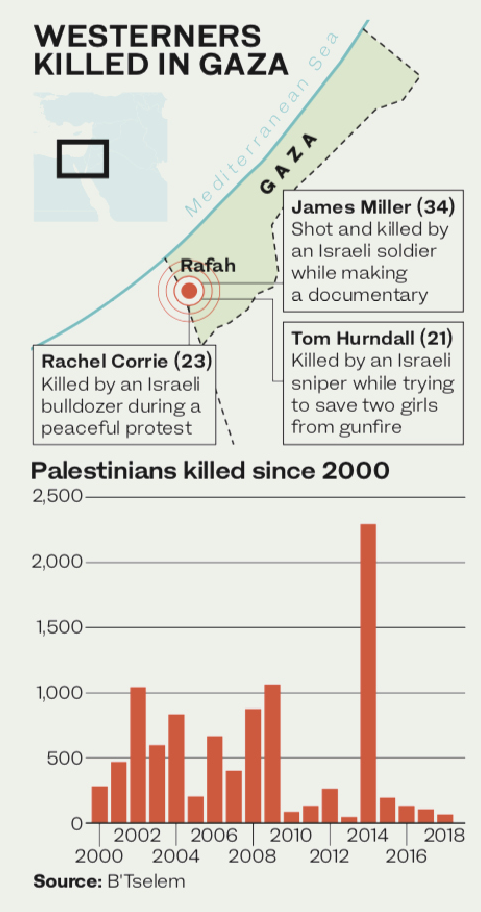
Witness accounts detail the horrific scene that unfolded as the giant Caterpillar D9R bulldozer plowed over the slight figure clad in an orange fluorescent jacket before reversing back over her body and pulling away. Corrie died a short while later, her lungs crushed, ribs fractured and vital organs ruptured.
Weeks after the 15-year anniversary of her death on March 16, 2003, renewed violence in the Gaza Strip is a reminder that little here has changed.
At least 42 Palestinians have been killed and hundreds injured by Israeli forces during demonstrations as thousands of Gazans demand the right to return to lands they were driven from by Israeli settlements.
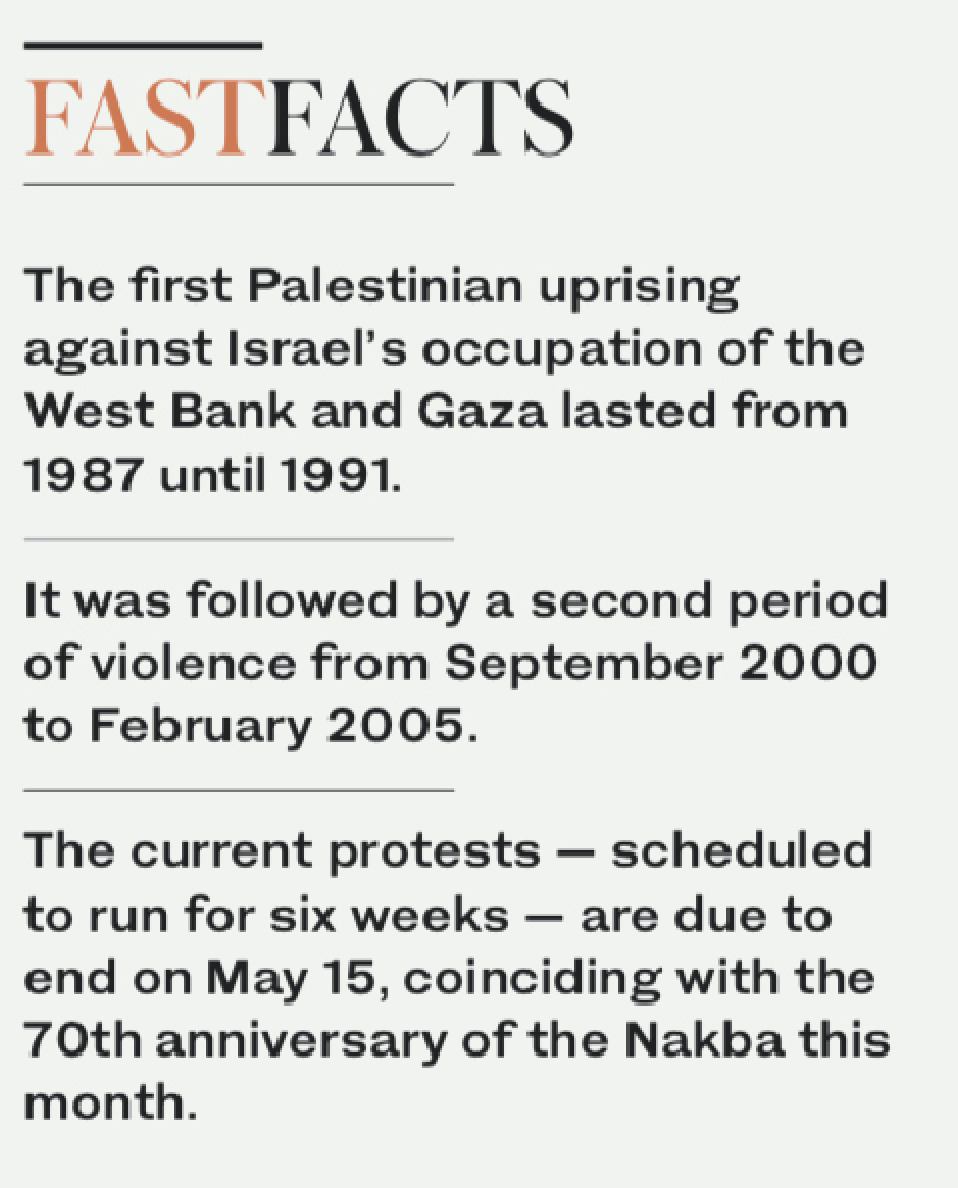
The first Palestinian uprising, or intifada, against Israel’s occupation of the West Bank and Gaza lasted from 1987 until 1991 and was followed by a second period of intensified violence from September 2000 to February 2005.
The current protests — scheduled to run for six weeks — are due to end on May 15, coinciding with the 70th anniversary of the Nakba (catastrophe) this month when 750,000 Palestinians lost their homes on the day Israel was created in 1948.
Reports of mounting casualties, including the killing of children and non-violent protesters, have revived international indignation, but for those living under occupation in Gaza and the West Bank, the violence appears endless. In her emails, Corrie described the “chronic, insidious genocide” she was witnessing. “I’m questioning my fundamental belief in the goodness of human nature. This has to stop.”
Tracing their daughter’s footsteps in Gaza after her death, the Corries visited the Nasrallah home. Their daughter had often stayed over, curled up on the floor with the children in their parents’ room at the back, far from the bullets Israeli soldiers sometimes sprayed at the walls from tanks passing at night.
She made her first call home from the house, trying to appear calm as the sounds of nearby shelling echoed down the line to her parents in Charlotte, North Carolina. “Her voice was trembling … I don’t think we said anything after we got off the phone that evening,” her mother recalled.
By then, little was left of the once-large neighborhood in southern Gaza, near the war-torn Egyptian border. “All the homes had already been destroyed by the Israeli military … they would go past and just fire the guns into the houses, trying to get people to move out,” her father, Craig Corrie, told Arab News.
The Israeli military had been steadily demolishing houses to widen the “buffer zone” between Gaza and Egypt, ostensibly for security purposes.
A Human Rights Watch report from 2004 said that almost 16,000 people, more than 10 percent of Rafah’s population, lost their homes in this way, making many refugees for a second or third time.
 The day she died, Corrie received a call at 2 p.m. from a fellow activist telling her the Nasrallah house was about to be flattened. She had formed a close bond with many Palestinians in the community through her work with the International Solidarity Movement (ISM), which protests against the occupation using non-violent methods, including sit-ins at homes, wells and other sites earmarked for demolition. Leaping into a taxi, she raced to the site.
Just before 5 p.m., one of the bulldozers started rumbling toward a wall near the house and Corrie positioned herself in front of it. Before, the bulldozers had always stopped short of hitting the ISM activists, but this time the massive machine carried on, despite screams and waves from onlookers.
Different versions of the circumstances surrounding Corrie’s death emerged in the aftermath as the Israeli military sought to distance itself, later claiming a wall had collapsed and crushed her. Giving testimony from behind a screen in court, the driver of the bulldozer said he was unable to see Corrie from the cabin. Witnesses who worked alongside the activist said there is “no doubt” he knew where she was.
Days after the incident, Tom Dale, a British activist who was nearby when she died, told the ISM: “The bulldozer continued to push Rachel, so she slipped down the mound of earth, turning as she went. Her face showed she was panicking and it was clear she was in danger of being overwhelmed.”
The Israeli government later described it as a “regrettable incident” and promised a “thorough, credible, and transparent investigation.” In 2015, after years of trials, the Corries’ case came to a close when a judge in Israel’s Supreme Court upheld an earlier ruling absolving the Israeli state and army from responsibility. Nobody was ever convicted for her death.
Corrie had educated herself about Palestine in the aftermath of 9/11 and “very deliberately” made the decision to go to Gaza. “She said she was going to see what it was like to be on the other end of US foreign policy. I think she really wanted to go and learn about how to be in solidarity with people that are struggling,” her father said.
At first, it was difficult for the ISM volunteers to gain the trust of the local community, but Corrie immersed herself in Gazan life, eating and sleeping in family homes, and embracing Palestinian customs and culture. “She loved them and they loved her,” recalls Abdul Raouf Rarbakh, who was in charge of a children’s organization in Rafah at the time.
On the day she died, Corrie had been playing football with local youths but had been “very sad,” he said. “She was killed on the same day that a Palestinian was killed. We organized a funeral for her with the Palestinian martyr.”
The Corries have often been asked to explain why the death of “a blonde American girl” has dwarfed the loss of Palestinian lives in the media. “I think Rachel would have agreed ... but if the death of a blonde American makes us pay attention to all those others then we’re OK with that,” her father said. “I would hope she would be, too.”
Several other foreign civilians were killed by Israeli forces in the months after Corrie’s death, including another ISM volunteer, 21-year-old Tom Hurndall, who was shot in the head on April 5 while rescuing two Palestinian girls from gunfire. The following month, James Miller, a 35-year-old Briton, was shot in the neck while filming an HBO documentary along the Egyptian border.
Yet it is Corrie who has since become an icon of solidarity for Palestinians in Gaza.
“She will always be part of the history of that place,” her father said. “Here we are, 15 years later, and her story still resonates.”
Watching the latest round of protests, the Corries feel “an absolute responsibility” toward the people of Gaza as they try to rouse the world to action through the Rachel Corrie Foundation for Peace and Justice. “People only pay attention when they see particular violence, but the occupation is always violent,” Craig said.
Today, the Nasrallah house is long gone and the land it stood on has become a barren border zone. Entry is restricted to landowners and the families who lived here have become refugees.
Iyad Abu Louly, who remembers Corrie as one of the “prominent personalities” among the ISM volunteers, now heads up the Rachel Corrie Human Rights Center, which documents violations committed by the occupation against Palestinians.
It is the same goal that Corrie had when she went to Gaza.
“Her memory will remain immortal in the hearts of the Palestinian people,” he said.


