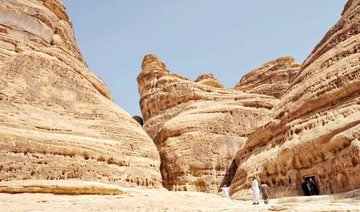
RIYADH: The Royal Commission of Al-Ula (RCU) has launched an integrated program to explore archaeological treasures in the historic area that includes Madain Saleh, which became Saudi Arabia’s first UNESCO World Heritage Site in 2008.
Madain Saleh is the southernmost settlement of the Nabataeans — who carved out the city of Petra in Jordan — and one of the region’s archaeological treasures.
The archaeological program, with a major conservation and development plan for the area, brought together leading international archaeologists to help prepare for a new era of renewed international collaboration and tourism in line with Vision 2030, which includes diversifying Saudi tourism.
Home to dramatic desert landscapes, spectacular rock formations and some of the Middle East’s most significant ancient sites including those built by Lihyanite and Nabataean civilizations of the first millennium BC and beyond, historic Al-Ula is a wonder of the ancient Arabian world.
Rebecca Foote, head of heritage and archaeology at the Royal Commission, told Arab News on Wednesday: “At the heart of the Royal Commission’s archaeology program is a commitment to preserving Al-Ula’s extraordinary cultural heritage sites for generations to come.”
“Our work observes international best practice standards and utilizes some of the most sophisticated technology available for the archaeological program,” Foote said. “The temporary public closure of sites such as Madain Saleh will allow us to carry out vital work locating, mapping and visualizing Al-Ula’s past in order to evaluate vulnerabilities and implement appropriate protective interventions throughout the area.”
 According to the RCU, a major integrated archaeological survey of Al-Ula valley and beyond has been launched by the commission, charged with protecting and regenerating this northwestern region. Until a conservation and development plan can be established, some of the sites including the World Heritage Site of Madain Saleh are temporarily closed to the public.
“Re-opening in 2020, the temporary closure will allow experts the opportunity to carry out vital research activity and plan for how to best preserve and present the sites,” the RCU said.
Using state-of-the-art technologies and methods such as aerial LiDAR scanning and photography captured from light aircraft, helicopter and drone, a team of the world’s leading experts led by Foote will meticulously document, map and model the area, supporting RCU’s mission to uncover Al-Ula’s ancient secrets and mysterious past.
Capable of recording surface features through vegetation, the LiDAR will see what lies within the palm groves of the oasis, and the helicopter team will record the remote and harder-to-reach sites.
Thoroughly documenting the area will provide a better understanding of these cultural heritage sites and their ancient past, something that is vital to safeguarding it for future generations.
Providing a window into the people and cultures that shaped the past, the findings will be collated in a bespoke heritage database and used by the RCU to develop a plan for preserving, studying and activating the area’s historic features.
This archaeological survey program supports the commission’s mission to protect and develop the heritage and historical sites of Al-Ula to achieve a sustainable transformation and to enable local, regional and international visitors to learn about the richness of its cultural, historical and natural heritage.
The RCU was established in July 2017 to protect and preserve the region’s extraordinary ancient heritage and natural landscapes and prepare for an era of renewed international collaboration and tourism coinciding with the goals set under Vision 2030.
The RCU has signed an agreement with Campus France, the leading international academic and vocational public institution in France, which will partly train young Saudis to work in this tourism area and discover archaeological treasures in the northwest of the Kingdom.
The first 200 young Saudis recruited for this purpose are in the vanguard of an ambitious project to bring travelers back to Al-Ula, this time as tourists and lovers of history eager to explore one of the greatest profusions of cultural and archaeological treasures.
Recruited from Al-Ula region, they are in Riyadh being trained in hospitality, learning new languages, studying farming and water technology and swotting up on the cultural, social and natural history of their home region.
Students from King Saud University are also being trained by expert archaeologists in international best practice, equipping them with the skills to become the next generation of cultural custodians for Al-Ula. Significantly, 5,000 years ago, Al-Ula was cosmopolitan. For traders and adventurers alike it was an essential stop on the route between the Mediterranean and the Arab world, and far beyond to Asia and Africa.
Located at a historic nexus of civilizations, on an important route of travel used from at least the first millennium BC for the trade of valuable commodities, Al-Ula is built on a history of exchange between cultures.
This exchange of knowledge and cultures goes back millennia and continues to be a crucial part of the area’s identity, and is a blueprint for its future.
A particular archaeological feature of the area are the more than 100 tombs, some over 20 meters tall, that dot the landscape.
French archaeologist Laila Nehme was the first foreign archaeologist to work in the Madain Saleh area and she discovered that it has many more secrets to be shared; the integrated archaeological program is underway to explore all these treasures.