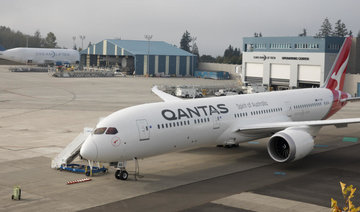
SYDNEY: Australian national carrier Qantas on Wednesday ordered six Dreamliner planes from aviation giant Boeing to replace the last of its aging jumbo jets, which have been a staple of the firm’s fleet since 1971.
The deal, worth $1.7 billion at list prices, comes as Qantas looks to build up its supply of 787-9 jets, which are more fuel efficient and have lower maintenance costs.
To date it has taken delivery of four and a further four are due to arrive by the end of 2018. The latest batch are due by the end of 2020.
“This really is the end of one era and the start of another,” said chief executive Alan Joyce.
“The jumbo has been the backbone of Qantas International for more than 40 years and we’ve flown almost every type that Boeing built.
“It’s fitting that its retirement is going to coincide with our centenary in 2020.”
He added that the “better economics and a longer range” have allowed Qantas to open up new routes like Perth to London.
“With a larger fleet of Dreamliners, we’ll be looking at destinations in the Americas, Asia, South Africa and Europe,” he added.
The announcement was made as Qantas revealed in a trading update it was on track to post a record full-year underlying profit before tax of A$1.55 billion to A$1.60 billion.
The result, slated to be officially released in August, comes on the back of an aggressive efficiency drive that has included hefty redundancies and a shift away from loss-making routes, despite rising fuel costs.
“We’re seeing solid results from each of our business units, which is a reflection of broadly positive trading conditions and the work we’ve done to strengthen the group,” said Joyce.


![]()

Qantas orders six more Boeing 787 Dreamliner aircraft as jumbo jets bow out
Qantas orders six more Boeing 787 Dreamliner aircraft as jumbo jets bow out

Latest updates




Recommended


© 2026 SAUDI RESEARCH & PUBLISHING COMPANY, All Rights Reserved And subject to Terms of Use Agreement.