Iraqi vice president’s ‘destroy’ threat sparks outrage

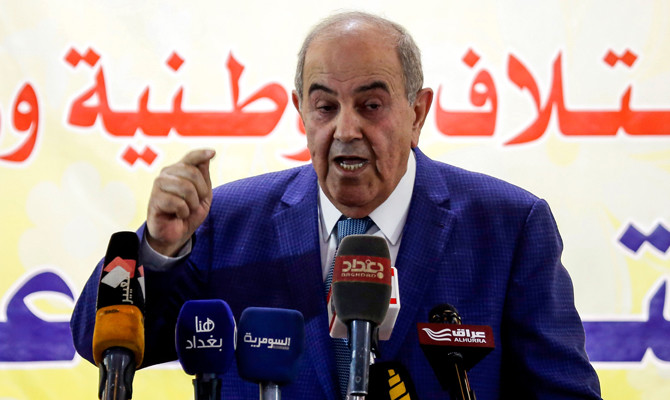
Former Iraqi Prime Minister and current parliament candidate Iyad Allawi speaks during an electoral campaign conference in the city of Najaf on April 29, 2018, ahead of the upcoming Iraqi parliamentary elections. (AFP / Haidar Hamdani)
Updated 02 May 2018
Follow

Iraqi vice president’s ‘destroy’ threat sparks outrage

  • The former prime minister was caught on video in a heated exchange with the man who complained about the lack of jobs
  • The incident is not the first since campaigning began in which political leaders have appeared to behave above the law

BAGHDAD: Iraqi Vice President Iyad Allawi came under fire yesterday after he was filmed threatening a voter in northern Baghdad.

The veteran politician and leader of the Al-Wattiniya electoral list was caught on video in a heated exchange with the man before saying he would “destroy” him. 

The exchange sparked outrage on social media with critics seizing on the remarks as typical of the political elite’s disdain for the Iraqi people.

The man did not raise a complaint with the police, but legal experts told Arab News that threatening a member of the public in Iraq could carry a seven-year prison sentence.

The video circulated on social media shows Allawi at a busy gathering of supporters in the Sunni-dominated district of Adhamiya.

The man, who has not been identified, is shown complaining to Allawi about the lack of jobs and the bad living conditions suffered by the Iraqi people.

“I am an officer of the former Iraqi Army. I came to talk to you, because you are responsible for me and the people before God,” the man tells Allawi. As he becomes increasingly animated, the vice president holds his hands in an attempt to persuade him to listen to him

“There are no jobs, no industry, no agriculture. You destroyed people,” the man continues.


Allawi’s bodyguards, who were watching the situation, were quick to separate the two men. As Allawi walked away, he said: “‘You destroyed us’ … I swear in God, we will destroy you.”

The incident on Sunday is not expected to significantly affect Allawi’s popularity, but it contributed to a feeling among Iraqis that the political leaders are not interested in what voters think.

“This behavior reflects the deep gap between the people and politicians,” Marrwa Al-Mosoui, a junior lawyer in Baghdad, told Arab News.

“Even during their election campaigns, they abuse people and try to impose their opinions and interests on the voters in a rude way.”

The incident is not the first since campaigning began in which political leaders have appeared to behave above the law.

Ammar Al-Hakim, the leader of Hikma, the dissident faction of the Shiite Supreme Islamic Iraqi Council, was accused in media reports of beating a poet after he publicly criticized the cleric during an election rally in the south several weeks ago.

Hours after the incident, the poet returned to publicly apologize and kiss Hakim’s hand.

About 7,000 candidates are preparing for the May 12 poll, the fourth national parliamentary elections in Iraq since the 2003 US-led invasion.

Campaigning, which began on April 14, has been some of the fiercest in the country in the post-Saddam Hussein era, with candidates attempting to ruin rivals’ chances.

Allawi, a secular Shiite, is backed by many of the Sunni political parties and figures on his list.

A candidate from the State Alliance — led by the former Iraqi Prime Minister Nouri Al-Maliki — was shot dead on Sunday morning in what police described as a “tribal conflict” in eastern Baghdad.

He has been focusing on winning votes in the Sunni-dominated provinces, where he is seen as a potential prime minister who would better represent Sunni interests.

Walid Al-Shibibi, an Iraqi lawyer and legal adviser employed by the UN and the Electoral Commission, told Arab News that if a police complaint is raised against Allawi, he could be charged with “committing an offense that threatens the public” — a charge that could lead to seven years in prison.

Ali Wajiih, a well-known Iraqi intellectual and poet, told Arab News that not only Allawi but all the Shiite, Sunni and Kurdish political hierarchy “do not see that they made any mistakes.”

“They see that we are the ones who destroyed their lives and we are the ones who made them tired and we are the ones who punished them by making their lives better,” he said.


Washington presses Syria to shift from Chinese telecom systems

Updated 26 February 2026
Follow

Washington presses Syria to shift from Chinese telecom systems

  • Syria is exploring the possibility of procuring Chinese technology
  • It was unclear whether the United States ⁠pledged financial or logistical support to Syria to do so

DAMASCUS: The United States has warned Syria against relying on Chinese technology in its telecommunications sector, arguing it conflicts with US interests and threatens US national security, according to three sources familiar with the matter.
The message was conveyed during an unreported meeting between a US State Department team and Syrian Communications Minister Abdulsalam Haykal in San Francisco on Tuesday. Washington has been coordinating closely with Damascus since 2024, when Syria’s now President Ahmed Al-Sharaa ousted longtime leader Bashar Assad, who had a strategic partnership with China.
Syria is exploring the possibility of procuring Chinese technology to support its telecommunications towers and the infrastructure of local Internet service providers, according to a Syrian businessman involved in the procurement talks.
“The US side asked for clarity on the ministry’s plans regarding Chinese telecom equipment,” said ⁠another source briefed on ⁠the talks.
But Syrian officials said infrastructure development projects were time-critical and that Damascus was seeking greater vendor diversity, the source added.
SYRIAN OFFICIALS CITE US EXPORT CONTROLS AS TELECOMS BARRIER
Syria is open to partnering with US firms but the matter was urgent and export controls and “over-compliance” remained an issue, according to person familiar with the meeting in San Francisco.
A US diplomat familiar with the discussions told Reuters that the US State Department “clearly urged Syrians to use American technology or technology from allied countries in the telecoms sector.”
It was unclear whether the United States ⁠pledged financial or logistical support to Syria to do so.
Responding to Reuters questions, a US State Department spokesperson said: “We urge countries to prioritize national security and privacy over lower-priced equipment and services in all critical infrastructure procurement. If it seems too good to be true, it probably is.”
The spokesperson added that Chinese intelligence and security services “can legally compel Chinese citizens and companies to share sensitive data or grant unauthorized access to their customers’ systems” and promises by Chinese companies to protect customers’ privacy were “entirely inconsistent with China’s own laws and well-established practices.”
China has repeatedly rejected allegations of it using technology for spying purposes.
The Syrian Ministry of telecommunications told Reuters any decisions related to equipment and infrastructure are made “in accordance with national technical and security standards, ensuring data protection and service continuity.”
The ministry said it is also prioritizing the diversification of partnerships and technology sources to ⁠serve the national interest.
Syria’s telecom ⁠infrastructure has relied heavily on Chinese technology due to US sanctions imposed on successive Assad governments over the civil war that grew from a crackdown on anti-government protests in 2011.
Huawei technology accounts for more than 50 percent of the infrastructure of Syriatel and MTN, the country’s only telecom operators, according to a senior source at one of the companies and documents reviewed by Reuters. Huawei did not immediately respond to a request for comment.
Syria is seeking to develop its private telecommunications sector, devastated by 14 years of war, by attracting foreign investment.
In early February, Saudi Arabia’s largest telecom operator, STC, announced it would invest $800 million to “strengthen telecommunications infrastructure and connect Syria regionally and internationally through a fiber-optic network extending over 4,500 kilometers.”
The ministry of telecommunications says that US restrictions “hinder the availability of many American technologies and services in the Syrian market,” emphasizing that it welcomes expanding cooperation with US companies when these restrictions are lifted.
Syria has inadequate telecommunications infrastructure, with network coverage weak outside city centers and connection speeds in many areas barely exceeding a few kilobits per second.