Pakistan summons Indian deputy high commissioner over cease-fire violations

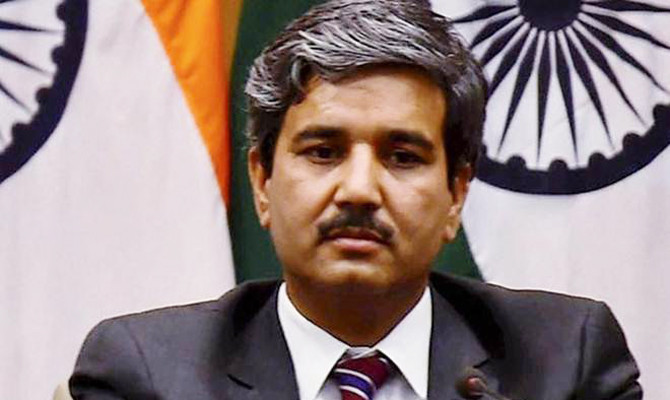
India’s Deputy High Commissioner in Islamabad JP Singh. (File Photo: PTI)
Updated 27 April 2018
Follow

Pakistan summons Indian deputy high commissioner over cease-fire violations

  • Foreign Ministry spokesman warns of threat to regional peace and security
  • Pakistan says there had been more than 1,000 cease-fire violations along the Line of Control by Indian forces so far in 2018

ISLAMABAD: Pakistan on Friday summoned New Delhi’s deputy high commissioner in Islamabad over alleged cease-fire violations by Indian forces along the Line of Control (LoC) that killed two civilians and injured two others.
Foreign Ministry spokesman Dr. Mohammad Faisal said he summoned J.P. Singh and condemned Thursday’s “unprovoked” cease-fire violations by “Indian occupation forces.” 
Indian forces along the LoC and the Working Boundary are continuously targeting civilian areas with heavy weapons, Faisal added. 
There have been more than 1,000 cease-fire violations by Indian forces so far in 2018, resulting in the killing of 23 civilians and the injury 107, he said. In 2017, there were 1,970 violations, he added.
“The deliberate targeting of civilian populated areas is… deplorable and contrary to human dignity, international human rights and humanitarian laws,” Faisal said.
The cease-fire violations “are a threat to regional peace and security, and may lead to a strategic miscalculation,” he added. Faisal urged India to respect the 2003 cease-fire arrangement and investigate its violations.


China backs Pakistan in fight against militancy after deadly Balochistan attacks

Updated 03 February 2026
Follow

China backs Pakistan in fight against militancy after deadly Balochistan attacks

  • China is a major ally and investor in Pakistan and has pledged over $65 billion in major infrastructure projects, including in Balochistan
  • Chinese Foreign Ministry spokesperson Lin Jian says ‘we mourn for lives lost, and our hearts go out to injured and those who lost loved ones’

ISLAMABAD: China condemns the recent attacks that killed more than 200 people in Pakistan’s southwestern Balochistan province, a Chinese foreign ministry spokesperson said on Tuesday, reaffirming Beijing’s support for Pakistan in its fight against militancy.

The Baloch Liberation Army (BLA) group launched coordinated attacks in several cities across Balochistan on Saturday, killing 33 civilians and 17 security personnel. Officials said 117 militants were killed in skirmishes and follow-up operations.

Balochistan, which borders Iran and Afghanistan, is the site of a decades-long insurgency waged by Baloch separatist groups who often attack security forces, foreigners and non-local Pakistanis and kidnap government officials.

China is a major ally and investor in Pakistan and has pledged over $65 billion in investment in road, infrastructure and development projects under the China-Pakistan Economic Corridor (CPEC).

“China strongly condemns the [Balochistan] attacks... We mourn for the lives lost, and our hearts go out to the injured and those who lost their loved ones,” Chinese Foreign Ministry spokesperson Lin Jian said at a press briefing on Tuesday.

“China firmly opposes any form of terrorism and will as always firmly support Pakistan in combating terrorism, maintaining solidarity and social stability, and protecting the safety of the people.”

Chinese nationals working in Pakistan have often been targeted by militants, particularly in the southwestern Balochistan province, where China is developing a deep seaport that is touted as the crown jewel of CPEC.

Interior Minister Mohsin Naqvi said last week the attacks, claimed by the separatist Baloch Liberation Army (BLA), were planned from India. New Delhi rejected the allegation as “baseless,” saying Islamabad was attempting to deflect attention from its internal challenges.

Balochistan is home to vast reserves of minerals and hydrocarbons. Separatist militant groups such as the BLA blame Islamabad for exploiting Balochistan’s natural resources and denying locals a share in them. The military and civilian government reject these allegations and say they are investing in the province’s development.