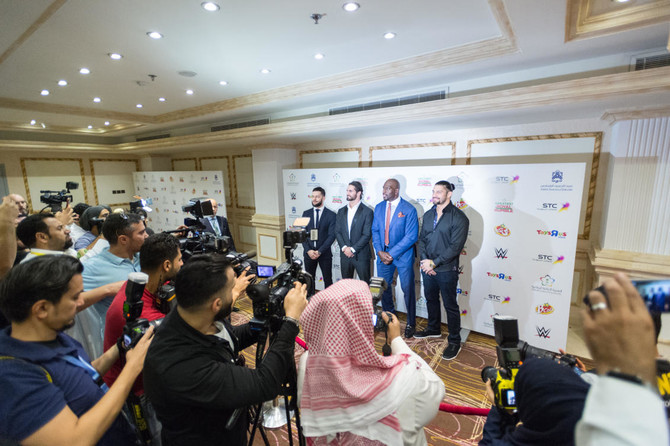
JEDDAH: If you believe the hype, including his own, WWE’s Roman Reigns has come to Saudi Arabia to win at the Greatest Royal Rumble.
But ask him about outside of the ring, and his visit to the Kingdom, the athlete says that everyone is winning, from WWE, to its athletes and the new fans they have met here.
“It’s the best feeling to be here in Saudi Arabia. Whenever you go to a new country for the first time and they see you for the first time, it really escalates that excitement, it makes it so special.
“It’s unbelievable coming to Saudi Arabia. We are always trying to break new ground, to move forward, break new ground, we are always trying to do better. I think this is a great example.”
The Greatest Royal Rumble marks the start of a 10-year partnership between WWE and the General Sports Authority of Saudi Arabia. Samoa Joe will compete in an Intercontinental Championship Ladder Match against Seth Rollins, Finn Bálor and The Miz in one of an incredible seven Championship matches at the Greatest Royal Rumble event.
WWE fans will also see John Cena vs Triple H, The Undertaker take on Rusev and Brock Lesnar compete against Roman Reigns in a Steel Cage Universal Championship match.
“We are trying to show Saudi Arabia to the world, that’s a big thing. We trying to be there for progress, to get better as human beings, to promote equality. Anything you can do on that level, it’s greater than you can do in the ring,” said Roman, at a press conference in Jeddah.
“It’s the best feeling to be here in Saudi Arabia. Whenever you go to a new country for the first time and they see you for the first time, it really escalates that excitement, it makes it so special.
“It’s so gratifying. There’s no real way to describe it, each time I get thrown down, any time I’m in pain, and I get that special energy and emotion back from the ground it makes it so worth it.
“I can’t wait to get to the stadium. When that curtain goes back and you see thousands of fans, when you hear that reaction, that emotion, that’s when you feel like superman.”
The event, which is now sold out, will air live in the Middle East on MBC Action, KSA Sports 1, Abu Dhabi Sports 1 and Abu Dhabi Sports 6, as well as stream live on Dawri Plus.
For WWE Superstar Titus O’Neil his goal is very clear, he’s here to entertain and spread a message that no matter where you are in the world, there are common things that unite us all.
“Our job is to put smiles on people’s faces and those faces are all colors, all religions, all backgrounds. We are entertainers and I feel our company, WWE, does the best job of breaking barriers and going into different situations and making the absolute best from it.
“That absolute best is making sure that every single person that comes to one of our events has a life-changing experience in Saudi Arabia and in Jeddah. This is the first time we are here, it’s the first time a Royal Rumble has had 50 men in the ring, and the first time that every single match is a championship match.
“Where-ever we are in the world we don’t separate by color or creed, we just want to entertain the masses. At the end of the day we all rooted in love and I embrace that, regardless of who you are, what religion you are we are all the same.
“Sports definitely unifies people and WWE have been doing it for years, bringing people from all different backgrounds into arenas and in front of televisions at home.
“The fact this show sold out in a very short space of time goes to show the fanbase is as strong here as it is anywhere else in the world.”


![]()
![]()

WWE’s Roman Reigns hails ‘unbelievable’ Saudi Arabia
WWE’s Roman Reigns hails ‘unbelievable’ Saudi Arabia
- Greatest Royal Rumble event takes place in Jeddah on Friday
- The event marks the start of a 10-year partnership between WWE and the General Sports Authority of Saudi Arabia
Related


Latest updates


© 2026 SAUDI RESEARCH & PUBLISHING COMPANY, All Rights Reserved And subject to Terms of Use Agreement.