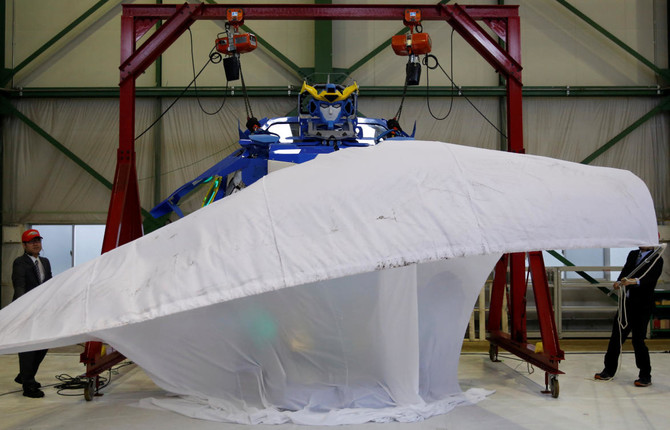
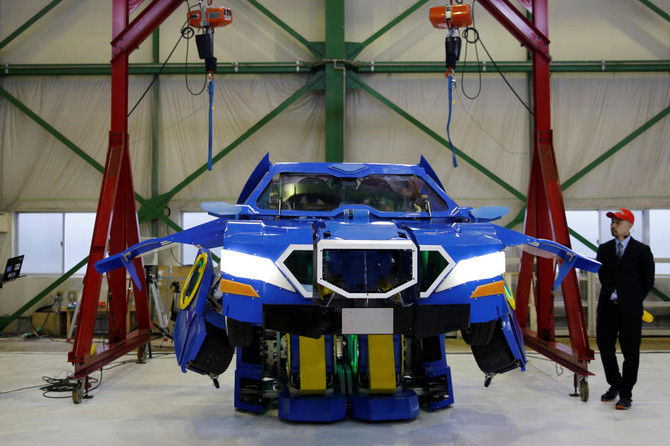
TOKYO: A Transformers-style, humanoid robot that can shape shift into a sports car in about 60 seconds was unveiled in Japan on Wednesday.
The “J-deite RIDE” robot is the brainchild of Kenji Ishida, CEO of Brave Robotics and a fan of anime movies featuring robots that could transform or combine with each other.
“I grew up believing that robots had to be capable of such things, which became my motivation to develop this robot,” Ishida told Reuters Television.
The blue and white robot is 3.7-meters (12 feet) tall and can carry two passengers as it transforms into a car or humanoid form.
Some people may view the robot as an “expensive toy,” but it was intended to inspire others, Ishida said.
The RIDE was co-developed with Asratec, a robot consulting firm, and amusement ride manufacturer Sansei Technologies.


Autobots Roll Out! — transforming robot unveiled in Japan


Autobots Roll Out! — transforming robot unveiled in Japan


Fans bid farewell to Japan’s only pandas
TOKYO: Panda lovers in Tokyo said goodbye on Sunday to a hugely popular pair of the bears that are set to return to China, leaving Japan without the beloved animals for the first time in half a century.
Loaned out as part of China’s “panda diplomacy” program, the distinctive black-and-white animals have symbolized friendship between Beijing and Tokyo since the normalization of diplomatic ties in 1972.
Some visitors at Ueno Zoological Gardens were left teary-eyed as they watched Japan’s only two pandas Lei Lei and Xiao Xiao munch on bamboo.
The animals are expected to leave for China on Tuesday following a souring of relations between Asia’s two largest economies.
“I feel like seeing pandas can help create a connection with China too, so in that sense I really would like pandas to come back to Japan again,” said Gen Takahashi, 39, a Tokyo resident who visited the zoo with his wife and their two-year-old daughter.
“Kids love pandas as well, so if we could see them with our own eyes in Japan, I’d definitely want to go.”
The pandas’ abrupt return was announced last month after Japan’s conservative premier Sanae Takaichi hinted Tokyo could intervene militarily in the event of any attack on Taiwan.
Her comment provoked the ire of Beijing, which regards the island as its own territory.
The 4,400 lucky winners of an online lottery took turns viewing the four-year-old twins at Ueno zoo while others gathered nearby, many sporting panda-themed shirts, bags and dolls to celebrate the moment.
Mayuko Sumida traveled several hours from the central Aichi region in the hope of seeing them despite not winning the lottery.
“Even though it’s so big, its movements are really funny-sometimes it even acts kind of like a person,” she said, adding that she was “totally hooked.”
“Japan’s going to be left with zero pandas. It feels kind of sad,” she said.
Their departure might not be politically motivated, but if pandas return to Japan in the future it would symbolize warming relations, said Masaki Ienaga, a professor at Tokyo Woman’s Christian University and expert in East Asian international relations.
“In the future...if there are intentions of improving bilateral ties on both sides, it’s possible that (the return of) pandas will be on the table,” he told AFP.


