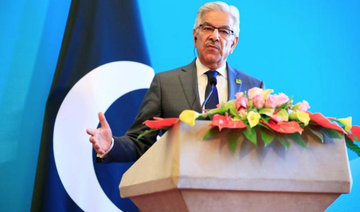
ISLAMABAD: Khawaja Mohammed Asif, the country’s foreign minister, was disqualified from holding a parliamentary seat by a three-member bench of Islamabad High Court (IHC) on Thursday, putting the veteran politician’s career in jeopardy.
The ruling was announced after Asif failed to declare his employment, work visa and monthly salary with a UAE company; his nondisclosure of a foreign bank account and incorrectly stating his occupation while filing his nomination papers with the Election Commission of Pakistan for the 2013 general elections.
Asif was not available for comment immediately but rejected the charge that he had concealed anything and pledged to challenge the court ruling in a quick statement to a local television network.
“We declare that … (Khawaja Mohammed Asif) was not qualified to contest the General Election of 2013 from NA-110 as he did not fulfill the conditions described under Article 62(1)(f) of the Constitution, read with section 99(1)(f) of the Act of 1976,” stated the 35-page order sheet, a copy of which was obtained by Arab News.
The petition seeking Asif’s disqualification was filed by opposition leader Usman Dar of Pakistan Tehreek-e-Insaf (PTI) party, who campaigned against and lost to Asif in the last general elections. Dar pleaded in his petition to the court that Asif had hidden his income from the UAE and covertly renewed his iqama (UAE work visa) while serving as Pakistan’s foreign minister.
Sharafat Ali, former Law Ministry adviser and legal expert, told Arab News the “disqualification is for life” under Article 62(1)(f).
“No one can meet this criteria mentioned in this constitutional provision, and the concept of democracy gets defaced. The article is impractical under the given circumstances. It is created for ideal conditions that are only found in a utopian environment,” Ali said.
Former Prime Minister Nawaz Sharif and PTI leader Jahangir Tareen were both disqualified under the same article by the country’s top court last year.
The legal expert said that the article was amended many times, mainly during military rules. “If you read the Article (62’s) sub section D and E, that would render everyone disqualified under Islamic injunctions,” he explained, adding the same legal and constitutional criteria should also be applied to the judiciary and the armed forces of Pakistan.
The judgment, however, stated that the matter should have first been taken to Parliament.
“It would have been appropriate if the political party (PTI) to which the petitioner belongs had raised the issue at hand in the Parliament before invoking the jurisdiction of this court,” it said.
The judges noted their discomfort with the decision to disqualify an elected representative of people. It was a tough verdict against “a seasoned and accomplished politician” but more so “because the dreams and aspirations of 34,125 registered voters have suffered a setback,” the judgment concluded.
Maryam Nawaz, Sharif’s heir-apparent, has called the decision “a fixed match,” a term used in cricket when the game’s outcome is preset by certain stakeholders.
The verdict is another blow to the ruling Pakistan Muslim League-Nawaz (PML-N), amid signs that it is undergoing an internal crisis.
Qamar Cheema, a political analyst, told Arab News that PML-N “has a strong base in Punjab and will emerge as either a strong opposition or will maintain a thin majority which will let it to be relevant after the 2018 general elections.”
He also maintained that the disqualifications would strengthen the PML-N narrative on the sanctity of the vote. “Instead of people questioning the PML-N over its five-year performance, it’s now PML-N that’s asking the people why its leaders have been forced out,” he said.
Cheema added that the party had entered into an aggressive campaigning mode to win the hearts and minds of the people, showcasing its “political martyrs” who were elected by the masses but removed without public consent.


Pakistan’s foreign minister ineligible to hold public office, court says

Pakistan’s foreign minister ineligible to hold public office, court says
- Khawaja Asif disqualified for life over nondisclosure of foreign income and employment
- Asif earned monthly salary of 50,000 dirhams ($14,000) while serving as foreign minister of Pakistan


Bill Clinton says he ‘did nothing wrong’ with Epstein as he faces grilling over their relationship
- “I saw nothing, and I did nothing wrong,” the former Democratic president said
- The closed-door deposition in Chappaqua, New York, marks the first time a former president has been compelled to testify to Congress
WASHINGTON: Former President Bill Clinton told members of Congress on Friday that he “did nothing wrong” in his relationship with Jeffrey Epstein and saw no signs of Epstein’s sexual abuse as he faced hours of grilling from lawmakers over his connections to the disgraced financier from more than two decades ago.
“I saw nothing, and I did nothing wrong,” the former Democratic president said in an opening statement he shared on social media at the outset of the deposition.
The closed-door deposition in Chappaqua, New York, marks the first time a former president has been compelled to testify to Congress. It came a day after Clinton’s wife, former Secretary of State Hillary Clinton, sat with lawmakers for her own deposition.
Bill Clinton has also not been accused of any wrongdoing. Yet lawmakers are grappling with what accountability in the United States looks like at a time when men around the world have been toppled from their high-powered posts for maintaining their connections with Epstein after he pleaded guilty in 2008 to state charges in Florida for soliciting prostitution from an underage girl.
“Men — and women for that matter — of great power and great wealth from all across the world have been able to get away with a lot of heinous crimes and they haven’t been held accountable and they have not even had to answer questions,” said Republican Rep. James Comer, the chair of the House Oversight Committee, before the deposition began Friday.
Hillary Clinton told lawmakers Thursday that she had no knowledge of how Epstein had sexually abused underage girls and had no recollection of even meeting him. But Bill Clinton will have to answer questions on a well-documented relationship with Epstein and his former girlfriend Ghislaine Maxwell, even if it was from the late 1990s and early 2000s.
Bill Clinton in his opening statement said that he would likely often tell the committee that he did not recall the specifics of events from more than 20 years ago. But he also expressed certainty that he had not witnessed signs of Epstein’s abuse.
During a break after two hours of questioning, Democratic lawmakers said that Bill Clinton had tried to answer every question and had not invoked his Fifth Amendment right against self-incrimination.
Still, Republicans were relishing the opportunity to scrutinize the former Democratic president under oath.
“No one’s accusing anyone of any wrongdoing, but I think the American people have a lot of questions,” Comer said.
Republicans finally get a chance to question Bill Clinton
Republicans have wanted to question Bill Clinton about Epstein for years, especially as conspiracy theories arose following Epstein’s 2019 suicide in a New York jail cell while he faced sex trafficking charges.
Those calls reached a fever pitch late last year when several photos of the former president surfaced in the Department of Justice’s first release of case files on Epstein and Maxwell, a British socialite who was convicted of sex trafficking in December 2021 but maintains she’s innocent. Bill Clinton was photographed on a plane seated alongside a woman, whose face is redacted, with his arm around her. Another photo showed Clinton and Maxwell in a pool with another person whose face was redacted.
Epstein also visited the White House several times during Clinton’s presidency, and the pair later made several international trips together for their humanitarian work. Comer claimed the committee has collected evidence that Epstein visited the White House 17 times and that Bill Clinton flew on Epstein’s airplane 27 times.
Democratic lawmakers said they also posed tough questions to Bill Clinton about his relationship with Epstein and Maxwell.
“We are only here because he hid it from everyone so well for so long,” Bill Clinton said in his opening statement. “And by the time it came to light with his 2008 guilty plea, I had long stopped associating with him.”
Comer pledged extensive questioning of the former president. He claimed that Hillary Clinton had repeatedly deferred questions about Epstein to her husband.
Bill Clinton went after Comer for calling his wife before the committee, telling him that “including her was simply not right.”
The committee was working to quickly publish a transcript and video recording of her deposition.
Has a precedent been set?
Democrats, who have supported the push to get answers from Bill Clinton, are arguing that it sets a precedent that should also apply to President Donald Trump, a Republican who had his own relationship with Epstein.
“I think that President Trump needs to man up, get in front of this committee and answer the questions and stop calling this investigation a hoax,” said Rep. Robert Garcia, the top Democrat on the committee, on Friday.
Comer has pushed back on that idea, saying that Trump has answered questions on Epstein from the press.
Trump on Friday expressed remorse at Bill Clinton being forced to testify. “I like Bill Clinton, and I don’t like seeing him deposed,” he told reporters as he departed the White House en route to Corpus Christi, Texas.
Democrats are also calling for the resignation of Trump’s Commerce Secretary Howard Lutnick. Lutnick was a longtime neighbor of Epstein in New York City but said on a podcast that he severed ties with Epstein following a 2005 tour of Epstein’s home that disturbed Lutnick and his wife.
The public release of case files showed that Lutnick actually had two engagements with Epstein years later. He attended a 2011 event at Epstein’s home, and in 2012 his family had lunch with Epstein on his private island.
“He should be removed from office and at a minimum should come before the committee,” Garcia said of Lutnick.
Republican Rep. Nancy Mace questioned Hillary Clinton about Lutnick’s relationship to Epstein during the deposition on Thursday. On Friday morning, Mace joined in calling for the commerce secretary to come before the committee.
“I believe we will have the votes to subpoena him,” Democratic Rep. Ro Khanna said.


