Toronto: Bodies and debris scattered over mile-long strip

1 / 2
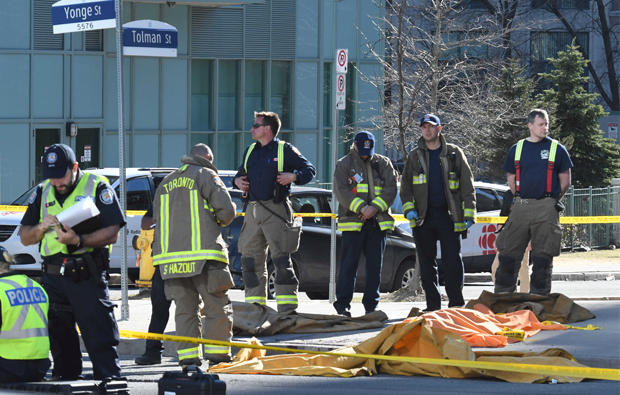
Fire fighters stand near a covered body after a van struck multiple people at a major intersection northern Toronto, Canada, on April 23, 2018. (REUTERS/Saul Porto)
2 / 2
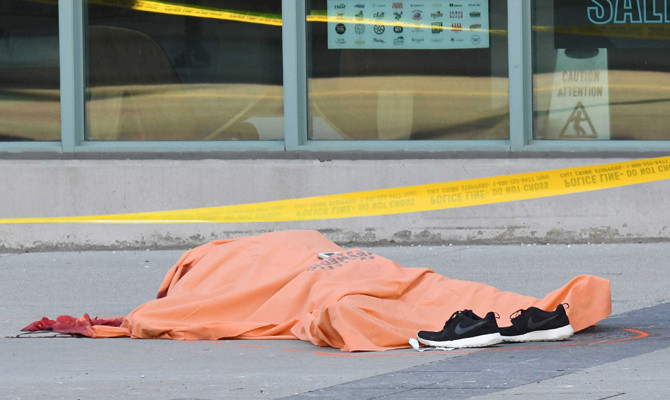
A covered body lies on a sidewalk after a van struck multiple people at a major intersection in northern Toronto, Canada, on April 23, 2018. (REUTERS/Saul Porto)
Updated 24 April 2018
Follow

Toronto: Bodies and debris scattered over mile-long strip

  • At least 10 people have died in the attack officials called “deliberate” but not linked to national security concerns
  • Toronto police have the suspect after a confrontation

TORONTO: The crime scene seems to go on forever, a taped off stretch of street scattered with bodies under orange sheets, urban debris and a pair of abandoned shoes.

Toronto police have arrived, and a suspect is under lock and key, but no one yet knows why the driver of a white rental van spread death and destruction under the warm spring sunshine.

“I heard screaming, yelling. I turned back and saw this truck going that way. He was going in and out, back and forth, zigzagging. He just kept on going,” said 42-year-old Rocco Cignielli.

There was nothing the customer service worker could do. Emergency services were on the scene quickly, but in some cases their efforts were in vain.

At least 10 people have died in the attack officials called “deliberate” but not linked to national security concerns.

“I saw there were people lying on the ground. I saw they were doing heart compression, and I saw two people dying right here in front of me,” Cignielli told AFP, pointing at the bodies.

It was shortly after 1 p.m. (1700 GMT) on a working Monday when the speeding van hit this commercial thoroughfare in a district of high-rise residences in the north of Canada’s biggest city.

A pale but cheery sun shone after a long and grim final winter stretch even by the region’s standards. Many local people were out and about.

Nana Agyeman Badu, a 56-year-old taxi driver, saw the van heading south toward central Toronto, where ministers from the G7 world powers were holding a security conference. Then the van swerved onto the sidewalk.

“I thought maybe he was making a delivery. But I was thinking, ‘Why would he drive in the pedestrian walkway like that?’ Very fast. Then I saw he had already run over some people,” the witness said.

“A lady was walking toward the car close to a bus shelter. The truck pinged the lady through the bus shelter and she fell back and all the broken glass fell onto her,” he added.

“I stopped and ran out to help her. The truck continued going and going and going.”

The truck smashed a yellow fire hydrant, a few newspaper dispensers and there, a bit further, lie a pair of sneakers.

“They belong to a victim,” a police officer said.

Some in a crowd that gathered by the police tape as dozens of rescue vehicles were deployed were dumbfounded. “It is a dangerous crossroads,” one woman suggested.

“Oh, it was no accident,” declared another passerby.


EU leaders begin India visit ahead of ‘mother of all deals’ trade pact

Updated 3 sec ago
Follow

EU leaders begin India visit ahead of ‘mother of all deals’ trade pact

  • Antonio Luis Santos da Costa, Ursula von der Leyen are chief guests at Republic Day function
  • Access to EU market will help mitigate India’s loss of access to US following Trump’s tariffs

New Delhi: Europe’s top leaders have arrived in New Delhi to participate in Republic Day celebrations on Monday, ahead of a key EU-India Summit and the conclusion of a long-sought free trade agreement.

European Council President Antonio Luis Santos da Costa and European Commission President Ursula von der Leyen arrived in India over the weekend, invited as chief guests of the 77th Republic Day parade.

They will hold talks on Tuesday with Prime Minister Narendra Modi at the EU-India Summit, where they are expected to announce a comprehensive trade agreement after years of stalled negotiations.

Von der Leyen called it the “mother of all deals” at the World Economic Forum in Davos last week — a reference made earlier by India’s Commerce Minister Piyush Goyal — as it will create a market of 2 billion people.

“The India-EU FTA has been a long time coming as negotiations have been going on between the two for more than a decade. Some of the red lines that prevented the signing of the FTA continue to this date, but it seems that the trade negotiations have found a way around it,” said Anupam Manur, professor of economics at the Takshashila Institution.

“The main contentious issue remains the Indian government’s desire to protect the farmers and dairy producers from competition and the European Union’s strict climate-based rules and taxation. Despite this, both see enormous value in the trade deal.”

India already has free trade agreements with more than a dozen countries, including Australia, the UAE, and Japan.

The pact with the EU would be its third in less than a year, after it signed a multibillion CEPA (comprehensive economic partnership agreement) with the UK in July and another with Oman in December. A week after the Oman deal, New Delhi also concluded negotiations on a free trade agreement with New Zealand, as it races to secure strategic and trade ties with the rest of the world, after US President Donald Trump slapped it with 50 percent tariffs.

The EU is also facing tariff uncertainty. Earlier this month Trump threatened to impose new tariffs on several EU countries unless they supported his efforts to take over Greenland, which is an autonomous region of Denmark.

“The expediting factor in the trade deal is the unilateral and economically irrational trade decisions taken by their biggest trading partner, the United States,” Manur told Arab News.

Being subject to the highest tariff rates, India has been required to sign FTAs with other major economies. Access to the EU market would help mitigate the loss of access to the US.

The EU is India’s largest trading partner in goods, accounting for about $136 billion in the financial year 2024-25.

Before the tariffs, India enjoyed a $45 billion trade surplus with the US, exporting nearly $80 billion. To the EU’s 27 member states, it exports about $75 billion.

“This can be sizably increased after the FTA,” Manur said. “Purely in value terms, this would be the biggest FTA for India, surpassing the successful FTAs with the UK, Australia, Oman and the UAE.”