JEDDAH: Singers Abadi Al-Johar, from Saudi Arabia, and Waleed Al- Shami, from Iraq, were a hit at their first concerts in front of families at King Abdullah Economic City on Friday.
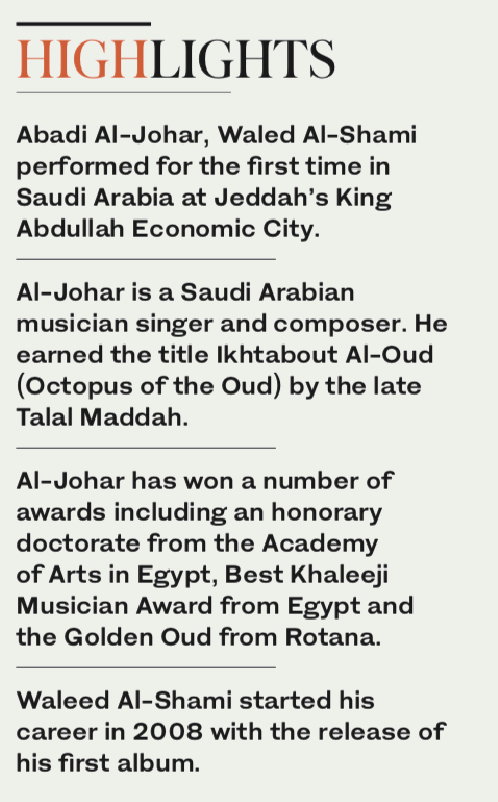
Al-Johar, 64, is a musician, singer and composer. One of the most popular Khaleeji singers in the Gulf, he has composed around 50 albums since he began his musical career in 1968. He earned the title Ikhtabout Al-Oud (Octopus of the Oud) from the late Talal Maddah because of his unmatchable Oud playing.
The Saudi singer is also a member of the Saudi Arabian Society for Culture and Arts. He won a number of awards including an honorary doctorate from the Academy of Arts in Egypt, Best Khaleeji Musician Award from Egypt and the Golden Oud from Rotana.
Al-Shami, 46, is an Iraqi singer and composer who began his musical career in 1999 and has composed four albums.
His career took off after the success of his first album “Musiba” in 2008.
 First to perform at the venue was Al-Shami. He sang hit songs such as “Sadmah,” “Eshtaqt Lak,” “Majnouni,” “Ahebah Kolesh” and his most popular song “Hala Hala.”
On stage, he thanked the General Entertainment Authority and BluePlan Media for providing the concert to the public.
“I hope it is not the last time we meet. We must repeat this, here, Riyadh and the Eastern Province. That is a promise,” he said.
Following Al-Shami’s performance, Al-Johar sang hit songs such as “Khalas Erjaa,” “El Mazhareya,” “Khayarteni,” “Daqayeq” and “Hobbak Samaa.”
During his performance, the Saudi legend said: “I am delighted by your presence, I will sing any song you want me to.”
Television presenter Kholud Alnimer attended the concert. “It is very crowded, that means there is a lot of love for these singers,” she told Arab News.
The audience was overjoyed with the music of Waled Al Shami and Abadi Al-Johar.
“It is great to see a Khaleeji concert for the first time in front of families, and it has been done very professionally — looking forward to more.” Nadeem bin Talal, a fan, told Arab News


![]()
![]()
![]()

Khaleeji music enthralls Saudi audience



Khaleeji music enthralls Saudi audience
- Saudi singer Abadi Al-Johar has composed around 50 albums since he began his musical career in 1968
- Al-Johar has been awarded the Best Khaleeji Musician Award from Egypt and the Golden Oud from Rotana


Latest updates



Recommended


© 2026 SAUDI RESEARCH & PUBLISHING COMPANY, All Rights Reserved And subject to Terms of Use Agreement.