

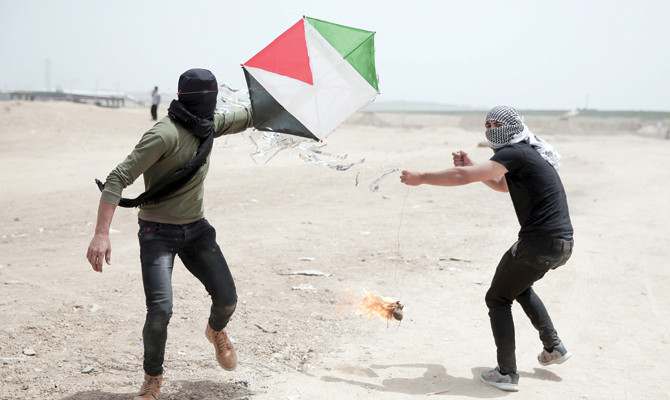
Israeli gunfire in new Gaza border protest kills 4 Palestinians
Thousands of Gazans were gathered on Friday at various locations along the border in the Gaza Strip, calling for Palestinian refugees to be able to return to their former lands in what is now Israel.
Israel is accusing the Palestinian movement Hamas of using the protests as cover to carry out violence.
Updated 21 April 2018
AFP AP
GAZA: Thousands of Palestinians joined the fourth weekly protest on Gaza’s border with Israel on Friday, some burning tires or flying kites with flaming rags dangling from their tails. Atleast four Palestinians were killed by Israeli troops firing from across the border fence, health officials said.
Huge black plumes of smoke from the blazing tires engulfed the area, as Israeli troops fired tear gas and live bullets, witnesses said. Gaza’s Health Ministry said 40 protesters were injured, but did not say how many of those were wounded by gunfire or overcome by tear gas.
The protests are part of what organizers, led by Gaza’s ruling Hamas group, have billed as an escalating showdown with Israel, to culminate in a mass march on May 15. Organizers have made conflicting statements about whether they plan an eventual mass border breach.
In the past three weeks, 34 Palestinians were killed and hundreds wounded by Israeli troops firing from across the border fence.
In addition, four Palestinians, including a 15-year-old boy, were shot and killed in a border area in northern Gaza, the Health Ministry said. The Israeli military had no immediate comment.
Hamas says the protests are aimed at breaking a crippling border blockade that was imposed by Israel and Egypt after the group overran Gaza in 2007, a year after winning Palestinian Parliament elections.
Catastrophe
The marches also press for a “right of return” of Palestinian refugees and their descendants to what is now Israel. Hundreds of thousands of Palestinians fled or were forced from homes in the 1948 war over Israel’s creation. Palestinians mark May 15, the anniversary of Israel’s founding, as their “nakba,” or catastrophe, to mourn their mass uprooting.
“We will stay here until we reclaim our lands,” said Ahmed Nasman, 21, speaking in a protest tent camp east of Gaza City, as activists near him prepared kites. “Every day, we will come here with a new way to resist them,” he said, referring to Israel.
Several thousand protesters flocked to the border area Friday, most gathering in five tent camps several hundred meters away from the border. Smaller groups advanced toward the fence, throwing stones, burning tires and flying kites with burning rags.
The kites are part of a new tactic aimed at setting fields on the Israeli side on fire. Most kites were stitched together in the colors of the Palestinian flag. One white kite bore the Nazi swastika.
Earlier Friday, Israeli military aircraft had dropped leaflets urging Palestinians to stay away from the fence and warning that they endanger their lives if they follow Hamas directives.
The military has said it is defending Israel’s border and that its troops, including snipers, only target “instigators.” It has also accused Hamas of using mass protests as a cover for attacks.
Israel has faced international criticism for its response to the mass marches. Rights groups have branded open-fire orders as unlawful, saying they effectively permit soldiers to use potentially lethal force against unarmed protesters.
White House envoy Jason Greenblatt, a member of President Donald Trump’s Mideast team, said on social media that Palestinians in Gaza have a “right to protest their dire humanitarian circumstances.”
Organizers “should focus on that message, not stoke the potential for more violence with firebombs and flaming kites, and must keep a safe distance from the border,” said Greenblatt, adding that “the cost of these demonstrations is too high in loss of life and injuries.”
While Hamas and smaller Palestinian factions have taken a lead as organizers, the mass marches are also fueled by growing desperation among Gaza’s 2 million residents.
The border blockade has trapped nearly all of them in the tiny coastal territory, gutted the economy and deepened poverty. Gaza residents typically get fewer than five hours of electricity per day, while unemployment has soared above 40 percent.
DUBAI: Gaza’s fishing industry — once a critical source of food, income and affordable protein — has been largely destroyed as a result of Israel’s war with Hamas, worsening the Palestinian enclave’s food security crisis.
According to the UN Food and Agriculture Organization, fishing activity in Gaza now stands at less than 10 percent of prewar levels following the widespread destruction of boats, ports and equipment, combined with prolonged maritime closures enforced under Israel’s naval blockade.
UN and human rights organizations estimate that up to 72 percent of Gaza’s fishing fleet has been damaged or destroyed, alongside near-total devastation of related infrastructure, including landing sites, storage facilities and repair workshops.
Israel's naval blockade has Gaza's fishing industry to decline to about a tenth of pre-war levels. (Reuters photo)
The remaining vessels are small, damaged skiffs capable of operating only meters from shore.
Ramzy Baroud, a journalist, author and editor of The Palestine Chronicle, said the destruction of Gaza’s fishing sector must be understood as part of a deliberate policy aimed at preventing Palestinians from developing independent food-producing systems.
Baroud says Israel had pursued a strategy since 1967 to foster Palestinian dependency — first on the Israeli economy, and later on humanitarian aid entering Gaza through Israeli-controlled crossings — leaving the population permanently vulnerable to economic collapse.
“This vulnerability is functional for Israel, as it allows the Israeli government and military to leverage their control over Palestinian lives through political pressure in pursuit of concessions,” he told Arab News.
Palestinians were prevented from developing local industry through restrictions on imports and exports, while much of Gaza’s arable land was seized or turned into military targets, he said.
“Likewise, the fishing sector was deliberately crippled through direct attacks on fishermen, including arrests, live fire, confiscation of equipment, and the sinking or destruction of boats,” he added.
FAO has documented widespread destruction across Gaza’s coastal fishing areas.
“In Gaza’s fishing areas now lie broken boats, torn nets, and ruined infrastructure, standing in stark contrast to the once-vibrant industry that supported thousands of fishers for generations,” Beth Bechdol, FAO deputy director-general, said in a statement.
Before the war, more than 4,000 registered fishermen worked along Gaza’s 40-kilometer coastline, supporting tens of thousands of family members and contributing to local food security in an enclave heavily dependent on imports.
Today, the majority have been stripped of their livelihoods, as access to the sea has become sporadic, dangerous, or entirely prohibited.
For decades, fishing off Gaza was restricted to shifting maritime zones — typically between three and 12 nautical miles offshore — often tightened or closed entirely during periods of escalation.
Since October 2023, when the Israel-Hamas conflict began, humanitarian organizations say there have been extended periods of total maritime closure, effectively banning fishing and depriving Gaza’s population of one of its few remaining sources of local food production.
Baroud said the assault on Gaza’s fishing sector was not a by-product of war, but part of a deliberate strategy that intensified during the conflict.
“For Gaza, the sea represents freedom,” he said. “All of Gaza’s other borders are controlled by Israel, either directly or indirectly.”
Israel had consistently worked to deny Palestinians access to the sea, he said. And despite commitments under the Oslo Accords to allow fishing up to 20 nautical miles offshore, those provisions were never honored.
“The assault on Gaza’s fishing sector is therefore not incidental,” Baroud said. “It is about severing Palestinians from one of the few spaces not entirely enclosed by walls, checkpoints, and military control.”
Israel has generally rejected or not accepted accusations that it is unlawfully targeting Gaza’s fishermen, framing incidents at sea as enforcement of security zones or as under investigation rather than deliberate attacks on civilians.
In past lethal incidents at sea highlighted by Human Rights Watch, the Israel Defense Forces have typically said boats “deviated from the designated fishing zone” and that forces fired after warnings were ignored.
According to FAO, rebuilding Gaza’s fishing sector will be impossible without a fundamental change in access and security conditions.
“For Gazans, the sea was not just a source of food, but a source of livelihood and identity,” Bechdol said.
“FAO can assist to help rebuild Gaza’s fishing industry. But for this to happen, peace must first be established and fishers must be allowed to operate their boats and cast their nets without fear of harm.”
Ciro Fiorillo, head of the FAO office for the West Bank and Gaza, said the agency is primed to offer assistance once the security situation improves.
“FAO is ready to restart projects, replenish damaged boats and equipment, and inject emergency funds as soon as these key fishing inputs for production are allowed to enter the Strip, a sustained ceasefire is in place, and access to the sea is restored,” Fiorillo said in a statement.
Since the Oct. 7, 2023, Hamas-led attack on southern Israel triggered the Israeli military assault on Gaza, much of the enclave has been flattened, tens of thousands killed, and some 90 percent of the population displaced.
Even since the ceasefire came into effect with the exchange of hostages and prisoners in October last year, pockets of violence have continued and humanitarian needs remain dire. The collapse of fishing has only compounded an already catastrophic food crisis.
The UN Office for the Coordination of Humanitarian Affairs has repeatedly warned that the destruction of food-producing systems — including agriculture, fisheries and markets — has pushed Gaza toward famine, with households facing extreme shortages of protein and calories.
With farmland destroyed, livestock killed and imports severely restricted, fish was once among the few foods that could still be sourced locally.
Its near disappearance has driven prices beyond reach for most families and increased dependence on limited humanitarian aid.
“This is about denying Palestinians access to life itself — to survival,” said Baroud.
The destruction of fishing forces Palestinians into deeper dependence on humanitarian aid that Israel itself controls, effectively weaponizing food rather than allowing Palestinians to sustain themselves independently, he said.
Human rights groups documenting maritime enforcement report that fishermen attempting to operate — even close to the shore — face gunfire, pursuit, detention and arrest, contributing to a climate in which fishing has become a life-threatening activity rather than a livelihood.
According to rights monitors, the destruction of larger vessels has eliminated the possibility of reaching deeper waters, forcing the few remaining fishermen to operate in unsafe, shallow zones with damaged equipment, limited fuel and no protection.
Baroud said international law clearly obligates an occupying power to protect civilian livelihoods and ensure access to food and means of survival.
“The systematic targeting of fishermen — who are civilians engaged in subsistence activity — cannot be justified as a military necessity, especially when it results in starvation and famine,” Baroud said.
He said the Fourth Geneva Convention prohibits collective punishment, the destruction of civilian infrastructure and the targeting of livelihoods.
The Palestinian Centre for Human Rights has described the restriction of Gaza’s fishing sector as part of a broader assault on civilian survival systems, warning that the denial of access to the sea has direct implications for nutrition, employment and aid dependency.
Baroud said the recovery of Gaza’s fishing sector could not occur in isolation from the broader economy.
“Only a measure of real freedom for Palestinians — freedom of movement, access to land and sea, and the ability to import, export and produce independently — can allow Gaza’s industries and economy to recover,” he said.
Without ending the system of control governing Palestinian life, Baroud said, any discussion of reconstruction or recovery would remain hollow.
As famine warnings intensify, the fishing sector’s collapse stands as a stark example of how Gaza’s food system has fractured.
What was once a daily livelihood is now reduced to occasional, high-risk attempts to secure food.
With no functioning fleet and no safe access to waters, Gaza’s fishermen are operating at the edge of survival.